
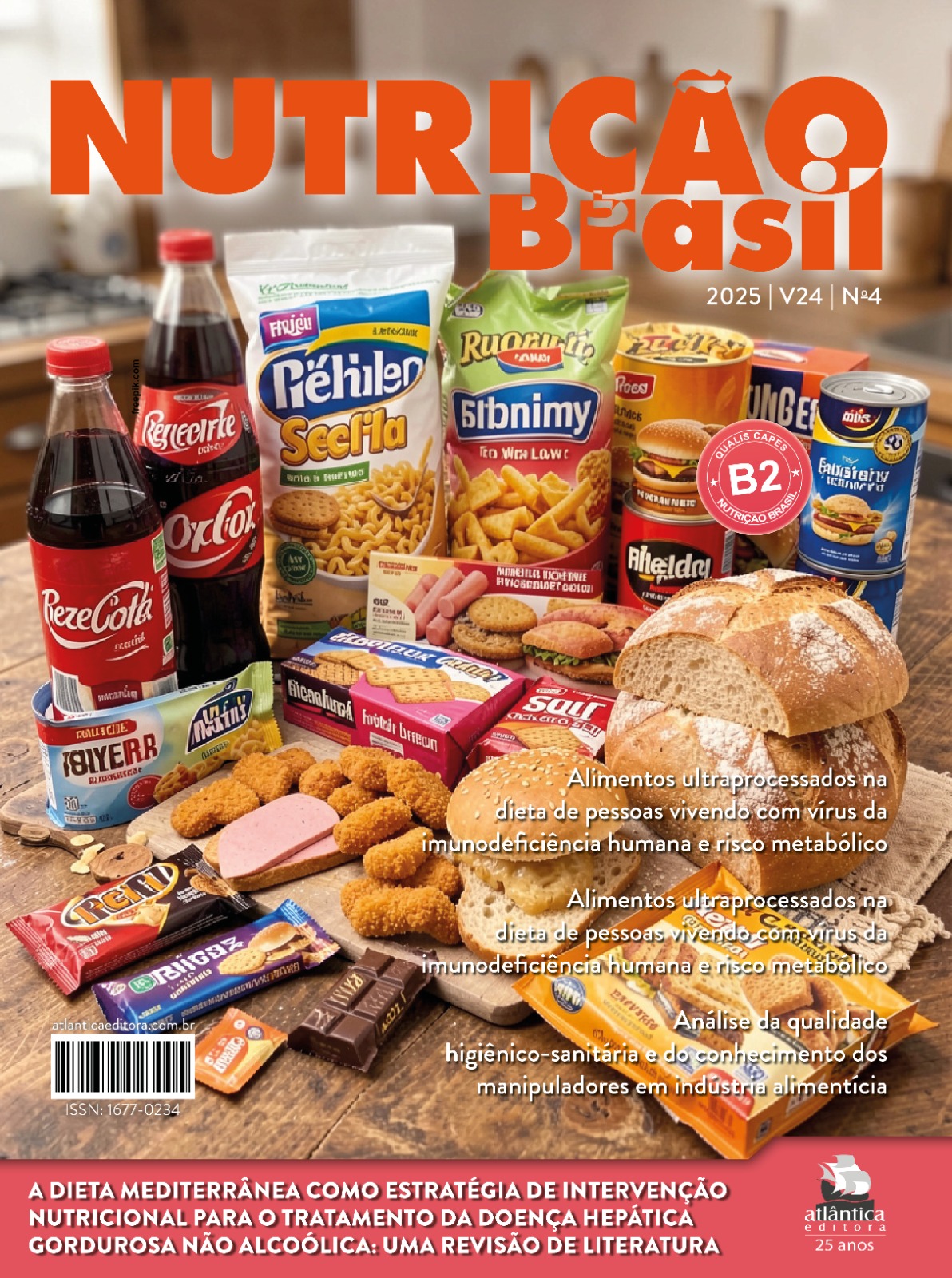
Ultra-processed foods in the diet of people living with human immunodeficiency virus and metabolic risk
DOI:
https://doi.org/10.62827/nb.v24i4.3077Keywords:
Processed; Anthropometry; Physiological; HIV; Antiretroviral Therapy.Abstract
Introduction: Research suggests that fat accumulation in the upper body in people with human immunodeficiency virus (HIV), along with poor diet and unhealthy lifestyles, contribute to increased mortality from chronic noncommunicable diseases in this population. However, investigations covering the consumption of ultra-processed foods by these individuals are scarce. Objective: We evaluated the dietary consumption of ultra-processed foods (UPF) in people with HIV and investigated the possible association with metabolic risk. Methods: Cross-sectional study involving 200 adults with HIV. Demographic and clinical data were collected using forms and medical records. Food consumption was investigated using a 24-hour recall, with foods grouped according to their level of processing using the NOVA classification. Metabolic risk was investigated based on neck circumference (NC), which was classified as “normal” or “increased. Results: Consumption of ultra-processed foods was significant (17.37% of dietary calories), with a notable intake of cookies, snacks, sausages, and soft drinks. There was a high prevalence of individuals at metabolic risk, at 29.5% (N=59). Individuals with increased CP also had higher proportions of overweight (98.31%; p<0.001). Despite the high prevalence, metabolic risk was independent of ultra-processed food consumption in this study, with no statistical association between its energy contribution and neck circumference (p>0.05). Conclusion: High consumption of ultra-processed foods and high proportions of overweight and metabolically at-risk individuals indicate the need for nutritional intervention in people with HIV to prevent chronic diseases.
References
Marais H, redator. A urgência do agora: A AIDS frente a uma encruzilhada. Genebra: Programa Conjunto das Nações Unidas sobre HIV/AIDS [Internet]. 2024 [acesso em 16 nov 2025]. Disponível em: https://unaids.org.br/wp-content/uploads/2024/07/RelatorioGlobalPTBR.pdf.
Maartens G, Celum C, Lewin SR. HIV infection: epidemiology, pathogenesis, treatment, and prevention. Lancet. 2014 Jul 19;384(9939):258-71. Disponível em https://doi.org/10.1016/s0140-6736(14)60164-1.
Deresz LF, Brito CD, Schneider CD, Rabito EI, Ikeda MLR, Lago PD. Dietary intake and cardiovascular risk among people living with HIV/AIDS. Ciênc Saúde Colet. 2018 Aug;23(8):2533-2542. Disponível em: https://doi.org/10.1590/1413-8123201823820542016.
Dutta D, Sharma M, Anand A, Garga UC, Bansal R, Sharma N. Increased trunk fat along with decreased peripheral fat as an important predictor of hypertriglyceridemia & hypercholesterolaemia in Indians with HIV infection. Indian J Med Res. 2018 Oct;148(1):411-21. Disponível em: https://doi.org/10.4103/ijmr.ijmr_236_17.
Oliveira IKF, Teixeira NDSCCA, Rêgo BMP, Aires IO, Torres Rodrigues RR, Araújo REDS, et al. Neck circumference as a predictor of cardiometabolic risk and truncal obesity in people living with HIV. Nutr Hosp. 2023 (Sep-Oct);38(3):823-831. Disponível em: https://doi.org/10.20960/nh.04402.
Lima CBG. Avaliação do consumo alimentar de pacientes assistidos por um programa de HIV. [Dissertação de Mestrado em Informação e Comunicação em Saúde]. Rio de Janeiro: Instituto de Comunicação e Informação Científica e Tecnológica em Saúde, Fundação Oswaldo Cruz, 2020 [acesso em 16 nov 2025]. 81 p. Disponível em: https://www.arca.fiocruz.br/handle/icict/55979.
Guterres AS, Gama RS, Rocha JPS, Vieira CRSF, Guerra ELN, Freitas EDN, et al. Food survey and quality of life of people living with HIV/AIDS in northern Brazil. Res Soc Dev. 2022;11(11):e330111132492. Disponível em: 10.33448/rsd-v11i11.32492.
Duda P, Knysz B, Gąsiorowski J, Szetela B, Piotrowska E, Bronkowska M. Assessment of dietary habits and lifestyle among people with HIV. Adv Clin Exp Med. 2020 Dec; 29(12): 1459-1467. Disponível em: https://doi.org/10.17219/acem/128234.
Jeżewska-Zychowicz M, Gawecki J, Wadolowska L, Czarnocinska J, Galinski G, Kollajtis-Dolowy A, et al. Dietary Habits and Nutrition Beliefs Questionnaire and the manual for developing of nutritional data [Instrumento de Pesquisa e Manual na Internet]. 2018 [acesso em 16 nov 2025]. Disponível em: https://www.researchgate.net/publication/322764546_Dietary_Habits_and_Nutrition_Beliefs_Questionnaire_and_the_manual_for_developing_of_nutritional_data.
Chen X, Zhang Z, Yang H, Qiu P, Wang H, Wang F, et al. Consumption of ultra-processed foods and health outcomes: a systematic review of epidemiological studies. Nutr J. 2020 Aug;19(86. Disponível em: https://doi.org/10.1186/s12937-020-00604-1.
World Health Organization. Obesity: preventing and managing the global epidemic. Geneva: WHO Tech Rep Ser; 2000. Disponível em: https://pubmed.ncbi.nlm.nih.gov/11234459/.
Verly-Jr E, Sichieri R, Baltar VT. Correção de medidas de associação pela variação do dia a dia no consumo alimentar: avaliação do desempenho por meio de simulação. Cad Saúde Pública. 2017;33(6). Disponível em: https://doi.org/10.1590/0102-311X00173216.
Moshfegh AJ, Rhodes DG, Baer DJ, Murayi T, Clemens JC, Rumpler WV, et al. The US Department of Agriculture Automated Multiple-Pass Method reduces bias in the collection of energy intakes. Am J Clin Nutr. 2008 Aug;88(2):324-332. Disponível em: https://doi.org/10.1093/ajcn/88.2.324.
NEPA-UNICAMP. Tabela brasileira de composição de alimentos (TACO) [Internet]. 4. ed. Rev. e ampl. Campinas: NEPA-UNICAMP; 2011 [acesso em 16 nov 2025]. Disponível em: https://www.cfn.org.br/wp-content/uploads/2017/03/taco_4_edicao_ampliada_e_revisada.pdf.
Universidade de São Paulo (USP). Tabela brasileira de composição de alimentos (TBCA) [Internet]. Food Research Center (FoRC). Versão 7.0. São Paulo: USP, 2019 [acesso em 16 nov 2025]. Disponível em: https://www.tbca.net.br/.
Pinheiro AVB, Lacerda EMA, Benzecry EH, Gomes MCS, Costa VM. Tabela para avaliação do consumo alimentar em medidas caseiras. 5. ed. São Paulo: Atheneu; 2005.
Bombem KCM, Canella DS, Bandoni DH, Jaime PC. Manual de medidas caseiras e receitas para cálculos dietéticos. São Paulo: M. Books, 2012.
Ministério da Saúde. Guia alimentar para a população brasileira. [Internet]. 2. ed. Brasília, DF: 2014. Disponível em: https://bvsms.saude.gov.br/bvs/publicacoes/guia_alimentar_populacao_brasileira_2ed.pdf.
Ministério da Saúde. Sistema de Vigilância Alimentar e Nutricional - Sisvan: orientações básicas para coleta, processamento, análise de dados e informações em serviços de saúde. [Internet]. 2011. Brasília. Disponível em: http://nutricao.saude.gov.br.
Carvalho WRC, França AKTC, Santos AM, Padilha LL, Bogea EG. Pontos de corte da circunferência do pescoço e da relação cintura-estatura como preditores da obesidade e risco cardiovascular em adolescentes. Rev Saúde Pública. 2023;57:24. Disponível em: https://doi.org/10.11606/s1518-8787.2023057004349.
Yang G, Yuan S, Fu H, Wan G, Zhu L, Bu XL, et al. Neck circumference positively related with central obesity, overweight, and metabolic syndrome in Chinese subjects with type 2 diabetes: Beijing Community Diabetes Study 4. Diabetes Care. 2010 Nov;33(11):2465-2467. doi: 10.2337/dc10-0798.
De Moraes Ferrari GL, Kovalskys I, Fisberg M, Gomez G, Rigotti A, Sanabria LYC, et al. Association of moderate-to-vigorous physical activity with neck circumference in eight Latin American countries. BMC Public Health. 2019 Jun;19(1):809. doi: 10.1186/s12889019-7153-y.
Kure A, Abebe A, Baza D, Paulos W. Overweight and obesity and associated factors among adult ART patients at Hawassa University Comprehensive Specialized Hospital, Southern Ethiopia. BMC Nutrition. 2022 Jul;8(63). Disponível em: https://doi.org/10.1186/s40795-022-00556-1.
Eckarda RA, Mccomseyab AG. Weight gain and integrase inhibitors. Curr Opin Infect Dis. 2020 Feb; 3(1):10-19. Disponível em: 10.1097/QCO.0000000000000616.
Oliveira NA, Guimarães NS, Mazon e Silva SL, Messias AC, Lopes GF, Nascimento-Júnior IB, et al. Correlations among neck circumference and anthropometric indicators to estimate body adiposity in people living with HIV. Rev Soc Bras Med Trop. 2021 Oct;54. Disponível em: https://doi.org/10.1590/0037-8682-0649-2020.
Louzada MLC, Cruz GL, Silva KAAN, Grassi AGF, Andrade GC, Rauber F, et al. Consumo de alimentos ultraprocessados no Brasil: distribuição e evolução temporal 2008–2018. Rev Saúde Pública. 2023 Abr;57(14). Disponível em: https://doi.org/10.11606/s1518-8787.2023057004744.
Kraemer C, Machado FC, Adami FS. Perfil nutricional de adultos relacionado ao consume alimentar de ultraprocessados. Rev Bras Obes Nutr Emagrecimento. 2020 Jan-Fev;14(84):80-88. Disponível em: https://www.rbone.com.br/index.php/rbone/article/view/1176.
Monteiro CA, Cannon G, Levy RB, Moubarac JC, Louzada ML, Rauber F, et al. Ultra-processed foods: what they are and how to identify them. Public Health Nutr. 2019 Feb;22(2):936-941. Disponível em: https://doi.org/10.1017/S1368980018003762.
Lopes LL. Consumo de lipídios e suas fontes: associação com síndrome metabólica e ganho de peso (Projeto CUME) [Tese de Doutorado]. Viçosa: Universidade Federal de Viçosa; 2020 [acesso em 16 nov 2025]. 87 f. Disponível em: https://locus.ufv.br//handle/123456789/28957.
Solbak NM, Robson PJ, Siou GL, Rajabi AA, Paek S, Vena JE, et al. Administering a combination of online dietary assessment tools, the Automated Self-Administered 24-Hour Dietary Assessment Tool, and Diet History Questionnaire II, in a cohort of adults in Alberta’s Tomorrow Project. J Acad Nutr Diet. 2021 Feb;121(7):1312-1326. Disponível em: https://doi.org/10.1016/j.jand.2021.01.014.
Downloads
Published
Issue
Section
License
Copyright (c) 2026 Kevilly da Silva Ramos, Carlos Alessandro Santos Machado , Iara Katrynne Fonsêca Oliveira, Marillya Oliveira Sousa , Adriana de Azevedo Paiva (Autor)

This work is licensed under a Creative Commons Attribution 4.0 International License.
Autores que publicam nesta revista concordam com os seguintes termos:
Autores mantém os direitos autorais e concedem à revista o direito de primeira publicação, com o trabalho simultaneamente licenciado sob a Licença Creative Commons Attribution 4.0 que permite o compartilhamento do trabalho com reconhecimento da autoria e publicação inicial nesta revista.
Autores têm autorização para distribuição não-exclusiva da versão do trabalho publicada nesta revista (ex.: publicar em repositório institucional ou como capítulo de livro), com reconhecimento de autoria e publicação inicial nesta revista.