
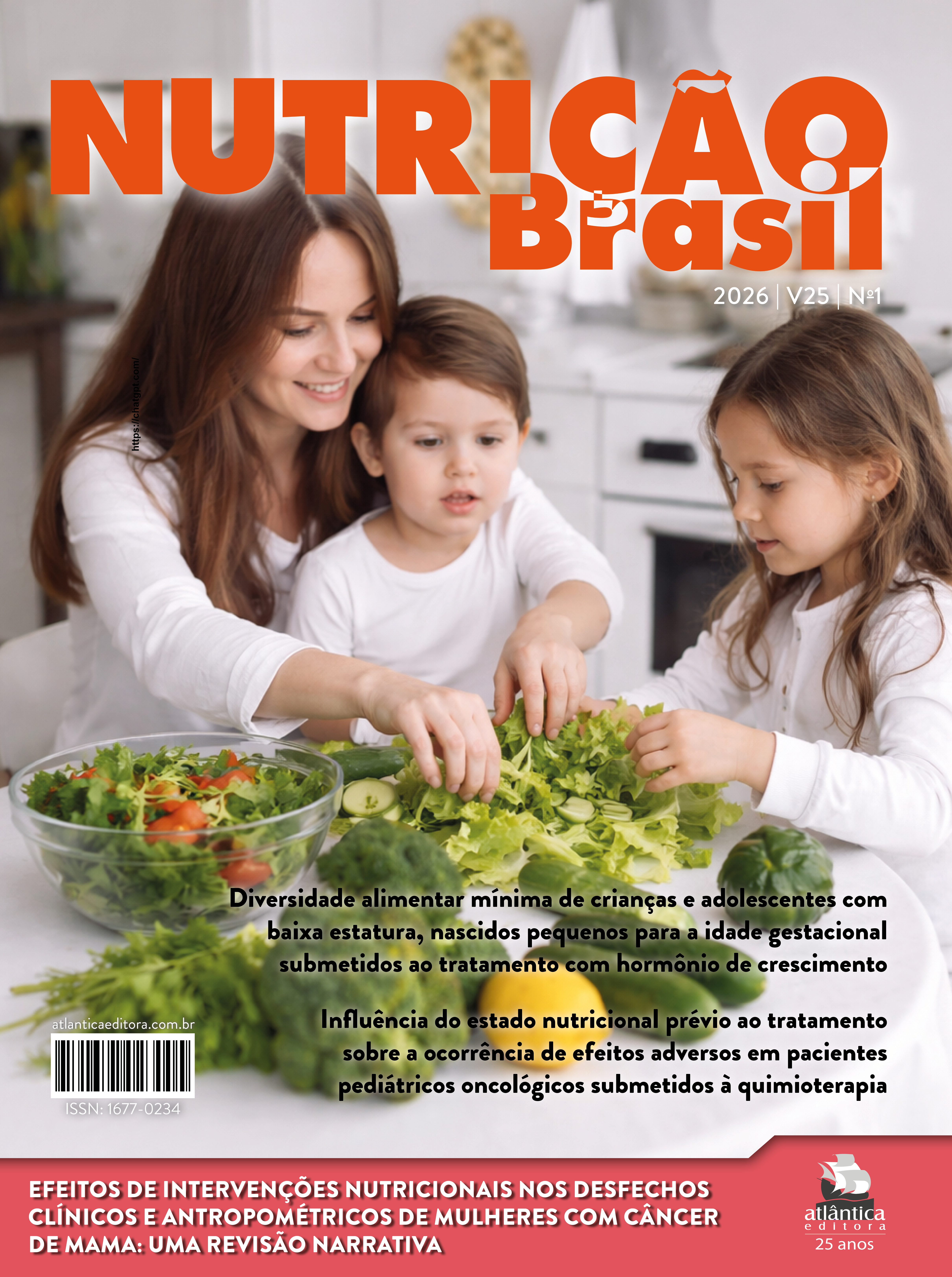
Diversidade alimentar mínima de crianças e adolescentes com baixa estatura, nascidos pequenos para a idade gestacional submetidos ao tratamento com hormônio de crescimento
DOI:
https://doi.org/10.62827/nb.v25i1.3081Palabras clave:
Hormônio do Crescimento; Criança; Adolescente; Recém-Nascido Pequeno para a Idade Gestacional.Resumen
Introdução: Crianças nascidas Pequenas para a Idade Gestacional (PIG) podem apresentar crescimento linear em altura insuficiente e maior risco de problemas metabólicos, com maior predisposição para doenças crônicas na vida adulta. A diversidade alimentar é um dos principais pontos para uma dieta equilibrada e fundamental para atingir uma alimentação saudável. Objetivo: Analisou-se a Diversidade Alimentar Mínima (DAM) de crianças e adolescentes com baixa estatura, nascidos pequenos para a idade gestacional, antes e após 18 meses de tratamento com Hormônio de Crescimento (HC). Métodos: O estudo avaliou crianças e adolescentes nascidos pequenos para idade gestacional, pré-púberes em terapia com HC, antes e após 18 meses de tratamento. O consumo alimentar foi avaliado por meio de Registro Alimentar de três dias e a DAM foi calculada com base no consumo de dez grupos alimentares. Resultados: Observou-se um padrão de monotonia alimentar em ambos os momentos, caracterizado pelo consumo frequente de grãos, raízes e tubérculos, carnes, aves e peixes e leite e derivados e pela ausência total de vegetais e das frutas e vegetais ricos em vitamina A. A prevalência da DAM não apresentou melhora estatisticamente significativa após o tratamento com HC. Adicionalmente, foi observada uma redução significativa no consumo de grupos dos leite e derivados e dos ovos. Conclusão: Após o período de terapia com o HC não houve melhora na qualidade e na DAM dessas crianças e adolescentes. Esse padrão dietético de monotonia alimentar, reforça a necessidade de intervenções nutricionais complementares e simultâneas ao tratamento hormonal.
Referencias
Cardoso-Demartini AA, Boguszewski MCS, Alves CAD. Postnatal management of growth failure in children born small for gestational age. J. pediatr. (Rio J). 2019 [cited 2025 Out 30];95(Suppl 1): S23-9. Available from: https://pubmed.ncbi.nlm.nih.gov/30550759/. doi: 10.1016/j.jped.2018.10.015.
Paixão ES, Blencowe MDH, Falção IR, Ohuma EO, Rocha AS, Alves FJO. Risk of mortality for small newborns in Brazil, 2011-2018: A national birth cohort study of 17.6 million records from routine register-based linked data. Lancet Reg Health Am. 2021 [cited 2025 Nov 1]; 3:100045. Available from: https://pubmed.ncbi.nlm.nih.gov/34820675/. doi: 10.1016/j.lana.2021.100045.
Rocha AS, Ribeiro-Silva RC, Silva JFM, Pinto EJ, Silva NJ, Paixão ES, et al. Postnatal growth in small vulnerable newborns: a longitudinal study of 2 million Brazilians using routine register-based linked data. Am J Clin Nutr. 2024 [Cited 2025 Out 27];119(2):444-55. Available from: https://pubmed.ncbi.nlm.nih.gov/38128734/. doi: 10.1016/j.ajcnut.2023.12.009.
Boguszewski CL, Boguszewski MCS. Tratamento com Hormônio de Crescimento em Crianças com Baixa Estatura Nascidas Pequenas para a Idade Gestacional. Arq Bras Endocrinol Metabol. 2008 [cited 2025 Out 28];52(5):846-53. Available from: https://www.scielo.br/j/abem/a/CXb7HQxsVHDc8ZRXkDcqMPn/?lang=pt. doi: 10.1590/S0004-27302008000500011.
Netchine I, de Lemos-Sloane N, Be C, Azzi S, Pima D, Le L, et al. New horizons in short children born small for gestational age. Front Pediatr. 2021 [cited 2025 Nov 1]; 9:655931. Available from: https://pubmed.ncbi.nlm.nih.gov/34055692/. doi: 10.3389/fped.2021.655931.
Wall CR, Murphy R, Waldie KE, Mitchell EA, Wati P, Thompson JMD. Dietary intakes in children born small for gestational age and appropriate for gestational age: A longitudinal study. Matern Child Nutr. 2017[cited 2025 Out 25];13(3):e12373. Available from: https://pubmed.ncbi.nlm.nih.gov/27860346/. doi: 10.1111/mcn.12373.
Ortelan N, Neri DA, Benicio MHD. Práticas alimentares de lactentes brasileiros nascidos com baixo peso e fatores associados. Rev Saude Publica. 2020 [cited 2025 Out 25]; 54:14. Available from: https://www.scielo.br/j/rsp/a/GsCMt9xctbhyjGDFdTHR4nR/?lang=pt. doi: 10.11606/s1518-8787.2020054001028.
Brasil. Ministério da Saúde. Secretaria de Atenção Primária à Saúde. Departamento de Promoção da Saúde. Diretrizes e recomendações do guia alimentar para crianças brasileiras menores de 2 anos: documento de evidências. Brasília (DF): Editora MS; 2024. 164 p. Disponível em: http://bvsms.saude.gov.br/bvs/publicacoes/diretrizes_recomendacoes_guia_alimentar_criancas.pdf.
Yakoob MY, Lo CW. Nutrition (Micronutrients) in Child Growth and Development: A Systematic Review on Current Evidence, Recommendations and Opportunities for Further Research. J Dev Behav Pediatr. 2017; [cited 2025 Out 27]t;38(8):665-79. Available from: https://pubmed.ncbi.nlm.nih.gov/28746059/. doi: 10.1097/DBP.0000000000000482.
Esposito S, Leonardi A, Lanciotti L, Cofini M, Muzi G, Penta L. Vitamin D and growth hormone in children: a review of the current scientific knowledge. J Transl Med. 2019 [cited 2025 Out 28]; 17:87. Available from: https://pmc.ncbi.nlm.nih.gov/articles/PMC6421660/. doi: 10.1186/s12967-019-1840-4.
Kühl AM. Impacto da terapia com hormônio do crescimento recombinante na composição corporal de crianças nascidas pequenas para a idade gestacional [tese]. Curitiba: Universidade Federal do Paraná; 2022 [cited 2025 Out 2020]. Available from: https://acervodigital.ufpr.br/xmlui/handle/1884/81310?show=full.
Siqueira IMBJ. Diversidade alimentar mínima de mulheres em idade reprodutiva e fatores associados em estudo de base populacional, Campinas, São Paulo [dissertação]. Curitiba: Universidade Federal do Paraná; 2021 [cited 2025 Out 26] Disponível em: https://acervodigital.ufpr.br/xmlui/handle/1884/73458.
Brasil. Ministério da Saúde. Secretaria de Atenção à Saúde. Departamento de Atenção Básica. Orientações Para a Coleta e Análise de Dados Antropométricos Em Serviços de Saúde: Norma Técnica Do Sistema de Vigilância Alimentar e Nutricional - SISVAN. Brasília (DF): Ministério da Saúde; 2011 [cited 2025 Out 31]. Available from: https://bvsms.saude.gov.br/bvs/publicacoes/orientacoes_coleta_analise_dados_antropometricos.pdf.
World Health Organization. WHO AnthroPlus: software for assessing growth of the world's children and adolescents. Geneva: WHO; 2009 [cited 2025 Out 28]. Available from: https://www.who.int/tools/growth-reference-data-for-5to19-years/application-tools.
World Health Organization. WHO child growth standards: length/height-for-age, weight-for-age, weight-for-length, weight-for-height and body mass index-for-age: methods and development. Geneva: WHO; 2006 [cited 2025 Nov 3]. Available from: https://www.who.int/publications/i/item/924154693X.
World Health Organization. Indicators for assessing infant and young child feeding practices: conclusions of a consensus meeting held 6–8 November 2007 in Washington D.C., USA. Geneva: WHO; 2008 [cited 2025 Out 27]. Disponível em: https://www.who.int/publications/i/item/9789241596664.
Kühl AM, Dias MRMG, Pereira RM. Effect of treatment with growth hormone on body composition and metabolic profile of short children born small for gestational age. Rev Paul Pediatr. 2024 [cited 2025 Out 29];42:e2023073. Available from: https://www.scielo.br/j/rpp/a/8pDjyFJCDJyZNrvx7wNXXTN/?format=html&lang=en. doi: 10.1590/1984-0462/2024/42/2023073.
George CM, Coglianese N, Bauler S, Perin J, Kuhl J, Williams C, et al. Low dietary diversity is associated with linear growth faltering and subsequent adverse child developmental outcomes in rural Democratic Republic of the Congo (REDUCE program). Matern Child Nutr. 2022 [cited 2025 Out 28];18(3):e13340. Available from: https://pubmed.ncbi.nlm.nih.gov/35313062/. doi: 10.1111/mcn.13340.
Arsenault JE, Yakes EA, Munirul I, Mohammad B, Hossain TA, Hotz C. Very Low Adequacy of Micronutrient Intakes by Young Children and Woman in Rural Bangladesh Is Primarily Explained by Low Food Intake and Limited Diversity. J Nutr. 2012[cited 2025 Nov 3];143(2):197-203. Available from: https://pubmed.ncbi.nlm.nih.gov/23256144/. doi: 10.3945/jn.112.169524.
Hong S. Essential micronutrients in children and adolescents with a focus on growth and development: a narrative review. J Yeungnam Med Sci. 2023 [cited 2025 Nov 5];40(1):33-41. Available from: https://pubmed.ncbi.nlm.nih.gov/39895255/. doi: 10.12701/jyms.2022.00762.
Molla W, Adem DA, Tilahun R, Shumye S, Kabthymer RH, Kebede D, et al. Dietary diversity and associated factors among children (6–23 months) in Gedeo zone, Ethiopia: cross - sectional study. Ital J Pediatr. 2021 [cited 2025 Out 29];47(1):233. Available from: https://pmc.ncbi.nlm.nih.gov/articles/PMC8665621/. doi: 10.1186/s13052-021-01181-7.
Bueno AL, Czepielewski MA. A importância do consumo dietético de cálcio e vitamina D no crescimento. J Pediatr (Rio J). 2008 [cited 2025 Nov 2];84(5):386-94. Disponível em: https://www.scielo.br/j/jped/a/NM4xCDcZPWLGWmKFgpzhVzm/abstract/?lang=pt. doi: 10.2223/JPED.1816
Veiga GRS, Padilha BM, Barbosa LB, Brandão TBC, Florêncio TMMT, Lima MC. Dietary patterns of children living in slums and their associated factors: a cross-sectional study, 2019-2022. Epidemiol Serv Saude. 2024 [cited 2025 Out 28];33(1):e20231275. Available from: https://www.scielo.br/j/ress/a/DB9YnK84DJbY7TxxnQqdfFr/?lang=en. doi: 10.1590/S2237-96222024v33e20231275.en
Bortolini GA, Vitolo MR, Gubert MB, Santos LM. Iniquidades sociais influenciam a qualidade e a diversidade da dieta de crianças brasileiras de 6 a 36 meses. Cad Saude Publica. 2015 [cited 2025 Out 23];31(11):2413-24. Available from: https://www.scielo.br/j/csp/a/tqqLH8tytM93C9dsT5pgtnH/?format=html&lang=p. doi: 10.1590/0102-311X00153414.
Carvalho RBN, Louzada MLDC, Rauber F, Levy RB. Characteristics associated with dietary patterns in Brazilian children under two years of age. Rev Saude Publica. 2022 [cited 2025 Out 20];56:118. Available from: https://www.scielo.br/j/rsp/a/nrHYNH5Sz3Wjfbw8FRTTPGH/?lang=en. doi: 10.11606/s1518-8787.2022056003757.
Gizaw Z, Yalew AW, Bitew BD, Lee J, Bisesi M. Stunting among children aged 24–59 months and associations with sanitation, enteric infections, and environmental enteric dysfunction in rural Northwest Ethiopia. Sci Rep. 2022 [cited 2025 Nov 9];12(1):19293. Available from: https://pubmed.ncbi.nlm.nih.gov/36369357/. doi: 10.1038/s41598-022-23981-5.
Wirthlin R, Linde JA, Trofholz A, Tate A, Loth K, Berge JM. Associations between parent and child physical activity and dietary behaviours: a secondary data analysis. BMC Public Health. 2020 [cited 2025 Out 19];20(1):1345. Disponível em: https://pmc.ncbi.nlm.nih.gov/articles/PMC7483145/. Doi: doi: 10.1017/S136898002000052X
Gol RM, Kheirouri S, Alizadeh M. Association of dietary diversity with growth outcomes in infants and children aged under 5 years: a systematic review. J Nutr Educ Behav. 2022 [cited 2025 Out 20];54(1):65-83. Available from: https://pubmed.ncbi.nlm.nih.gov/35000681/. doi: 10.1016/j.jneb.2021.08.003.
Ren X, Liu Y, Wang X, Li R, Guo X, Zhao S. Gender-, age-, and region-specific associations between dietary diversity, physical activity and nutritional outcomes in Chinese students. Nutrients. 2024 [cited 2025 Out 24];16(3):367. Available from: https://www.mdpi.com/2072-6643/17/13/2214. doi: 10.3390/nu16030367.
Baldasso JG, Galante AP, Ganen AP. Impact of actions of food and nutrition education program in a population of adolescents. Rev Nutr. 2016 [cited 2025 Nov 7];29(1):65-75. Available from: https://www.scielo.br/j/rn/a/Lkz3Vf4JDKJzRHMzxNrPJtm/?lang=en. doi: 10.1590/1678-98652016000100007.
Descargas
Publicado
Número
Sección
Licencia
Derechos de autor 2026 Aline de Souza Machado, Adriana Masiero Kühl , Marcela Komechen Brecailo, Paula Chuproski Saldan, Marcia Regina Messaggi Gomes Dias, Rosana Marques Pereira (Autor)

Esta obra está bajo una licencia internacional Creative Commons Atribución 4.0.
Autores que publicam nesta revista concordam com os seguintes termos:
Autores mantém os direitos autorais e concedem à revista o direito de primeira publicação, com o trabalho simultaneamente licenciado sob a Licença Creative Commons Attribution 4.0 que permite o compartilhamento do trabalho com reconhecimento da autoria e publicação inicial nesta revista.
Autores têm autorização para distribuição não-exclusiva da versão do trabalho publicada nesta revista (ex.: publicar em repositório institucional ou como capítulo de livro), com reconhecimento de autoria e publicação inicial nesta revista.