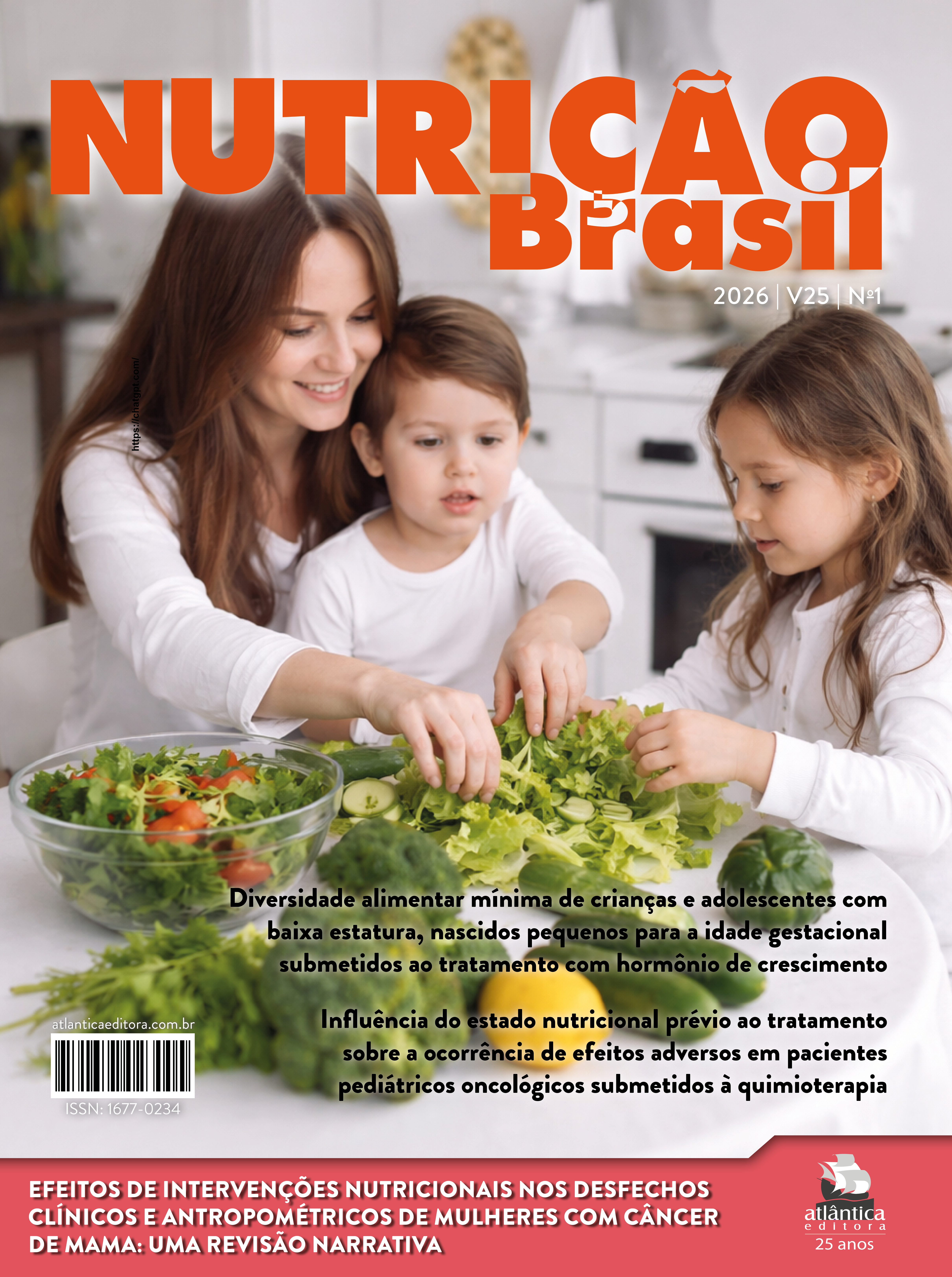
Effects of Nutritional Interventions on Clinical and Anthropometric Outcomes in Women with Breast Cancer: A Narrative Review
DOI:
https://doi.org/10.62827/nb.v25i1.3082Keywords:
Anthropometry; Breast Cancer; Diet; Food; Dietary Supplement.Abstract
Introduction: Breast cancer is the leading cause of cancer-related death among women. A healthy lifestyle is essential for improving both the prognosis and quality of life of breast cancer survivors. Considering the epidemiological relevance of the disease and the challenges women face in managing health parameters such as body weight and inflammation after diagnosis, it is important to develop a literature review on the effects of nutritional interventions on patient outcomes. Objective: The main objective of this study was to investigate the effects of nutritional interventions on clinical and anthropometric outcomes in women with breast cancer. Methods: This is a narrative review of studies published in the databases of PubMed and Scientific Electronic Library Online (SciELO). The search was conducted between August and September 2025, with the following inclusion criteria: publications from the last 5 years (2020 to 2024); articles in English or Portuguese; focus on nutritional interventions for women after breast cancer diagnosis. Studies focusing exclusively on primary prevention of cancer, literature reviews, case reports, dissertations, and PhD thesis were excluded. Results: A total of 20 studies were identified on the topic, of which (n=8) focused on clinical outcomes (improvements in quality of life, reduction in treatment toxicities, and reduction in mortality); (n=8) focused on anthropometric outcomes (reduction in weight and body fat); and (n=4) addressed biochemical outcomes (reduction in inflammatory markers and oxidative stress). The most frequently mentioned nutritional interventions were the Mediterranean diet (14.3%, n=3), and supplementation with vitamin D, omega-3, soy isoflavones, beta-glucans, zinc, and calcium (each cited in 9.5%, n=2). Conclusion: These findings are relevant for elucidating the main forms of dietary treatment for women with breast cancer, aiming to improve prognosis and quality of life.
References
World Health Organization (WHO), International Agency for Research on Cancer (IARC). Global cancer statistics 2020: breast cancer incidence and mortality. CA Cancer J Clin. 2021;71(3):209-249. doi:10.3322/caac.21660.
Arnold M, Morgan E, Rumgay H, Mafra A, Singh D, Laversanne M, Vignat J, Gralow J R, Cardoso F, Siesling S, Soerjomataram I. Current and future burden of breast cancer: Global statistics for 2020 and 2040. Breast. 2022 Dec;66:15-23. doi:10.1016/j.breast.2022.08.010.
Instituto Nacional de Câncer José Alencar Gomes da Silva (INCA). Incidência – dados e números: câncer de mama no Brasil [Internet]. Rio de Janeiro: INCA; 2022 [cited 2025 Jun 26].
Maehara Y, Shimazu K, Kurozumi S, Matsubara N, Ohsumi S, Takei H, et al. Survival benefits and less intensive treatment for women with early-stage breast cancer diagnosed while participating in population-based screening. Ann Surg Oncol. 2025;32:1234 1245. doi:10.1245/s10434-025-17845-1.
Pfeiler G, et al. Impact of BMI on patients with hormone receptor-positive early-stage breast cancer receiving endocrine therapy with or without palbociclib in the PALLAS study. Breast. 2023;68:120 127. doi:10.1016/j.breast.2023.02.005.
Anderson KN, Schwab RB, Martinez ME. Reproductive risk factors and breast cancer subtypes: a review of the literature. Breast Cancer Res Treat. 2014;144(1):1 10. doi:10.1007/s10549-014-2852-7.
Clusan L, et al. A basic review on estrogen receptor signaling pathways in breast cancer. Int J Mol Sci. 2023;24(7):6834. doi:10.3390/ijms24076834.
Ribeiro VG, Silva E, Matos JA, Souza ALF, Sousa WM de, Queiroz ABR, Vera Cunha SC, Silva de Almeida JA, Ferreira PHM, Costa CS. Prevalence of obesity-associated complications in breast cancer women: an integrative review. Res Soc Dev. 2023;12(4):e1512431920. doi:10.33448/rsd-v12i4.31920.
Castro Espin C, Agudo A. The role of diet in prognosis among cancer survivors: a systematic review and meta-analysis of dietary patterns and diet interventions. Nutrients. 2022;14(2):348. doi:10.3390/nu14020348.
World Cancer Research Fund/American Institute for Cancer Research. Diet, Nutrition, Physical Activity and Cancer: A Global Perspective. Continuous Update Project Expert Report. London: WCRF International; 2018 [cited 2025 Nov 03].
Klobodu C, Deutsch J, Vitolins MZ, Fisher K, Nasser JA, Stott D, Milliron BJ. Examining the role of nutrition in cancer survivorship and female fertility: a narrative review. Curr Dev Nutr. 2024;8(4):102134. doi:10.1016/j.cdnut.2024.102134.
Silva KFL, Silva PN, Dias DAM. Avaliação do estado nutricional de mulheres com câncer de mama em uso de hormonioterapia. Braspen J. 2019;34(4):391 395. doi:10.37111/braspenj.2019344014.
Lagares ÉB, Santos KF de, Mendes RC, Moreira FA, Anastácio LR. Excesso de peso em mulheres com diagnóstico de câncer de mama em hormonioterapia com tamoxifeno. Rev Bras Cancerol. 2013;59(2):201 10. doi:10.32635/2176 9745.RBC.2013v59n2.525.
Bruinsma TJ, Dyer A M, Rogers CJ, et al. Effects of diet and exercise induced weight loss on biomarkers of inflammation in breast cancer survivors: a systematic review and meta analysis. Cancer Epidemiol Biomarkers Prev. 2021;30(6):1048 1062. doi:10.1158/1055 9965.EPI 20 1303.
Spiker, Marie et al. “Academy of Nutrition and Dietetics: Revised 2020 Standards of Professional Performance for Registered Dietitian Nutritionists (Competent, Proficient, and Expert) in Sustainable, Resilient, and Healthy Food and Water Systems.” Journal of the Academy of Nutrition and Dietetics vol. 120,9 (2020): 1568-1585.e28. doi:10.1016/j.jand.2020.05.010.
Montagnese C, Porciello G, Vitale S, Palumbo E, Crispo A, Grimaldi M, et al. Quality of Life in Women Diagnosed with Breast Cancer after a 12-Month Treatment of Lifestyle Modifications. Nutrients. 2021;13(1):136. doi:10.3390/nu13010136.
Vafa S, Zarrati M, Malakootinejad M, Saneei Totmaj A, Zayeri F, Salehi M, Sanati V, Haghighat S. Calorie restriction and synbiotics effect on quality of life and edema reduction in breast cancer-related lymphedema, a clinical trial. Breast. 2020 Dec;54:37–45. doi: 10.1016/j.breast.2020.08.008.
Souza JS, Reitz LK, Copetti CLK, Moreno YMF, Vieira FGK, Di Pietro PF. Lower adherence to lifestyle recommendations of the World Cancer Research Fund/American Institute for Cancer Research (2018) is associated with decreased overall 10-year survival in women with breast cancer. Nutrients. 2025 Mar 12;17(6):1001. doi:10.3390/nu17061001.
Nimee F, Gioxari A, Papandreou P, Amerikanou C, Karageorgopoulou S, Kaliora AC, Skouroliakou M. The effect of melatonin supplementation on cancer-related fatigue during chemotherapy treatment of breast cancer patients: a double-blind, randomized controlled study. Cancers (Basel). 2024 Feb 16;16(4):802. doi: 10.3390/cancers16040802.
Porciello G, Montagnese C, Crispo A, Grimaldi M, Libra M, Vitale S, et al. Mediterranean diet and quality of life in women treated for breast cancer: A baseline analysis of DEDiCa multicentre trial. PLoS One. 2020;15(10):e0239803. doi:10.1371/journal.pone.0239803.
Long Parma DA, Reynolds GL, Muñoz E, Ramirez AG, et al. Effect of an anti-inflammatory dietary intervention on quality of life among breast cancer survivors. Support Care Cancer. 2022;30:5903-5910. doi:10.1007/s00520-022-07023-4
de Souza APS, da Silva LC, Fayh APT. Nutritional Intervention Contributes to the Improvement of Symptoms Related to Quality of Life in Breast Cancer Patients Undergoing Neoadjuvant Chemotherapy. Nutrients. 2021;13(2):589. doi:10.3390/nu13020589.
Sathiaraj E, Afshan K, Sruthi R, Jadoni A, Murugan K, Patil S, Naik R. Effects of a Plant Based High Protein Diet on Fatigue in Breast Cancer Patients Undergoing Adjuvant Chemotherapy – a Randomized Controlled Trial. Nutr Cancer. 2022;74(9):2287 2296. doi:10.1080/01635581.2022.2159044.
Juan Z, Qing Z, Yongping L, et al. Probiotics for the treatment of docetaxel related weight gain of breast cancer patients: a single center, randomized, double blind, and placebo controlled trial. Front Nutr. 2021;8:762929. doi:10.3389/fnut.2021.762929.
Parsowith EJ, Stock MS, Kocuba O, Schumpp A, Jackson K, Brooks AM, et al. Impact of short-term creatine supplementation on muscular performance among breast cancer survivors. Nutrients. 2024.
Almassri HF, Abdul Kadir A, Srour M, Foo LH. The effects of omega-3 fatty acids and vitamin D supplementation on the nutritional status of women with breast cancer in Palestine: an open-label randomized controlled trial. Nutrients. 2024;16(22):3960. doi:10.3390/nu16223960.
Campbell TM, Campbell EK, Culakova E, et al. A whole food, plant based randomized controlled trial in metastatic breast cancer: weight, cardiometabolic, and hormonal outcomes. Breast Cancer Res Treat. 2024;205:257 266. doi:10.1007/s10549 024 07266 1.
Grupińska J, Budzyń M, Maćkowiak K, Oliveira JJ, Kycler W, Leporowska E, et al. Efeitos benéficos dos suplementos nutricionais orais na composição corporal e parâmetros bioquímicos em mulheres com câncer de mama submetidas à quimioterapia pós-operatória: uma análise de correspondência de pontuação de propensão. Nutrientes. 2021;13(10):3549. doi:10.3390/nu13103549.
Arsic A, Krstic P, Paunovic M, Nedovic J, Jakovljevic V, Vucic V. Anti-inflammatory effect of combining fish oil and evening primrose oil supplementation on breast cancer patients undergoing chemotherapy: a randomized placebo-controlled trial. Sci Rep. 2023;13:6449. doi:10.1038/s41598-023-28411-8.
Willett WC, Sacks F, Trichopoulou A, Drescher G, Ferro-Luzzi A, Helsing E, Trichopoulos D. Mediterranean diet pyramid: a cultural model for healthy eating. Am J Clin Nutr. 1995 Jun;61(6 Suppl):1402S-1406S. doi: 10.1093/ajcn/61.6.1402S.
van den Brandt PA, Schulpen M. Mediterranean diet adherence and risk of postmenopausal breast cancer: results of a cohort study and meta-analysis. Int J Cancer. 2017 May 15;140(10):2220-2231. doi:10.1002/ijc.30654.
Behisht N, Navaneetha R. Impact of Plant-Based Diet in Prevention of Non-Communicable Diseases. Int J Res Appl Sci Eng Technol. 2022 Jul 7;10(7):-. doi:10.22214/ijraset.2022.45428.
Souza JS, Reitz LK, Copetti CLK, Moreno YMF, Vieira FGK, Di Pietro PF. Lower adherence to lifestyle recommendations of the World Cancer Research Fund/American Institute for Cancer Research (2018) is associated with decreased overall 10-year survival in women with breast cancer. Nutrients. 2025 Mar 12;17(6):1001. doi:10.3390/nu17061001.
Turesky, Robert J. “Mechanistic Evidence for Red Meat and Processed Meat Intake and Cancer Risk: A Follow-up on the International Agency for Research on Cancer Evaluation of 2015.” Chimia vol. 72,10 (2018): 718-724. doi:10.2533/chimia.2018.718.
Stolley MR, et al. Health behaviors and breast cancer: Experiences of urban African American women. Health Education & Behavior. 2006;33(5):604-24.
Gadea E, et al. Importance of metabolic changes induced by chemotherapy on prognosis of early-stage breast cancer patients: a review of potential mechanisms. Obesity Reviews. 2012;13(4):368-80.
Maunsell E, et al. Dietary change after breast cancer: Extent, predictors, and relation with psychological distress. Journal of Clinical Oncology. 2002;20(4):1017-25.
Moreira Lima Verde SM, et al. Acquired food aversion and quality of life in women with breast cancer. Revista de Nutrição-Brazilian Journal of Nutrition. 2009;22(6):795-807.
Ambrosi C, et al. Fatores que influenciam o consumo energético de mulheres no tratamento do câncer de mama. Revista Brasileira de Ginecologia e Obstetrícia. 2011;33(8):207-13.
Park CL, et al. Positive and negative health behavior changes in cancer survivors: A stress and coping perspective. Journal of Health Psychology. 2008;13(8):1198-206.
Ferrer RA, Bergman HE, Klein WMP. Worry as a predictor of nutrition behaviors: Results from a nationally representative survey. Health Education & Behavior. 2013;40(1):88-96.
Speck RM, et al. Taste alteration in breast cancer patients treated with taxane chemotherapy: experience, effect, and coping strategies. Supportive Care in Cancer. 2013;21(2):549-55.
Silva L, Pereira M, Souza R, et al. Research, Society and Development. 2022;11(6): e44111629411. doi:10.33448/rsd-v11i6.29411.
Horie LM, Barrére APN, Castro MG, Oliveira AMB, Carvalho AMB, Pereira A, et al. Diretriz BRASPEN de terapia nutricional no paciente com câncer. BRASPEN J. 2019;34(Supl 1):2–32.
Martínez-Campa C, González A, Mediavilla MD, Alonso-González C, Alvarez-García V, Sánchez-Barceló EJ, Cos S. Melatonin inhibits aromatase promoter expression by regulating cyclooxygenases expression and activity in breast cancer cells. Br J Cancer. 2009 Sep 22;101(10):1613-9. doi: 10.1038/sj.bjc.6605336.
Hill SM, Belancio VP, Dauchy RT, Xiang S, Brimer S, Mao L, Hauch A, Lundberg PW, Summers W, Yuan L, Frasch T, Blask DE. Melatonin: an inhibitor of breast cancer. Endocr Relat Cancer. 2015 Jun;22(3):R183-204. doi: 10.1530/ERC-15-0030.
Feldman D, Krishnan AV, Swami S, Giovannucci E, Feldman BJ. The role of vitamin D in reducing cancer risk and progression. Nat Rev Cancer. 2014;14(5):342-57. doi:10.1038/nrc3691.
Rose AA, Elser C, Ennis M, Goodwin PJ. Blood levels of vitamin D and early stage breast cancer prognosis: a systematic review and meta-analysis. Breast Cancer Res Treat. 2013 Oct;141(3):331-9. doi:10.1007/s10549-013-2713-9.
Li Z, Wu Y, Zhang H, Huang Z, Thabane L, Li T. Effect of vitamin D supplementation on risk of breast cancer. Breast Cancer Res Treat. 2021;186(1):121-129. doi:10.1007/s10549-020-05842-z.
Rock CL, Flatt SW, Natarajan L, Thomson CA, Bardwell WA, Newman V, et al. Plasma carotenoids and recurrence-free survival in women with a history of breast cancer. J Clin Oncol. 2005 Sep 20;23(27):6631–8. doi:10.1200/JCO.2005.19.505.
Castro LRM, Silveira GF, Caiado Fraga IA, Santos LP, Ferreira PA, Monteiro de Castro A. O impacto da disbiose na progressão do câncer de mama. Rev Eletrôn Acervo Saúde. 2021;13(3):1-10. doi:10.25248/REAS.e6645.2021.
Lopes HN, Silva CAC, Sá C, Machado MLM, Mathias C, Silva CAC. O impacto da microbiota intestinal em oncologia. Rev Ciên Hosp Santa Izabel. 2025;9(1):1-29. doi:10.35753/rchsi.v9i1.583
Downloads
Published
Issue
Section
License
Copyright (c) 2026 Ana Caroline de Oliveira Pereira , Ana Luiza Clemente de Bortoli, Isabelli Ruschka, Jaqueline Schroeder de Souza (Autor)

This work is licensed under a Creative Commons Attribution 4.0 International License.
Autores que publicam nesta revista concordam com os seguintes termos:
Autores mantém os direitos autorais e concedem à revista o direito de primeira publicação, com o trabalho simultaneamente licenciado sob a Licença Creative Commons Attribution 4.0 que permite o compartilhamento do trabalho com reconhecimento da autoria e publicação inicial nesta revista.
Autores têm autorização para distribuição não-exclusiva da versão do trabalho publicada nesta revista (ex.: publicar em repositório institucional ou como capítulo de livro), com reconhecimento de autoria e publicação inicial nesta revista.