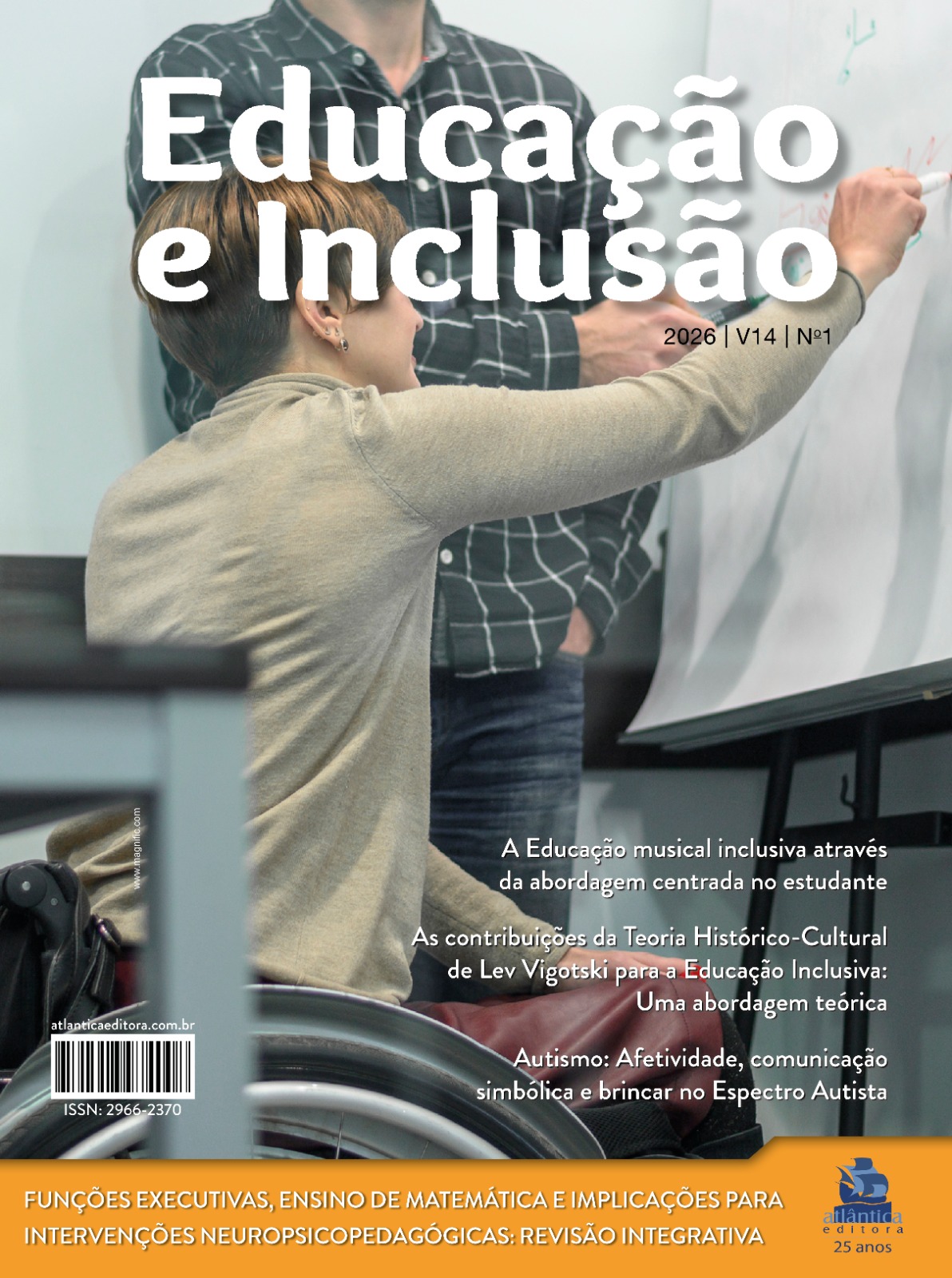
The contributions of Lev Vygotsky's Historical-Cultural Theory to Inclusive Education: A theoretical approach
DOI:
https://doi.org/10.62827/ei.v14i1.1012Keywords:
Psychology; Human Development; Education.Abstract
Introduction: Based on Historical-Dialectical Materialism, this study starts from the premise that the development of the subject is not determined solely by biological factors, but is a result of the social environment. Objective: This study describes the contributions of Historical-Cultural Theory, based on the studies of Lev Vygotsky, to the understanding of human development, focusing on people with disabilities, as well as their educational process. Methods: This is a qualitative research, based on classic and current works by Vygotsky and authors who identify with the theme, as well as studies by 19th-century theorists such as Itard, Séguin, and Montessori. Results: The analysis showed that the first interventions directed at people with disabilities originated in the medical field, supported by clinical and pathologizing conceptions. Although these theorists contributed to overcoming biological determinism by recognizing the influence of the environment on human development, it was the Russian theorist who provided a humanized perspective on disability. For Vygotsky, development occurs from the social to the individual, through the mediation of language, work, and cultural signs. Concepts such as social compensation and the Zone of Proximal Development demonstrate that, even in the face of limitations, the individual can reorganize their higher psychological functions when immersed in scientifically grounded educational practices. Conclusion: The results reinforce the role of the school and the teacher as mediators in the development of students through inclusive education that promotes the acquisition of scientific knowledge as a condition for the humanization and emancipation of individuals.
References
Tuleski SC. Formar para adaptar ou para transformar? Contribuições de Pistrak, Vigotsky e Saviani para a educação. São Paulo: Lutas Anticapital; 2021.
Martins LM. A constituição histórico-social da subjetividade humana: contribuições para a formação de professores. In: Miller S, Barbosa MV, Mendonça SGL, editors. Educação e humanização: as perspectivas da teoria histórico-cultural. Jundiaí: Paco Editorial; 2014. p. 97-110.
Netto JP. Introdução ao estudo do método de Marx. São Paulo: Expressão Popular; 2011.
Meira MEM. Práticas educativas e a produção da subjetividade na escola contemporânea. In: Miller S, Barbosa MV, Mendonça SGL, editors. Educação e humanização: as perspectivas da teoria histórico-cultural. Jundiaí: Paco Editorial; 2014. p.161-72.
Caixeta ME. Condillac e o ensino de ciências: que relações podemos encontrar ainda hoje? Ensaio Pesqui Educ Cienc (Belo Horizonte) [Internet]. 2003 [cited 2026 Mar 1];5(1):26-41. Avaliable from: https://doi.org/10.1590/1983-21172003050104. doi: 10.1590/1983-21172003050104
Cordeiro AFM, Antunes MAM. A ação pedagógica de Itard na educação de Victor, o "selvagem de Aveyron": contribuição à história da psicologia. Bol Acad Paul Psicol [Internet]. 2020 [cited 2026 Mar 1];40(99):296-306. Available from: https://pepsic.bvsalud.org/scielo.php?script=sci_arttext&pid=S1415-711X2020000200016
Miranda AAB. História, deficiência e educação especial. Rev HISTEDBR On-line [Internet]. 2004 [cited 2026 Mar 1];1(15):1-7. Available from: https://www.cursosavante.com.br/cursos/curso471/conteudo8569.pdf
Barbosa HF, Barbosa MFA, Gomes RVB. A história e as contribuições de Maria Montessori para a educação especial na perspectiva inclusiva. Rev Educ Incl [Internet]. 2022 [cited 2026 Mar 1];7(2):323-35. Available from: https://revista.uepb.edu.br/REIN/article/view/417
Montessori M. A mente da criança: mente absorvente. São Paulo: Planeta do Brasil; 2025.
Vigotski LS. Problemas de defectologia. Vol. 1. Prestes Z, Tunes E, editors, translators, technical reviewers. São Paulo: Expressão Popular; 2021.
Alves JM. As formulações de Vygotsky sobre a zona de desenvolvimento proximal. Amaz Rev Educ Cienc Mat [Internet]. 2005 [cited 2026 Mar 1];1(1):11-16. Avaliable from: https://periodicos.ufpa.br/index.php/revistaamazonia/article/view/1466. doi:10.18542/amazrecm.v1i0.1466.
Padilha AML, Silva RHR. Pedagogia histórico-crítica e a educação escolar das pessoas com deficiência. Nuances Estud Educ [Internet]. 2020 [cited 2026 Mar 1];31(Spec No 1):103-125. doi:10.32930/nuances.v31iesp.1.8291.
Ruppel C, Hansel AF, Ribeiro L. Vygotsky e a defectologia: contribuições para a educação dos estudantes com deficiência nos dias atuais. Rev Diálogos Perspect Educ Espec [Internet]. 2021 [cited 2026 Mar 1];8(1):11-24. Avaliable from: https://revistas.marilia.unesp.br/index.php/dialogoseperspectivas/article/view/10599. doi:10.36311/2358-8845.2021.v8n1.p11-24.
Brasil. Lei nº 13.146, de 6 de julho de 2015. Lei Brasileira de Inclusão da Pessoa com Deficiência [Internet]. Brasília (DF): Presidência da República; 2015 [cited 2026 Feb 11]. Available from: https://www.planalto.gov.br/ccivil_03/_ato2015-2018/2015/lei/l13146.htm
Januzzi G. Algumas concepções de educação do deficiente. Rev Bras Cienc Esporte [Internet]. 2004 [cited 2026 Mar 1];25(3):9-25. Available from: http://www.oldarchive.rbceonline.org.br/index.php/RBCE/article/viewFile/235/237
Rafante HC, Lopes RE. Helena Antipoff e o desenvolvimento da educação especial no Brasil (1929-1961). Rev HISTEDBR On-line [Internet]. 2014; [cited 2026 Mar 1];13(53):331-356. Avaliable from: https://periodicos.sbu.unicamp.br/ojs/index.php/histedbr/article/view/8640208. doi:10.20396/rho.v13i53.8640208.
Bourdieu P, Passeron JC. A reprodução: elementos para uma teoria do sistema de ensino. 8. ed. Petrópolis: Vozes; 2023.
Kassar MCM. O que tem de especial a educação especial? In: Orlando RM, Bengtson C, editors. (Des)mitos da educação especial. São Carlos: EDESP-UFSCar; 2022. p. 13-25.
Brasil. Ministério da Educação. Secretaria de Educação Especial. Política Nacional de Educação Especial na Perspectiva da Educação Inclusiva [Internet]. Brasília (DF): MEC/SEESP; 2008 [cited 2026 Feb 11]. Available from: https://portal.mec.gov.br/seesp/arquivos/pdf/politica.pdf
Downloads
Published
Issue
Section
License
Copyright (c) 2026 Natalia Dias de Oliveira (Autor)

This work is licensed under a Creative Commons Attribution 4.0 International License.
Autores que publicam nesta revista concordam com os seguintes termos:
Autores mantém os direitos autorais e concedem à revista o direito de primeira publicação, com o trabalho simultaneamente licenciado sob a Licença Creative Commons Attribution 4.0 que permite o compartilhamento do trabalho com reconhecimento da autoria e publicação inicial nesta revista.
Autores têm autorização para distribuição não-exclusiva da versão do trabalho publicada nesta revista (ex.: publicar em repositório institucional ou como capítulo de livro), com reconhecimento de autoria e publicação inicial nesta revista.