
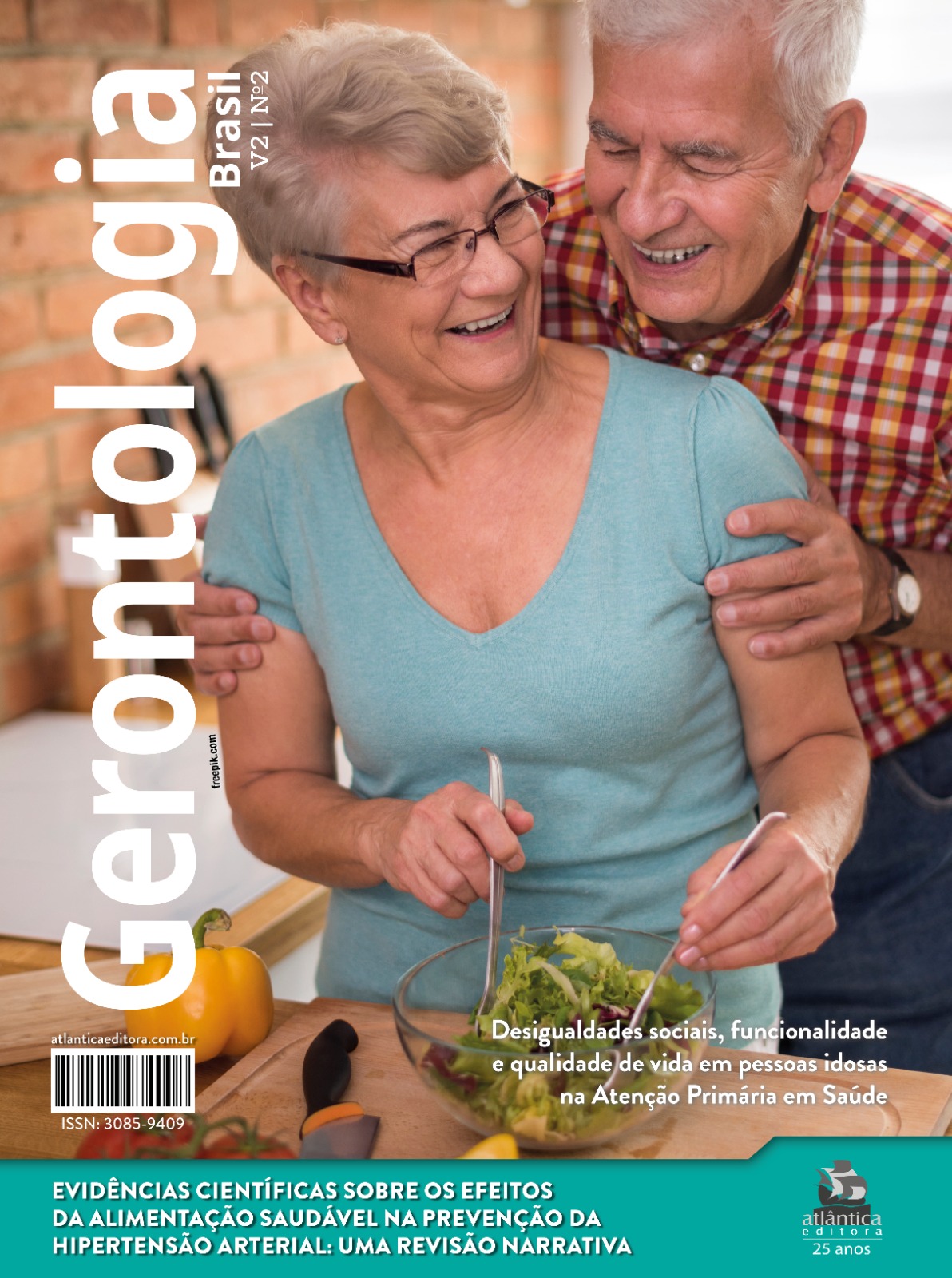
Social inequalities, functioning and quality of life in older adults in Primary Health Care
DOI:
https://doi.org/10.62827/gb.v2i2.0013Keywords:
Aging; Socioeconomic Factors; Epidemiology; Quality of Life.Abstract
Objective: To investigate social inequalities in the relationships between indicators of functional capacity and quality of life among older adults using Primary Heath Care (PHC) services. Methods: A cross-sectional study was conducted with a representative sample of 201 older adults receiving care in Primary Health Care (PHC) in a municipality in Minas Gerais, Brazil. Indicators of functional capacity included mobility, mobility under dual motor and cognitive task conditions, handgrip strength, and lower limb strength. Quality of life was assessed using the 26-item World Health Organization Quality of Life-Brief Version (WHOQOL-BREF), generating total and domain-specific scores. Social inequalities examined included sex, age group, educational level, and income sufficiency. Descriptive analyses were performed, along with Student’s t‑tests and Pearson’s correlation, adopting a 5% significance level. Results: The sample consisted predominantly of women (77.1%;n=155), individuals aged 60 to 74 years (79.1%;n=159), those with lower educational levels (54.7%;n=110), and those reporting insufficient income (67.2%;n=135). Indicators of functional capacity were correlated with quality of life among younger older adults, women, individuals with higher educational attainment, and those with insufficient income. Conclusion: Social inequalities influence the relationships between indicators of functional capacity and quality of life, particularly regarding sex and income sufficiency. The findings suggest that declines in functional capacity may have a greater impact on quality of life among women and individuals with insufficient income. Dual-task mobility tests, both motor and cognitive, may contribute to effective monitoring of functionality and prevention of functional decline in older adults receiving care in primary health services.
References
Varela-Vásquez LA, Minobes-Molina E, Jerez-Roig J. Dual-task exercises in older adults: a structured review of current literature. J Frailty Sarcopenia Falls. 2020;5(2):31–37. doi: 10.22540/JFSF-05-031.
Organização Pan-Americana da Saúde, Organização Mundial da Saúde. Envelhecimento ativo: uma política de saúde [Internet]. Brasília: OPAS/OMS; 2005. Disponível em: https://iris.paho.org/server/api/core/bitstreams/2209f4e1-e981-42d7-aaf9-65044603dde1/content.
Veras R, Cordeiro R. A contemporary care model for older adults should seek coordinated care, greater quality and the reduction of costs. Int J Fam Community Med. 2019;3(5):210–214. doi: 10.15406/ijfcm.2019.03.00159.
Fleck MPA. O instrumento de avaliação de qualidade de vida da Organização Mundial da Saúde (WHOQOL-100): características e perspectivas. Cien Saude Colet. 2000;5(1):33–38. doi: 10.1590/S1413-81232000000100004.
Hu N, Yin W, Noon RI, Alabdullatif N. The longitudinal relationship between physical functions and cognitive functions among middle-aged and older adults in primary care. Int J Environ Res Public Health. 2025;22(6):908. doi: 10.3390/ijerph22060908.
Silva e Farias IP, Montenegro LAS, Wanderley RL, Pontes JCX, Pereira AC, Almeida LFD, et al. Physical and psychological states interfere with health-related quality of life of institutionalized elderly: a cross-sectional study. BMC Geriatr. 2020 Oct 6;20(1):386. doi: 10.1186/s12877-020-01791-6.
Lawton MP. A multidimensional view of quality of life in frail elders. In: The concept and measurement of quality of life in the frail elderly. San Diego: Academic Press; 1991. p.3–27. doi: 10.1016/B978-0-12-101275-5.50005-3.
Sipilä S, Tirkkonen A, Hänninen T, Laukkanen P, Alen M, Fielding RA, et al. Promoting safe walking among older people: the effects of a physical and cognitive training intervention vs. physical training alone on mobility and falls among older community-dwelling men and women (the PASSWORD study): Design and methods of a randomized trial. BMC Geriatr. 2018;18(1):1–12. doi: 10.1186/s12877-018-0906-0.
Alexandre TS, Meira DM, Rico NC, Mizuta SK. Accuracy of Timed Up and Go Test for screening risk of falls among community-dwelling elderly. Braz J Phys Ther. 2012;16(5):381–388. doi: 10.1590/S1413-35552012005000041.
Fried LP, Tangen CM, Walston J, Newman AB, Hirsch C, Gottdiener J, et al. Frailty in older adults: evidence for a phenotype. J Gerontol A Biol Sci Med Sci. 2001;56(3):146–157. doi: 10.1093/gerona/56.3.m146.
Brustio PR, Rabaglietti E, Formica S, Liubicich ME. Dual-task training in older adults: the effect of additional motor tasks on mobility performance. Arch Gerontol Geriatr. 2018;75:119–124. doi:10.1016/j.archger.2017.12.003.
Wollesen B, Wildbredt A, Van Schooten KS, Lim ML, Delbaere K. The effects of cognitive-motor training interventions on executive functions in older people: a systematic review and meta-analysis. Eur Rev Aging Phys Act. 2020 Jul 2;17:9. doi: 10.1186/s11556-020-00240-y.
Herold F, Hamacher D, Schega L, Müller NG. Thinking while moving or moving while thinking – concepts of motor-cognitive training for cognitive performance enhancement. Front Aging Neurosci. 2018 Aug 6;10:228. doi: 10.3389/fnagi.2018.00228.
Hao Y, Zhao Y, Luo H, Xie L, Hu H, Sun C. Comparative effectiveness of different dual task mode interventions on cognitive function in older adults with mild cognitive impairment or dementia: a systematic review and network meta-analysis. Aging Clin Exp Res. 2025 Apr 30;37(1):139. doi: 10.1007/s40520-025-03016-5.
Valero CNA, Meira TFG, Assumpção D de, Neri AL. Significados de ser feliz na velhice e qualidade de vida percebida segundo idosos brasileiros. Rev Bras Geriatr Gerontol. 2021;24(2):e200298. doi: 10.1590/1981-22562021024.200298.
Belmonte JMMM, Pivetta NRS, Batistoni SST, Neri AL, Borim FSA. The association between self-rated health and functional capacity indicators. Geriatr Gerontol Aging. 2017;11(2):61–67. doi: 10.5327/Z2447-211520171700021.
Zhang CQ, Chung PK, Zhang R, Schüz B. Socioeconomic inequalities in older adults’ health: the roles of neighborhood and individual-level psychosocial and behavioral resources. Front Public Health. 2019 Oct 25;7:318. doi: 10.3389/fpubh.2019.00318.
Barros MBA, Goldbaum M. Challenges of aging in the context of social inequalities. Rev Saude Publica. 2018 Oct 25;52(Suppl 2):1s. doi: 10.11606/S1518-8787.201805200supl2ed.
Paiva MM, Lima MG, Barros MBA. Desigualdades sociais do impacto das quedas de idosos na qualidade de vida relacionada à saúde. Ciênc saúde coletiva. 2020 May;25(5):1887–1896. doi: 10.1590/1413-81232020255.34102019
Pereira JL, De Araujo FF, Santos KT. Capacidade funcional e qualidade de vida em idosos. Fisioter Bras. 2020;21(2):135–140. doi: 10.33233/fb.v21i2.1310.
Neri AL, Borim FSA, Fontes AP, Rabello DF, Cachioni M, Batistoni SST, et al. Fatores associados à qualidade de vida percebida em adultos mais velhos: ELSI-Brasil. Rev. Saude Publica. 2018;52(Suppl 2):16s. doi: 10.11606/S1518-8787.2018052000613.
Hofheinz M, Schusterschitz C. Dual task interference in estimating the risk of falls and measuring change: a comparative, psychometric study of four measurements. Clin Rehabil. 2010 Sep;24(9):831–842. doi: 10.1177/0269215510367993. Epub 2010 Jun 18.
Podsiadlo D, Richardson S. The Timed Up and Go: A test of basic functional mobility for frail elderly persons. J Am Geriatr Soc. 1991 Feb;39(2):142–148. doi: 10.1111/j.1532-5415.1991.tb01616.x.
Guerra M, Garcia D, da Costa Daniele TM, Berglind D, Guerra J, Evangelista BP, et al. Associations between physical activity, socioeconomic and sociodemographic factors, and risk of sarcopenia in older adults in Northeast Brazil. BMC Public Health. 2025 Nov 10;25(1):3865. doi: 10.1186/s12889-025-25158-x.
Montero-Odasso MM, Sarquis-Adamson Y, Speechley M, Borrie MJ, Hachinski VC, Wells J, et al. Association of dual-task gait with incident dementia in mild cognitive impairment: results from the gait and brain study. JAMA Neurol. 2017 Jul 1;74(7):857-65. doi: 10.1001/jamaneurol.2017.0643. Errata em: JAMA Neurol. 2017 Nov 1;74(11):1381. doi: 10.1001/jamaneurol.2017.2722.
Araujo RF, Caran GM, Souza IVP. Orientação temática e coeficiente de correlação para análise comparativa entre altmetrics e citações: uma análise da revista DataGramaZero. EQ. 2016 Set;22(3):184–200. doi: https://doi.org/10.19132/1808-5245223.
Wu W, Zhang B, Li J, Zhao Y, Wang L, Zhao J, et al. Global and national burden of falls among individuals aged 55 years and older (1990-2021): analysis of the global burden of disease study 2021. BMC Public Health. 2025 Oct 31;25(1):3681. doi: 10.1186/s12889-025-25016-w.
Zaremba LS, Smoleński WH. Optimal portfolio choice under a liability constraint. Ann Oper Res. 2000;97(1–4):131–141.
Pinto JM, Fontaine AM, Neri AL. The influence of physical and mental health on life satisfaction is mediated by self-rated health: a study with Brazilian elderly. Arch Gerontol Geriatr. 2016 Jul-Aug; 65:104–110. doi: 10.1016/j.archger.2016.03.009.
Fakoya OO, Abioye-Kuteyi EA, Bello IS, Oyegbade OO, Olowookere SA, Ezeoma IT. Determinants of quality of life of elderly patients attending a general practice clinic in Southwest Nigeria. Int Q Community Health Educ. 2018 Oct;39(1):37. doi: 10.1177/0272684X18781781.
Scarabottolo CC, Cyrino ES, Nakamura PM, Tebar WR, Canhin DDS, Gobbo LA, et al. Relationship of different domains of physical activity practice with health-related quality of life among community-dwelling older people: a cross-sectional study. BMJ Open. 2019 Jun 27;9(6):e027751. doi: 10.1136/bmjopen-2018-027751.
Coelho-Júnior HJ, Gonçalves IO, Sampaio RAC, Sampaio PYS, Cadore EL, Calvani R, et al. Effects of combined resistance and power training on cognitive function in older women: a randomized controlled trial. Int J Environ Res Public Health. 2020 May 14;17(10):3435. doi: 10.3390/ijerph17103435.
Kwak Y, Kim Y. Quality of life and subjective health status according to handgrip strength in the elderly: a cross-sectional study. Aging Ment Health. 2019 Jan;23(1):107–112. doi:10.1080/13607863.2017.1387766.
Rantakokko M, Portegijs E, Viljanen A, Iwarsson S, Kauppinen M, Rantanen T. Perceived environmental barriers to outdoor mobility and changes in sense of autonomy in participation outdoors among older people: a prospective two-year cohort study. Aging Ment Health. 2017 Aug;21(8):805–809. doi: 10.1080/13607863.2016.1159281.
Loayza LS, Valenzuela MT. Health-related quality of life in older people with functional independence or mild dependence. Aging Ment Health. 2021 Dec;25(12):2213–2218. doi: 10.1080/13607863.2020.1830943.
Downloads
Published
Issue
Section
License
Copyright (c) 2026 Juliana Martins Pinto, Claudio Mardey Nogueira, Luciana Rocha Nunes Nogueira, Yunara Fernandes Venturelli , Gabrielly Fernanda Silva , Thalyta Isis de Matos Pires, Paulo Henrique Ferreira de Araujo Barbosa (Autor)

This work is licensed under a Creative Commons Attribution 4.0 International License.
Autores que publicam nesta revista concordam com os seguintes termos:
Autores mantém os direitos autorais e concedem à revista o direito de primeira publicação, com o trabalho simultaneamente licenciado sob a Licença Creative Commons Attribution 4.0 que permite o compartilhamento do trabalho com reconhecimento da autoria e publicação inicial nesta revista.
Autores têm autorização para distribuição não-exclusiva da versão do trabalho publicada nesta revista (ex.: publicar em repositório institucional ou como capítulo de livro), com reconhecimento de autoria e publicação inicial nesta revista.