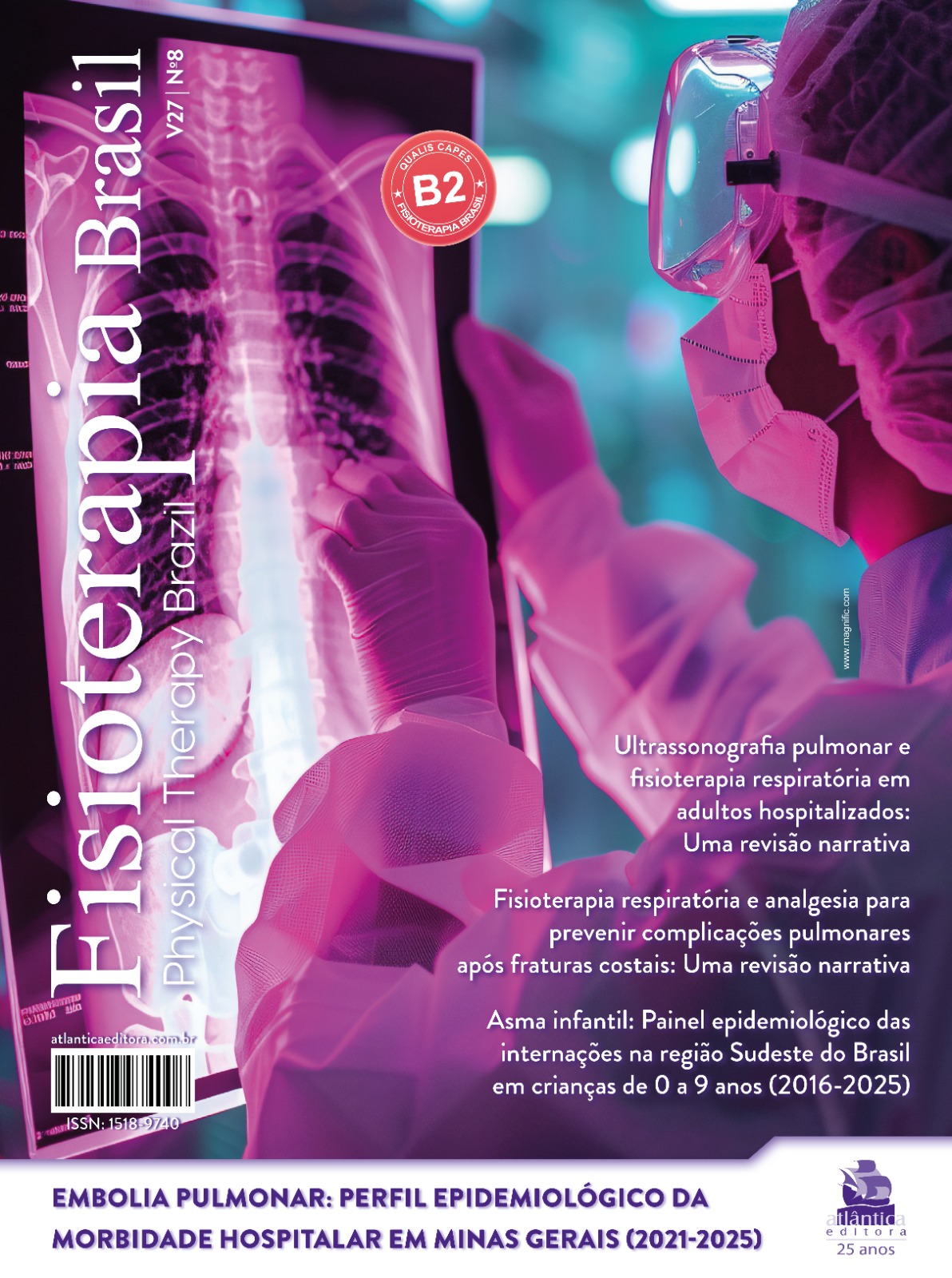
Fisioterapia respiratória e analgesia para prevenir complicações pulmonares após fraturas costais: Uma revisão narrativa
DOI:
https://doi.org/10.62827/fb.v27i8.1285Palavras-chave:
Traumatismos Torácicos; Exercícios Respiratórios; Deambulação Precoce; Fraturas das Costelas; Pneumonia.Resumo
Introdução: Fraturas costais podem limitar inspiração, tosse e mobilidade e favorecer atelectasia, retenção de secreções, pneumonia e insuficiência respiratória. Objetivo: Analisar a integração entre fisioterapia respiratória e controle da dor na prevenção de complicações pulmonares em adultos com fraturas costais traumáticas. Métodos: Revisão narrativa com buscas na Medical Literature Analysis and Retrieval System Online e na Physiotherapy Evidence Database, atualizadas pela última vez em 17 de setembro de 2026. As buscas identificaram 301 registros e 262 após deduplicação; 27 publicações compuseram a síntese. Incluíram-se estudos de adultos com fraturas costais ou trauma torácico contuso. A apreciação considerou delineamento, relação direta, consistência, precisão e limitações das fontes, sem graduação formal de certeza. Resultados: A evidência sustenta avaliação seriada, educação, expansão pulmonar, tosse apoiada, posicionamento e mobilização precoce, embora muitas recomendações derivem de consenso e estudos observacionais. O espirômetro de incentivo apresentou resultados conflitantes. Técnicas regionais reduziram dor e opioides, mas seus efeitos sobre pneumonia e mortalidade permaneceram incertos. Protocolos integrados associaram-se a menos complicações e menor permanência hospitalar. Conclusão: O conjunto atual de evidências favorece integrar analgesia multimodal, fisioterapia, mobilização e reavaliação objetiva; contudo, associações observacionais não demonstram efeito causal do pacote, e a contribuição independente de cada componente requer ensaios pragmáticos.
Referências
Martin TJ, Eltorai AS, Dunn R, Varone A, Joyce MF, Kheirbek T, et al. Clinical management of rib fractures and methods for prevention of pulmonary complications: a review. Injury. 2019;50(6):1159-1165. doi:10.1016/j.injury.2019.04.020.
Baker E, Barnett J, Driscoll T, Hutchings H, O'Neill C, Price M, et al. The role of the physiotherapist in the assessment and management of blunt mechanism chest wall injury: a systematic integrative review and narrative synthesis. Injury. 2025;56(6):112355. doi:10.1016/j.injury.2025.112355.
Bulger EM, Arneson MA, Mock CN, Jurkovich GJ. Rib fractures in the elderly. J Trauma. 2000;48(6):1040-6; discussion 1046-7. doi:10.1097/00005373-200006000-00007.
Mukherjee K, Schubl SD, Tominaga G, Cantrell S, Kim B, Haines KL, et al. Non-surgical management and analgesia strategies for older adults with multiple rib fractures: a systematic review, meta-analysis, and joint practice management guideline from the Eastern Association for the Surgery of Trauma and the Chest Wall Injury Society. J Trauma Acute Care Surg. 2023;94(3):398-407. doi:10.1097/TA.0000000000003830.
Heindel P, Ordoobadi A, El Moheb M, Serventi-Gleeson J, Garvey S, Heyman A, et al. Patient-reported outcomes 6 to 12 months after isolated rib fractures: a nontrivial injury pattern. J Trauma Acute Care Surg. 2022;92(2):277-286. doi:10.1097/TA.0000000000003451.
Claydon J, Maniatopoulos G, Robinson L, Fearon P. Challenges experienced during rehabilitation after traumatic multiple rib fractures: a qualitative study. Disabil Rehabil. 2018;40(23):2780-2789. doi:10.1080/09638288.2017.1358771.
Battle C, Pelo C, Hsu J, Driscoll T, Whitbeck S, White T, et al. Expert consensus guidance on respiratory physiotherapy and rehabilitation of patients with rib fractures: an international, multidisciplinary e-Delphi study. J Trauma Acute Care Surg. 2023;94(4):578-583. doi:10.1097/TA.0000000000003875.
Weinberg BJ, Roos R, van Aswegen H. Effectiveness of nonpharmacological therapeutic interventions on pain and physical function in adults with rib fractures during acute care: a systematic review and meta-analysis. S Afr J Physiother. 2022;78(1):1764. doi:10.4102/sajp.v78i1.1764.
van Aswegen H. Physiotherapy management of patients with trunk trauma: a state-of-the-art review. S Afr J Physiother. 2020;76(1):1406. doi:10.4102/sajp.v76i1.1406.
Sum SK, Peng YC, Yin SY, Huang PF, Wang YC, Chen TP, et al. Using an incentive spirometer reduces pulmonary complications in patients with traumatic rib fractures: a randomized controlled trial. Trials. 2019;20(1):797. doi:10.1186/s13063-019-3943-x.
Dote H, Homma Y, Sakuraya M, Funakoshi H, Tanaka S, Atsumi T. Incentive spirometry to prevent pulmonary complications after chest trauma: a retrospective observational study. Acute Med Surg. 2020;7(1):e619. doi:10.1002/ams2.619.
Jaconelli T, Crane S. Incentive spirometry to reduce pulmonary complications after rib fractures. Emerg Med J. 2026;43(4):255-257. doi:10.1136/emermed-2025-215302.
Saliba KA, Blackstock F, McCarren B, Tang CY. Effect of positive expiratory pressure therapy on lung volumes and health outcomes in adults with chest trauma: a systematic review and meta-analysis. Phys Ther. 2022;102(1):pzab254. doi:10.1093/ptj/pzab254.
Shin HJ, Son HH. Effect of diaphragmatic breathing training with visual biofeedback on respiratory function in patients with multiple rib fractures: a randomized-controlled study. Turk J Phys Med Rehabil. 2024;70(1):131-141. doi:10.5606/tftrd.2024.12601.
Zhang H, Ding Y, Ren J, Zhu J. Effect of respiratory training intervention on rehabilitation of patients with rib fracture: a meta-analysis. BMC Sports Sci Med Rehabil. 2025;17(1):59. doi:10.1186/s13102-025-01108-3.
Galvagno SM Jr, Smith CE, Varon AJ, Hasenboehler EA, Sultan S, Shaefer G, et al. Pain management for blunt thoracic trauma: a joint practice management guideline from the Eastern Association for the Surgery of Trauma and Trauma Anesthesiology Society. J Trauma Acute Care Surg. 2016;81(5):936-951. doi:10.1097/TA.0000000000001209.
Peek J, Smeeing DPJ, Hietbrink F, Houwert RM, Marsman M, de Jong MB. Comparison of analgesic interventions for traumatic rib fractures: a systematic review and meta-analysis. Eur J Trauma Emerg Surg. 2019;45(4):597-622. doi:10.1007/s00068-018-0918-7.
Gamberini L, Moro F, Dallari C, Tartaglione M, Mazzoli CA, Allegri D, et al. Regional anesthesia modalities in blunt thoracic trauma: a systematic review and Bayesian network meta-analysis. Am J Emerg Med. 2025;89:199-208. doi:10.1016/j.ajem.2024.12.029.
Partyka C, Farenden S, Tian D, Delaney A, Curtis K. Single-shot regional anesthesia for early rib fracture-associated pain management: systematic review and network meta-analysis. Acad Emerg Med. 2026;33(4):e70277. doi:10.1111/acem.70277.
Sadauskas V, Fofana M, Brunson D, Choi J, Spain D, Quinn JV, et al. Serratus anterior plane block improves pain and incentive spirometry volumes in trauma patients with multiple rib fractures: a prospective cohort study. Trauma Surg Acute Care Open. 2024;9(1):e001183. doi:10.1136/tsaco-2023-001183.
Todd SR, McNally MM, Holcomb JB, Kozar RA, Kao LS, Gonzalez EA, et al. A multidisciplinary clinical pathway decreases rib fracture-associated infectious morbidity and mortality in high-risk trauma patients. Am J Surg. 2006;192(6):806-11. doi:10.1016/j.amjsurg.2006.08.048.
Curtis K, Asha SE, Unsworth A, Lam M, Goldsmith H, Langcake M, et al. ChIP: an early activation protocol for isolated blunt chest injury improves outcomes, a retrospective cohort study. Australas Emerg Nurs J. 2016;19(3):127-32. doi:10.1016/j.aenj.2016.06.002.
Butts CC, Miller P, Nunn A, Nelson A, Rosenberg M, Yanmis O, et al. RIB fracture triage pathway decreases ICU utilization, pulmonary complications and hospital length of stay. Injury. 2021;52(2):231-234. doi:10.1016/j.injury.2020.10.008.
Margiotta E, Wenger IE, Henglein J, Kuo YH, Boland P, Martella N, et al. Implementation of a modified Pain, Inspiration, Cough protocol in patients with traumatic rib fractures. J Surg Res. 2025;306:1-9. doi:10.1016/j.jss.2024.11.028.
Bass GA, Stephen C, Forssten MP, Bailey JA, Mohseni S, Cao Y, et al. Admission triage with Pain, Inspiratory Effort, Cough score can predict critical care utilization and length of stay in isolated chest wall injury. J Surg Res. 2022;277:310-318. doi:10.1016/j.jss.2022.04.001.
Hsu JM, Clark PT, Connell LE, Welfare M. Efficacy of high-flow nasal prong therapy in trauma patients with rib fractures and high-risk features for respiratory deterioration: a randomized controlled trial. Trauma Surg Acute Care Open. 2020;5(1):e000460. doi:10.1136/tsaco-2020-000460.
Sermonesi G, Bertelli R, Pieracci FM, Balogh ZJ, Coimbra R, Galante JM, et al. Surgical stabilization of rib fractures (SSRF): the WSES and CWIS position paper. World J Emerg Surg. 2024;19(1):33. doi:10.1186/s13017-024-00559-2.
Publicado
Edição
Seção
Licença
Copyright (c) 2026 Rafael Viana dos Santos Coutinho, Igor Parada Marangoni, Bárbara Junqueira Carvalho Coutinho, Victor Augusto Sebben, Kamila Lima Rocha (Autor)

Este trabalho está licenciado sob uma licença Creative Commons Attribution 4.0 International License.
Autores que publicam nesta revista concordam com os seguintes termos:
Autores mantém os direitos autorais e concedem à revista o direito de primeira publicação, com o trabalho simultaneamente licenciado sob a Licença Creative Commons Attribution 4.0 que permite o compartilhamento do trabalho com reconhecimento da autoria e publicação inicial nesta revista.
Autores têm autorização para distribuição não-exclusiva da versão do trabalho publicada nesta revista (ex.: publicar em repositório institucional ou como capítulo de livro), com reconhecimento de autoria e publicação inicial nesta revista.