
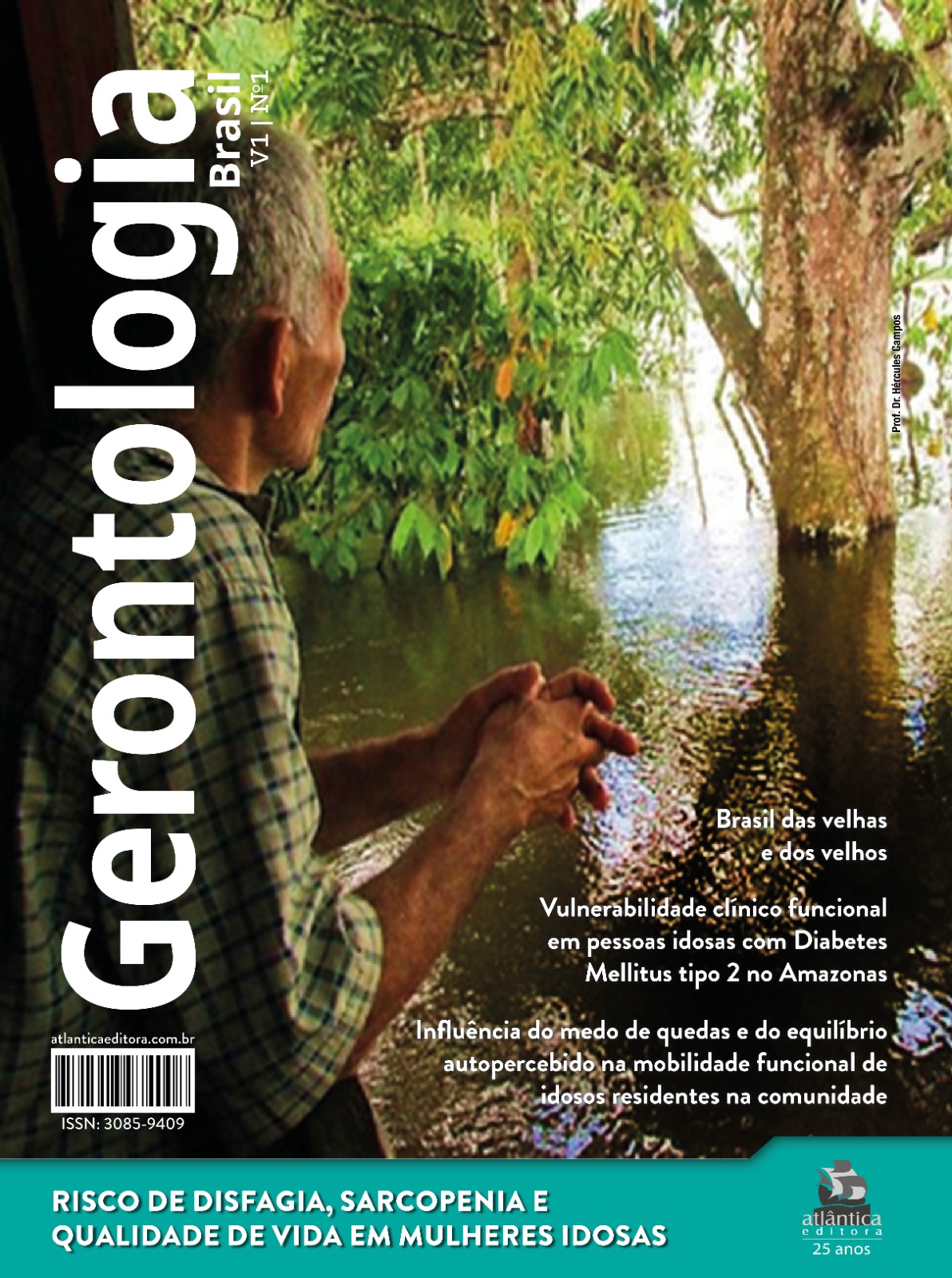
Influence of fear of falls and self-perceived balance on functional mobility of community-dwelling older adults
DOI:
https://doi.org/10.62827/gb.v1i1.0004Keywords:
Physical Functional Performance; Walking Speed; Functional Status; Self Concept; Mental Health.Abstract
Introduction: Falls and fear of falling (FOF) have considerable consequences for older adults' health, causing physical and psychological limitations that affect daily activities. Self-perception of balance, although little investigated, may interfere with older adults' motivation and confidence in moving around, impacting their functional independence. Objective: To investigate the association between FOF and self-perceived balance, as well as the influence of these variables on functional mobility. Methods: A total of 152 independent community-dwelling older adults aged 60 to 84 years participated. Participants were assessed for self-perception of balance and FOF, and performed clinical tests: single-leg stance (SLS), Timed Up and Go (TUG), Five Times Sit to Stand (5TSS), and gait speed (GS). Binary logistic regression analyzed the association between FOF and balance self-perception. Multiple linear regression was used to evaluate the association of FOF and balance perception with clinical test performance. Results: FOF was positively associated with TUG (p = 0.013) and negatively with GS (p = 0.004). Balance self-perception was positively associated with SLS (p = 0.001) and GS (p = 0.038), and negatively with TUG (p = 0.004). Conclusion: Both FOF and negative balance self-perception negatively affect functional mobility. However, balance self-perception showed a broader influence on functional test performance, while FOF was only associated with tasks involving changes in the base of support.
References
Silva A, Dal Prá KR. Envelhecimento populacional no Brasil: o lugar das famílias na proteção aos idosos. Argumentum 2014;6:99–115.
Santos JF dos, Sousa RM de A, Moreira AA da S, Andrade SR de S, Borges LC de C, Queiroz NCA, et al. Avaliação Do Equilíbrio E Risco De Queda Em Idosos Institucionalizados 2019;02:37–43.
Vitorino LM, Araujo C, Teixeira B, Laís E, Boas V, Pereira RL, et al. Medo de cair em idosos residentes no domicílio: fatores associados. Revista Da Escola de Enfermagem Da USP 2017;51:1–7. https://doi.org/10.1590/S1980-220X2016011803215.
Karuka AH, Silva JAMG, Navega MT. Análise da concordância entre instrumentos de avaliação do equilíbrio corporal em idosos Analysis of agreement of assessment tools of body balance in the elderly. Rev Bras Fisioter 2011;15:460–6.
Lavedán A, Viladrosa M, Jürschik P, Botigué T, Nuín C, Masot O, et al. Fear of falling in community-dwelling older adults: A cause of falls, a consequence, or both? PLoS ONE 2018;13:1–14. https://doi.org/10.1371/journal.pone.0194967.
Scheffer AC, Schuurmans MJ, Van dijk N, Van der hooft T, De rooij SE. Fear of falling: Measurement strategy, prevalence, risk factors and consequences among older persons. Age and Ageing 2008;37:19–24. https://doi.org/10.1093/ageing/afm169.
Liu JYW. Fear of falling in robust community-dwelling older people: Results of a cross-sectional study. Journal of Clinical Nursing 2015;24:393–405. https://doi.org/10.1111/jocn.12613.
Trombetti A, Reid KF, Hars M, Herrmann FR, Pasha E, Phillips EM, et al. Age-associated declines in muscle mass, strength, power, and physical performance: impact on fear of falling and quality of life. Osteoporosis International 2016;27:463–71. https://doi.org/10.1007/s00198-015-3236-5.
Reelick MF, van Iersel MB, Kessels RPC, Olde Rikkert MGM. The influence of fear of falling on gait and balance in older people. Age and Ageing 2009;38:435–40. https://doi.org/10.1093/ageing/afp066.
Denkinger MD, Lukas A, Nikolaus T, Hauer K. Factors associated with fear of falling and associated activity restriction in community-dwelling older adults: A systematic review. American Journal of Geriatric Psychiatry 2015;23:72–86. https://doi.org/10.1016/j.jagp.2014.03.002.
Moore DS, Ellis R. Measurement of fall-related psychological constructs among independent-living older adults: A review of the research literature. Aging and Mental Health 2008;12:684–99. https://doi.org/10.1080/13607860802148855.
Marques AP, Mendes YC, Taddei U, Pereira CAB, Assumpção A. Brazilian-Portuguese translation and cross cultural adaptation of the activities-specific balance confidence (ABC) scale. Brazilian Journal of Physical Therapy 2013;17:170–7. https://doi.org/10.1590/S1413-35552012005000072.
Camargos FFO, Dias RC, Dias JMD, Freire MTF. Adaptação transcultural e avaliação das propriedades psicométricas da Falls Efficacy Scale - International em idosos brasileiros (FES-I-BRASIL). Revista Brasileira de Fisioterapia 2010;14:237–43. https://doi.org/10.1590/S1413-35552010000300010.
Bocarde L, Porto JM, Freire Júnior RC, Fernandes JA, Nakaishi APM, Abreu DCC de. Medo de quedas e força muscular do quadril em idosos independentes da comunidade. Fisioterapia e Pesquisa 2019;26:298–303. https://doi.org/10.1590/1809-2950/18034526032019.
Porto JM, Iosimuta NCR, Freire RC, de Matos Brunelli Braghin R, Leitner É, Freitas LG, et al. Risk factors for future falls among community-dwelling older adults without a fall in the previous year: A prospective one-year longitudinal study. Archives of Gerontology and Geriatrics 2020:104161. https://doi.org/10.1016/j.archger.2020.104161.
Schoene D, Heller C, Aung YN, Sieber CC, Kemmler W, Freiberger E. A systematic review on the influence of fear of falling on quality of life in older people: Is there a role for falls? Clinical Interventions in Aging 2019;14:701–19. https://doi.org/10.2147/CIA.S197857.
Apolinario D, Lichtenthaler DG, Magaldi RM, Soares AT, Busse AL, Das Gracas Amaral JR, et al. Using temporal orientation, category fluency, and word recall for detecting cognitive impairment: The 10-point cognitive screener (10-CS). International Journal of Geriatric Psychiatry 2016;31:4–12. https://doi.org/10.1002/gps.4282.
Feng Y, Schlösser FJ, Sumpio BE. The Semmes Weinstein monofilament examination as a screening tool for diabetic peripheral neuropathy. Journal of Vascular Surgery 2009;50:675-682.e1. https://doi.org/10.1016/j.jvs.2009.05.017.
Matsudo S, Araújo T, Matsudo VR, Andrade D, Andrade E, Oliveira LC, et al. Questionário Internacional de Atividade Física (Ipaq): Estudo de Validade e Reprodutividade no Brasil. Revista Brasileira de Atividade Física e Saúde 2001;6:5–18.
Shumway-Cook A, Woollacott M. Controle motor: Teoria e aplicações práticas. 3rd ed. Manole; 2010.
Gray J. A Psicologia do Medo e do Stress. Rio de Janeiro: 1976.
Goldberg A, Casby A, Wasielewski M. Minimum detectable change for single-leg-stance-time in older adults. Gait and Posture 2011;33:737–9. https://doi.org/10.1016/j.gaitpost.2011.02.020.
Pinheiro PA, Carneiro JAO, Coqueiro RS, Pereira R, Fernandes MH. “Chair stand testˮ as simple tool for sarcopenia screening in elderly women. Journal of Nutrition, Health and Aging 2016;20:56–9. https://doi.org/10.1007/s12603-016-0676-3.
Bohannon RW. Measurement of sit-to-stand among older adults. Topics in Geriatric Rehabilitation 2012;28:11–6. https://doi.org/10.1097/TGR.0b013e31823415fa.
Alexandre TS, Meira DM, Rico NC, Mizuta SK. Accuracy of Timed Up and Go Test for screening risk of falls among community-dwelling elderly. Brazilian Journal of Physical Therapy 2012;16:381–8. https://doi.org/10.1590/s1413-35552012005000041.
Magnani PE, Porto JM, Genovez MB, Zanellato NFG, Alvarenga IC, dos Santos PF, et al. What is the best clinical assessment tool for identification of adults aged ≥80 years at high risk of falls? Physiotherapy (United Kingdom) 2020:1–7. https://doi.org/10.1016/j.physio.2020.03.002.
Peters DM, Fritz SL, Krotish DE. Assessing the reliability and validity of a shorter walk test compared with the 10-Meter Walk Test for measurements of gait speed in healthy, older adults. Journal of Geriatric Physical Therapy 2013;36:24–30. https://doi.org/10.1519/JPT.0b013e318248e20d.
Liu TW, Ng GYF, Chung RCK, Ng SSM. Cognitive behavioural therapy for fear of falling and balance among older people: A systematic review and meta-analysis. Age and Ageing 2018;47:520–7. https://doi.org/10.1093/ageing/afy010.
Sun JK, Smith J. Self-perceptions of aging and perceived barriers to care: Reasons for health care delay. Gerontologist 2017;57:S216–26. https://doi.org/10.1093/geront/gnx014.
Zhang B, Lin Y, Gao Q, Zawisza M, Kang Q, Chen X. Effects of aging stereotype threat on working self-concepts: An event-related potentials approach. Frontiers in Aging Neuroscience 2017;9:1–14. https://doi.org/10.3389/fnagi.2017.00223.
Lopes KJ, Costa DF, Santos LF, Castro DP, Bastone AC. Prevalence of fear of falling among a population of older adults and its correlation with mobility, dynamic balance, risk and history of falls. Revista Brasileira de Fisioterapia 2009;13:223–9. https://doi.org/10.1590/S1413-35552009005000026.
Brustio PR, Magistro D, Zecca M, Liubicich ME, Rabaglietti E. Fear of falling and activities of daily living function: mediation effect of dual-task ability. Aging and Mental Health 2018;22:856–61. https://doi.org/10.1080/13607863.2017.1318257.
Chamberlin ME, Fulwider BD, Sanders SL, Medeiros JM. Does fear of falling influence spatial and temporal gait parameters in elderly persons beyond changes associated with normal aging? Journals of Gerontology - Series A Biological Sciences and Medical Sciences 2005;60:1163–7. https://doi.org/10.1093/gerona/60.9.1163.
Kumar A, Carpenter H, Morris R, Iliffe S, Kendrick D. Which factors are associated with fear of falling in community-dwelling older people? Age Ageing 2014;43:76–84. https://doi.org/10.1093/ageing/aft154.
Hadjistavropoulos T, Delbaere K, Fitzgerald TD. Reconceptualizing the role of fear of falling and balance confidence in fall risk. Journal of Aging and Health 2011;23:3–23. https://doi.org/10.1177/0898264310378039.
Uemura K, Yamada M, Nagai K, Tanaka B, Mori S, Ichihashi N. Fear of falling is associated with prolonged anticipatory postural adjustment during gait initiation under dual-task conditions in older adults. Gait and Posture 2012;35:282–6. https://doi.org/10.1016/j.gaitpost.2011.09.100.
Kirkwood RN, Araújo PA, Dias CS. Biomecânica da marcha em idosos caidores e não caidores: uma revisão da literatura. Rev Bras Ciênc Mov 2006;14:103–10. https://doi.org/10.18511/rbcm.v14i4.722.
Choi K, Jeon GS, Cho S Il. Prospective study on the impact of fear of falling on functional decline among community dwelling elderly women. International Journal of Environmental Research and Public Health 2017;14. https://doi.org/10.3390/ijerph14050469.
Donoghue OA, Cronin H, Savva GM, O’Regan C, Kenny RA. Effects of fear of falling and activity restriction on normal and dual task walking in community dwelling older adults. Gait and Posture 2013;38:120–4. https://doi.org/10.1016/j.gaitpost.2012.10.023.
Downloads
Published
Issue
Section
License
Copyright (c) 2025 Anne Caroline Lima Bandeira, Jaqueline Mello Porto, Renato Campos Freire Júnior, Daniela Cristina Carvalho de Abreu (Autor)

This work is licensed under a Creative Commons Attribution 4.0 International License.
Autores que publicam nesta revista concordam com os seguintes termos:
Autores mantém os direitos autorais e concedem à revista o direito de primeira publicação, com o trabalho simultaneamente licenciado sob a Licença Creative Commons Attribution 4.0 que permite o compartilhamento do trabalho com reconhecimento da autoria e publicação inicial nesta revista.
Autores têm autorização para distribuição não-exclusiva da versão do trabalho publicada nesta revista (ex.: publicar em repositório institucional ou como capítulo de livro), com reconhecimento de autoria e publicação inicial nesta revista.