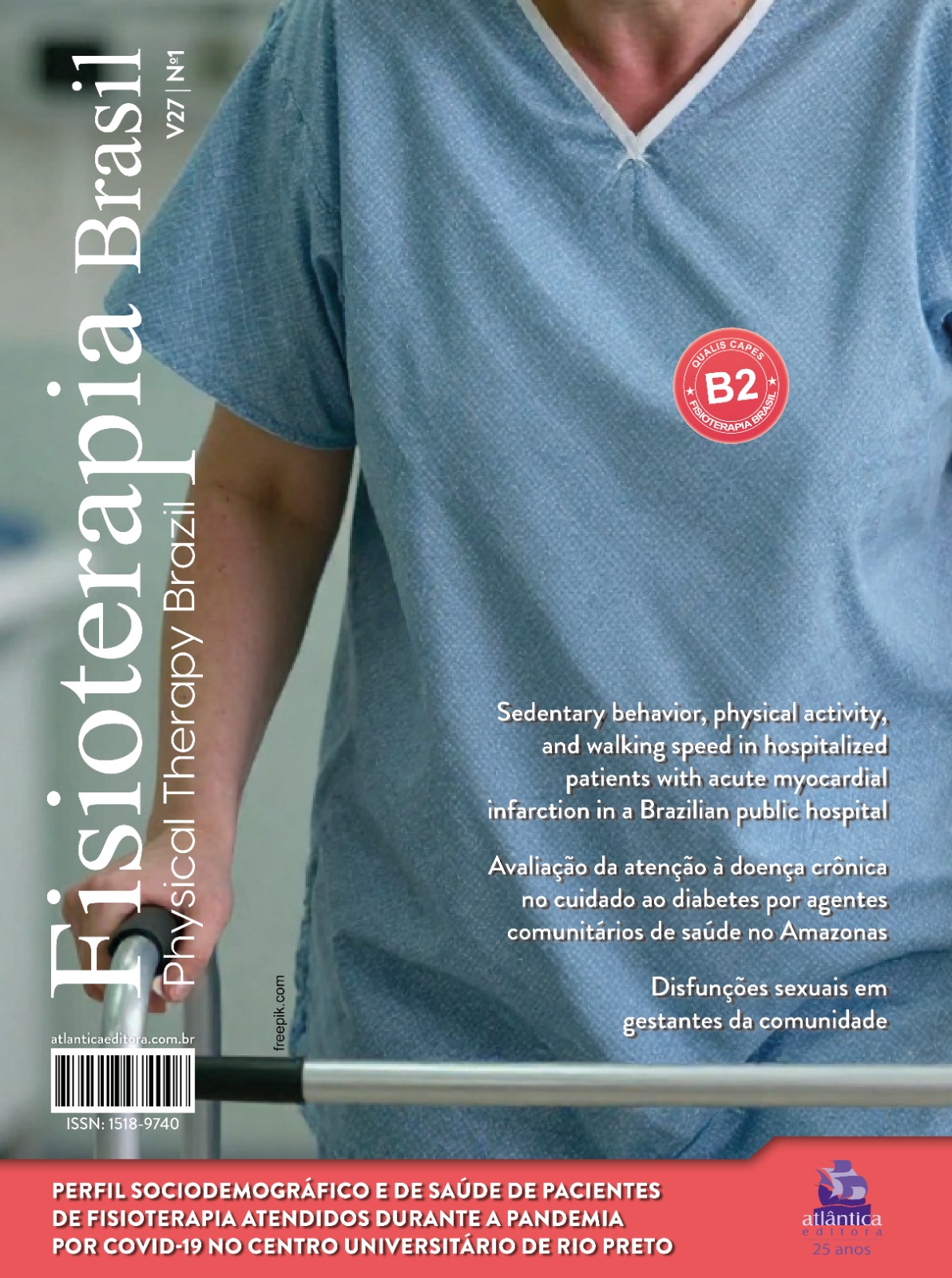
Sedentary behavior, physical activity, and walking speed in hospitalized patients with acute myocardial infarction in a Brazilian public hospital
DOI:
https://doi.org/10.62827/fb.v27i1.1111Palabras clave:
Exercise; Sedentary Behavior; Myocardial Infarction; Intensive Care Units; Walking Speed.Resumen
Introduction: The benefits of physical activity for cardiovascular disease prevention are well evidenced in the literature, however a high percentage of individuals in adulthood do not perform the physical activity levels recommended by World Health Organization. Objective: This study aimed to assess the previous physical activity levels and sedentary behavior in stable patients admitted to the ICU with a diagnosis of acute myocardial infarction. Methods: This cross-sectional study was conducted in the cardiological ICU of a high-complexity hospital. Sedentary behavior and physical activity were assessed using Sedentary Behavior Questionnaire (SBQ) and the International Physical Activity Questionnaire (IPAQ). The Walking Speed Test (WST) was used to assess functional capacity. Results: A high percentage of participants (45%) did not meet the physical activity recommendations. Dyslipidemia was the only risk factor associated with physical activity (p=0.025). The mean time of sedentary behavioir was 37.24 h/w (CI95% 31.17; 43.17) assessed by IPAC, and 52.17 h/w (CI95% 42.93; 61.41) assessed by SBQ. There was a positive correlation between sedentary behavior assessed by SBQ and IPAC (rs = 0.39; p = 0.01). The WST mean was 1.38 ± 0.36 m/s. Conclusion: A high proportion of patients did not meet the recommendations for physical activity before acute myocardial infarction. Physical activity had an association with dyslipidemia. Sedentary behavior accessed by IPAC and by SBQ had a positive correlation. SWT was safe, easy to apply in ICU, and suitable for this population.
Referencias
WORLD HEALTH ORGANIZATION (WHO). The top 10 causes of death, 2020. Available from: https://www.who.int/news-room/fact-sheets/detail/the-top-10-causes-of-death. Accessed on February 09, 2022.
GBD 2019 Diseases and Injuries Collaborators. Global burden of 369 diseases and injuries in 204 countries and territories, 1990-2019: a systematic analysis for the Global Burden of Disease Study 2019. Lancet [Internet]. 2020 Oct;396(10258):1204-1222. Available from: https://www.thelancet.com/journals/lancet/article/PIIS0140-6736(20)30925-9/fulltext. doi:10.1016/S0140-6736(20)30925-9
Précoma DB, Oliveira GMM, Simão AF, Dutra OP, Coelho OR, Izar MCO, et al. Atualização da Diretriz de Prevenção Cardiovascular da Sociedade Brasileira de Cardiologia – 2019. Arq Bras Cardiol [Internet]. 2019;113(4):787-891. Available from: http://publicacoes.cardiol.br/portal/abc/portugues/aop/2019/aop-diretriz-prevencao-cardiovascular-portugues.pdf. doi:0.5935/abc.20190204
WHO. WHO 2020 guidelines on physical activity and sedentary behaviour. World Health Organization, Geneva 2020. Available in: https://apps.who.int/iris/bitstream/handle/10665/336656/9789240015128-eng.pdf . Accessed on April 20, 2023.
Matthews CE, Carlson SA, Saint-Maurice PF, Patel S, Salerno EA, Loftfield E, Troiano RP, Fulton JE, Sampson JN, Tribby C, Keadle SK, Berrigan D. Sedentary Behavior in U.S. Adults: Fall 2019. Med Sci Sports Exerc [Internet]. 2021;53(12):2512-2519. Available from: https://journals.lww.com/acsm-msse/fulltext/2021/12000/sedentary_behavior_in_u_s__adults__fall_2019.6.aspx doi: 10.1249/MSS.0000000000002751.
Matsudo S, Araújo T, Marsudo V. Questinário internacional de atividade física (IPAQ): estudo de validade e reprodutibilidade no Brasil. Rev. Bras. Ativ. Fís. Saúde [Internet]. 2001;6(2)05-18. Available from: https://rbafs.org.br/rbafs/article/view/93. doi:10.12820/rbafs.v.6n2p5-18.
Guthold R, Stevens GA, Riley LM, Bull FC. Worldwide trends in insufficient physical activity from 2001 to 2016: a pooled analysis of 358 population-based surveys with 1· 9 million participants. The lancet global health [Internet]. 2018 Oct;6(10):e1077-e1086. Available from: https://www.thelancet.com/journals/langlo/article/PIIS2214-109X(18)30357-7/fulltext doi:10.1016/S2214-109X(18)30357-7
Hamilton MT, Hamilton DG, Zderic TW. Role of low energy expenditure and sitting in obesity, metabolic syndrome, type 2 diabetes, and cardiovascular disease. Diabetes [Internet]. 2007;56(11):2655-2667. Available from: https://diabetesjournals.org/diabetes/article-abstract/56/11/2655/13643/Role-of-Low-Energy-Expenditure-and-Sitting-in?redirectedFrom=fulltext doi:10.2337/db07-0882
Lazaros G, Oikonomou E, Vogiatzi G, et al. The impact of sedentary behavior patterns on carotid atherosclerotic burden: implications from the Corinthia epidemiological study. Atherosclerosis [Internet]. 2019 Mar;282:154-161. Available from: https://www.atherosclerosis-journal.com/article/S0021-9150(19)30039-5/abstract doi:10.1016/j.atherosclerosis.2019.01.026
Howard BJ, Fraser SF, Sethi P, et al. Impact on hemostatic parameters of interrupting sitting with intermittent activity. Med Sci Sports Exercise [Internet]. 2013;45(7):1285-1291.Available from: https://journals.lww.com/acsm-msse/fulltext/2013/07000/impact_on_hemostatic_parameters_of_interrupting.9.aspx doi: 10.1249/mss.0b013e318285f57e.
Katzmarzyk PT, Powell KE, Jakicic JM, Troiano RP, Piercy K, Tennant B. Physical Activity Guidelines Advisory Committee (2019). Sedentary behavior and health: update from the 2018 Physical Activity Guidelines Advisory Committee. Med Sci Sports Exercise [Internet]. 2019 June;51(6):1227. Available from: https://journals.lww.com/acsm-msse/fulltext/2019/06000/sedentary_behavior_and_health__update_from_the.18.aspx. doi:10.1249/MSS.0000000000001935.
Petersen CB, Bauman A, Gronbaek M, et al. Total sitting time and risk of myocardial infarction, coronary heart disease and all-cause mortality in a prospective cohort of Danish adults. Int J Behav Nutr Phys Act [Internet]. 2014;11(1):1-11. Available from: https://ijbnpa.biomedcentral.com/articles/10.1186/1479-5868-11-13. Doi:10.1186/1479-5868-11-13
Healy GN, Dunstan DW, Salmon J, Shaw JE, Zimmet PZ, Owen N. Television time and continuous metabolic risk in physically active adults. Med Sci Sports Exerc [Internet]. 2008 Apr; 40:639–645. Available from: https://journals.lww.com/acsm-msse/fulltext/2008/04000/television_time_and_continuous_metabolic_risk_in.8.aspx. doi:10.1249/MSS.0b013e3181607421
Hamilton M, Healy G, Dunstan D, Zderic T, Owen N. Too little exercise and too much sitting: inactivity physiology and the need for new recommendations on sedentary behavior. Curr Cardiovasc Rep [Internet]. 2008 Oct;2:292–298. Avalilable from: https://link.springer.com/article/10.1007/s12170-008-0054-8. doi:10.1007/s12170-008-0054-8.
Fuentes-Abolafio IJ, Stubbs B, Pérez-Belmonte LM, Bernal-López MR, Gómez-Huelgas R, Cuesta-Vargas AI. Physical functional performance and prognosis in patients with heart failure: a systematic review and meta-analysis. BMC Cardiovasc Disord [Internet]. 2020 Dec;20(1):512. Available from: https://bmccardiovascdisord.biomedcentral.com/articles/10.1186/s12872-020-01725-5. doi:10.1186/s12872-020-01725-5
Costa TY, Cristaldo MRA, Marin FA, Spexoto MCB. Nutrition impact symptoms, sarcopenia, and malnutrition in hospitalized patients. ABCS Health Sciences [Internet]. 2022;48: e023206. Available from: https://www.portalnepas.org.br/abcshs/article/view/2124. doi:10.7322/abcshs.2021079.2124
Martinez BP, Batista AKMS, Ramos IR, et al. Viability of gait speed test in hospitalized elderly patients. J Bras Pneumologia [Internet]. 2016;42(3):196-202. Available from: https://www.scielo.br/j/jbpneu/a/bb3sxpYjQKKNXXtcr3tZCTF/?format=html&lang=en. doi:10.1590/s1806-37562015000000058
Arjunan A, Peel NM, Hubbard R. Gait speed and frailty status in relation to adverse outcomes in geriatric rehabilitation. Arch Phys Med Rehabilitation [Internet]. 2019;100(5):859-864. Available from: https://www.archives-pmr.org/article/S0003-9993(18)31370-4. doi:10.1016/j.apmr.2018.08.187.
Fritz S, Lusardi M. White paper: “walking speed: the sixth vital sign”. J Geriatric Physical Therapy [Internet]. 2009;32(2):2-5. Available from: https://pubmed.ncbi.nlm.nih.gov/20039582/
Middleton A, Fritz SL, Lusardi M. Walking speed: the functional vital sign. J Aging Physical Activity [Internet]. 2015;23(2);314-322. Available from: Walking speed: the functional vital sign doi:10.1123/japa.2013-0236.
Thygesen K, Alpert JS, Jaffe AS, et al. Fourth universal definition of myocardial infarction (2018). Eur Heart J [Internet]. 2019;40(3):237-269. Available from: doi:10.1093/eurheartj/ehy462
Benedetti TRB, Antunes PDC, Rodriguez-Añez CR, Mazo G Z, Petroski ÉL. Reprodutibilidade e validade do Questionário Internacional de Atividade Física (IPAQ) em homens idosos. Rev Bras Med Esporte [Internet]. 2007;13(1):11-16. Available from: https://www.scielo.br/j/rbme/a/qMfYbx6NVfKKFyKZLSnBJgH/?lang=pt. doi:10.1590/S1517-86922007000100004
Rosenberg DE, Norman GJ, Wagner N, Patrick K, Calfas KJ, Sallis JF. Reliability and validity of the Sedentary Behavior Questionnaire (SBQ) for adults. J Physical Activity Health [Internet]. 2010;7(6):697-705. Available from: https://journals.humankinetics.com/view/journals/jpah/7/6/article-p697.xml. doi:10.1123/jpah.7.6.697
Carvalho LA. In: Adaptação e validação do sedentary behavior questionnaire for adults para o português brasileiro [database online]. Ceará: Universidade Estadual do Ceará; 2017. Available from: http://siduece.uece.br/siduece/trabalhoAcademicoPublico.jsf?id=85733. Updated February 8, 2021. Accessed february 24, 2021
Dodson J A, Arnold S V, Gosch K L, et al. Slow gait speed and risk of mortality or hospital readmission after myocardial infarction in the translational research investigating underlying disparities in recovery from acute myocardial infarction: patients' health status registry. Journal of the American Geriatrics Society [Internet]. 2016;64(3):596-601. Available from: https://agsjournals.onlinelibrary.wiley.com/doi/abs/10.1111/jgs.14016?casa_token=vupowhszDNcAAAAA%3A-2NGIYd6ZOM_eYQz9z8uENCuyLjXojWVfz1sELdv-eIz8MfgbR9CTRth-pSc-TP-03SD31_PhgTNk5-Vhg . doi:10.1111/jgs.14016
Jorge JDG, Santos MAA, Barreto Filho JAS, et al. Level of physical activity and in-hospital course of patients with acute coronary syndrome. Arq Bras Cardiologia [Internet]. 2015;106(1):33-40. Available from: https://www.scielo.br/j/abc/a/tcbs7J4fWPPbq5YRBjZMJYP/?format=html&lang=en. doi:10.5935/abc.20160006.
Pitsavos C, Kavouras SA, Panagiotakos DB, et al. Physical activity status and acute coronary syndromes survival: the GREECS (Greek Study of Acute Coronary Syndromes) study. J Am College Cardiology [Internet]. 2008;51(21):2034–2039. Available from: https://www.jacc.org/doi/abs/10.1016/j.jacc.2008.01.053. doi:10.1016/j.jacc.2008.01.053.
Matthias AT, de Silva D K N, Indrakumar J, Gunatilake S B. Physical activity levels of patients prior to acute coronary syndrome–Experience at a tertiary care hospital in Sri Lanka. Indian Heart Journal [Internet]. 2018;70(3):350-352. Available from: https://www.sciencedirect.com/science/article/pii/S0019483216309415. doi:10.1016/j.ihj.2017.08.020.
Winzer EB, Woitek F, Linke A. Physical activity in the prevention and treatment of coronary artery disease. J Am Heart Association [Internet]. 2018;7(4):e007725. Available from: https://www.ahajournals.org/doi/full/10.1161/JAHA.117.007725. doi:10.1161/JAHA.117.007725.
Tanasescu M, Leitzmann MF, Rimm EB, Willett WC, Stampfer MJ, Hu FB. Exercise type and intensity in relation to coronary heart disease in men. JAMA [Internet]. 2002;288(16):1994 –2000. Available from: https://jamanetwork.com/journals/jama/fullarticle/195439. doi:10.1001/jama.288.16.1994.
Sesso HD, Paffenbarger RS Jr., Lee IM. Physical activity and coronary heart disease in men: the Harvard Alumni Health Study. Circulation [Internet]. 2000;102:975-80. Available from: https://www.ahajournals.org/doi/full/10.1161/01.CIR.102.9.975. doi:10.1161/01.CIR.102.9.975.
Yusuf S, Hawken S, Ounpuu S, et al. Effect of potentially modifiable risk factors associated with myocardial infarction in 52 countries (the INTERHEART study): case-control study. Lancet [Internet]. 2004 Sept;364(9438):937-952. Available from: https://www.thelancet.com/journals/lancet/article/PIIS0140-6736(04)17018-9/abstract?pubType=related. doi:10.1016/S0140-6736(04)17018-9
Iborra RT, Ribeiro IC, Neves MQ, Charf AM, Lottenberg SA, Negrão CE, et al. Aerobic exercise training improves the role of high-density lipoprotein antioxidant and reduces plasma lipid peroxidation in type 2 diabetes mellitus. Scand J Med Sci Sports [Internet]. 2008;18(6):742-50. Available from: https://onlinelibrary.wiley.com/doi/abs/10.1111/j.1600-0838.2007.00748.x?casa_token=qtpIObCS_0QAAAAA:ncbgGDF8S7JD5t5RLdyemCqecANNrZaNKdUQJJeaH27VR5A3Q9a7rgkW1-xaBIWoHZONWip_JjUHIPQLJg. doi:10.1111/j.1600-0838.2007.00748.x.
Krüger K, Tirekoglou P, Weyh C. Immunological mechanisms of exercise therapy in dyslipidemia. Front Physiol [Internet]. 2022 Aug 8;13:903713. Available from: https://www.frontiersin.org/journals/physiology/articles/10.3389/fphys.2022.903713/full. doi:10.3389/fphys.2022.903713.
Kehler DS, Stammers AN, Horne D, et al. Impact of preoperative physical activity and depressive symptoms on post-cardiac surgical outcomes. Plos One [Internet]. 2019;14(2):e0213324. Available from: https://journals.plos.org/plosone/article?id=10.1371/journal.pone.0213324. doi:10.1371/journal.pone.0213324
Bakker EA, Hopman MT, Lee DC, et al. Correlates of Total and domain-specific Sedentary behavior: a cross-sectional study in Dutch adults. BMC Public Health [Internet]. 2020;20(1):1-10. Available from: https://link.springer.com/article/10.1186/s12889-020-8316-6. doi:10.1186/s12889-020-8212-0
McLaughlin M, Atkin AJ, Starr L. Worldwide surveillance of self-reported sitting time: a scoping review. Int J Behavioral Nutr Physical Activity [Internet]. 2020; 17(1):1-12. Available from: https://link.springer.com/article/10.1186/s12966-020-01008-4. doi:10.1186/s12966-020-01008-4
Santos DA, Silva AM, Baptista F, et al. Sedentary behavior and physical activity are independently related to functional fitness in older adults. Experimental Gerontology [Internet]. 2012;47(12):908-912. Available from: https://www.sciencedirect.com/science/article/pii/S053155651200201X?casa_token=aFjqxYdEgjgAAAAA:Ps5JGElAnU_mXzOXK6r_D3neutiwb6CeuXoLtMn_SJzwd_2M0c0TQYNGGbZsP006B5X-IpYasxYm.
Lau JH, Lee E S, Zhang Y, Zhang Y, Vaingankar JA, et al. Association Between Self-Reported Sedentary Behavior and Health-Related Quality of Life Among Multimorbidity Patients in Singapore. Am J Health Promotion [Internet]. 2021; 35(7):929-938. Available from: https://journals.sagepub.com/doi/epub/10.1177/08901171211001274. Doi:1177/08901171211001274
Rosenberg, DE, Bull FC, Marchall AL, Sallis JF, Bauman AE. Assessment of sedentary behavior with the International Physical Activity Questionnaire. J Physical Activity Health [Internet]. 2008;5(1):S30-S44. Available from: https://journals.humankinetics.com/view/journals/jpah/5/s1/article-pS30.xml. doi:10.1123/jpah.5.s1.s30.
Sato A, Kamiya K, Hamazaki N, Nozaki K, Ichikawa T, Yamashita M, Ako J. Gait speed and 6-minute walking distance are useful for identifying difficulties in activities of daily living in patients with cardiovascular disease. Heart & Lung [Internet]. 2022;51:46-51. Available from: https://www.sciencedirect.com/science/article/pii/S0147956321002466?casa_token=YkJUMk-Q5MoAAAAA:4coKpqK-FaAXUPelhsMqK26M6PX4Cq6Rofn6eIETczg6_TKVVuKaN_fST_gmmHWQzPcFivzTpYWd. doi:10.1016/j.hrtlng.2021.09.002
Gray EA, Skinner MA, Hale LA, Bunton RW. Preparation and support for physical activity following hospital discharge after coronary artery bypass graft surgery: A survey of current practice in New Zealand. Physiotherapy Research International [Internet]. 2022; 27(2): e1940. Available from: https://onlinelibrary.wiley.com/doi/abs/10.1002/pri.1940?casa_token=N61wtyjzdxUAAAAA:m9QXLxt_wtKNnmEjMz3nSDyjHhhNoVx6rCXNJywNuzDgej4L8rRF_rpfwLgK0x17c4xHDltL-IrFhttzHA. doi:10.1002/pri.1940
Descargas
Publicado
Número
Sección
Licencia
Derechos de autor 2026 Daniele Loss Gambet França, Patrícia Nóbrega Oliva, Flávia Marini Paro , Grace Anne Santos Silva, Raiany Franca Guimarães, Marcela Cangussu Barbalho-Moulim (Autor)

Esta obra está bajo una licencia internacional Creative Commons Atribución 4.0.
Autores que publicam nesta revista concordam com os seguintes termos:
Autores mantém os direitos autorais e concedem à revista o direito de primeira publicação, com o trabalho simultaneamente licenciado sob a Licença Creative Commons Attribution 4.0 que permite o compartilhamento do trabalho com reconhecimento da autoria e publicação inicial nesta revista.
Autores têm autorização para distribuição não-exclusiva da versão do trabalho publicada nesta revista (ex.: publicar em repositório institucional ou como capítulo de livro), com reconhecimento de autoria e publicação inicial nesta revista.