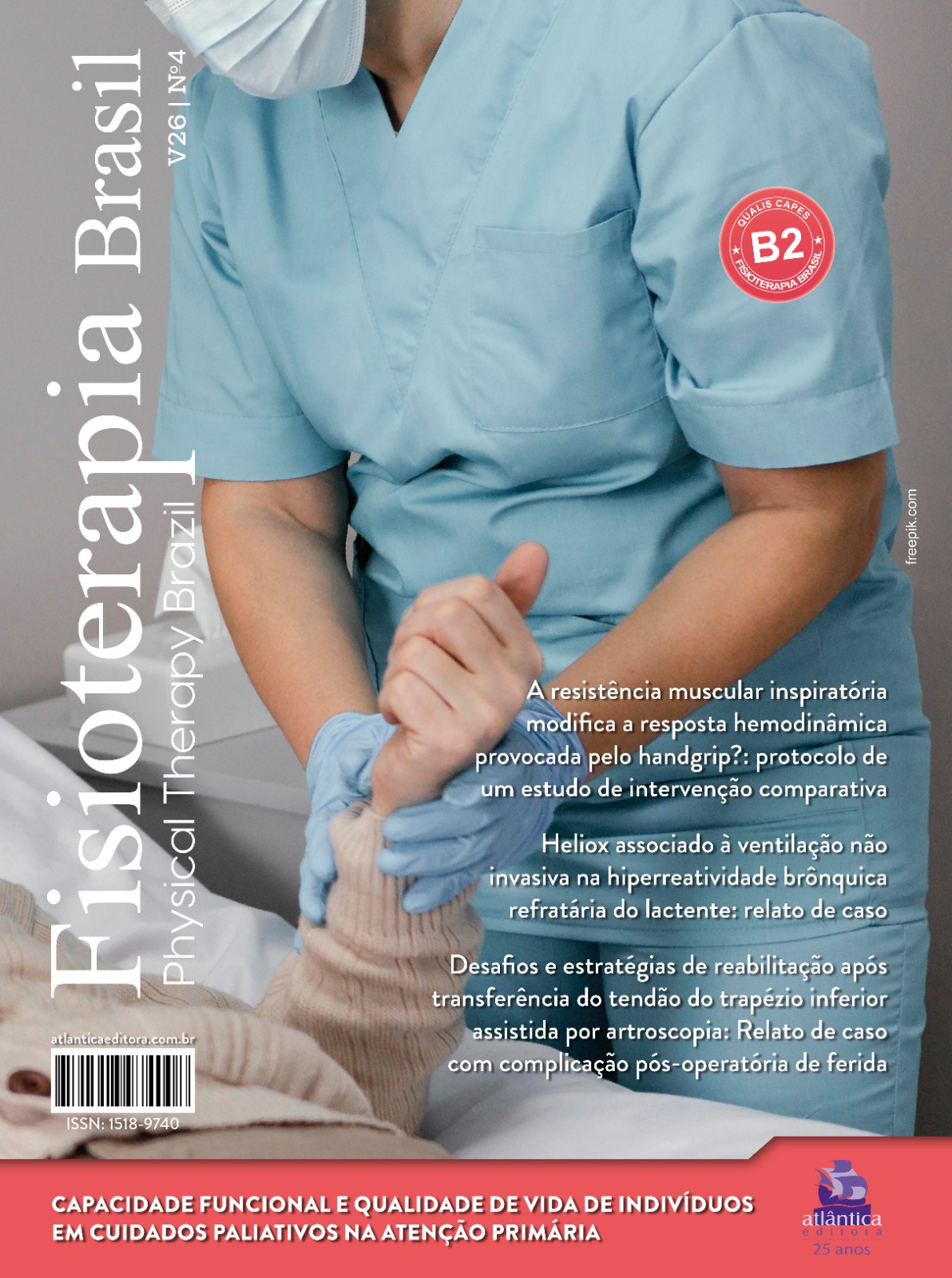
Desafios e estratégias de reabilitação após transferência do tendão do trapézio inferior assistida por artroscopia: Relato de caso com complicação pós-operatória de ferida
DOI:
https://doi.org/10.62827/fb.v26i4.1070Palabras clave:
Manguito Rotador; Transferência Tendinosa; Relatos de Casos.Resumen
Introdução: Lesões maciças e irreparáveis do manguito rotador em pacientes jovens representam um desafio clínico. A transferência do tendão do trapézio inferior (LTT) tem sido proposta como alternativa à artroplastia reversa, mas há escassez de dados sobre protocolos de reabilitação associados, especialmente diante de complicações pós-operatórias. Objetivo: Relatou-se a evolução clínica e os desafios da reabilitação fisioterapêutica após LTT assistida por artroscopia, com complicação de ferida operatória. Métodos: Este foi um estudo retrospectivo, que seguiu as diretrizes do CAse REports guideline (CARE) para descrição de relatos de caso, de um paciente de 51 anos com lesão irreparável do manguito rotador, submetido à LTT com aloenxerto do tendão calcâneo. O protocolo de reabilitação foi estruturado em três fases e adaptado conforme a evolução da cicatrização e função. Avaliações objetivas incluíram dinamometria isocinética. Resultados: Houve deiscência superficial da ferida entre a 8ª e a 10ª semanas, que atrasou a introdução de alguns exercícios. Ainda assim, o paciente atingiu amplitude de movimento total sem dor e melhora funcional parcial. A dinamometria revelou déficits de força de 66% em rotação externa e 28% em abdução, exigindo acompanhamento prolongado. A recuperação foi estimada em 75% pelo próprio paciente após seis meses e 38 sessões de fisioterapia. Conclusão: Mesmo diante de complicações, a LTT pode proporcionar melhora funcional significativa quando acompanhada de um programa de reabilitação individualizado. O manejo das expectativas e o acompanhamento em longo prazo são essenciais para o sucesso terapêutico.
Referencias
Kovacevic D, Suriani RJ Jr, Grawe BM, Yian EH, Gilotra MN, Hasan SA, et al. Management of irreparable massive rotator cuff tears: a systematic review and meta-analysis of patient-reported outcomes, reoperation rates, and treatment response. J Shoulder Elbow Surg. 2020 Dec;29(12):2459–75. doi:10.1016/j.jse.2020.07.030
Kucirek NK, Hung NJ, Wong SE. Treatment options for massive irreparable rotator cuff tears. Curr Rev Musculoskelet Med. 2021 Oct;14(5):304–15. doi:10.1007/s12178-021-09714-7
Elhassan BT, Wagner ER, Werthel JD. Outcome of lower trapezius transfer to reconstruct massive irreparable posterior-superior rotator cuff tear. J Shoulder Elbow Surg. 2016 Aug;25(8):1346–53. doi:10.1016/j.jse.2015.12.006
Elhassan BT, Alentorn-Geli E, Assenmacher AT, Wagner ER. Arthroscopic-assisted lower trapezius tendon transfer for massive irreparable posterior-superior rotator cuff tears: surgical technique. Arthrosc Tech. 2016 Aug 29;5(5):e981–8. doi:10.1016/j.eats.2016.04.025
Elhassan B, Bishop A, Shin A. Trapezius transfer to restore external rotation in a patient with a brachial plexus injury: a case report. J Bone Joint Surg Am. 2009 Apr;91(4):939–44. doi:10.2106/JBJS.H.00745
Desai V, Elhassan B, Reddy R, Peterson J, Wagner ER. Lower trapezius tendon transfer for irreparable rotator cuff injuries: a scoping review. JSES Rev Rep Tech. 2023;3(1):1–9. doi:10.1016/j.xrrt.2022.08.001
Herzberg G, Schoierer O, Berthonnaud E, Dimnet J, Urien J. Biomechanical analysis of tendon transfers for irreparable rotator cuff tears. In: Tendon transfer for irreparable cuff tear. Paris: Springer; 2011. p. [s.p.]. doi:10.1007/978-2-8178-0049-3_1
Descargas
Publicado
Número
Sección
Licencia
Derechos de autor 2025 Pedro Malachias, Freddy Marcondes, Rodrigo Ortiz (Autor)

Esta obra está bajo una licencia internacional Creative Commons Atribución 4.0.
Autores que publicam nesta revista concordam com os seguintes termos:
Autores mantém os direitos autorais e concedem à revista o direito de primeira publicação, com o trabalho simultaneamente licenciado sob a Licença Creative Commons Attribution 4.0 que permite o compartilhamento do trabalho com reconhecimento da autoria e publicação inicial nesta revista.
Autores têm autorização para distribuição não-exclusiva da versão do trabalho publicada nesta revista (ex.: publicar em repositório institucional ou como capítulo de livro), com reconhecimento de autoria e publicação inicial nesta revista.