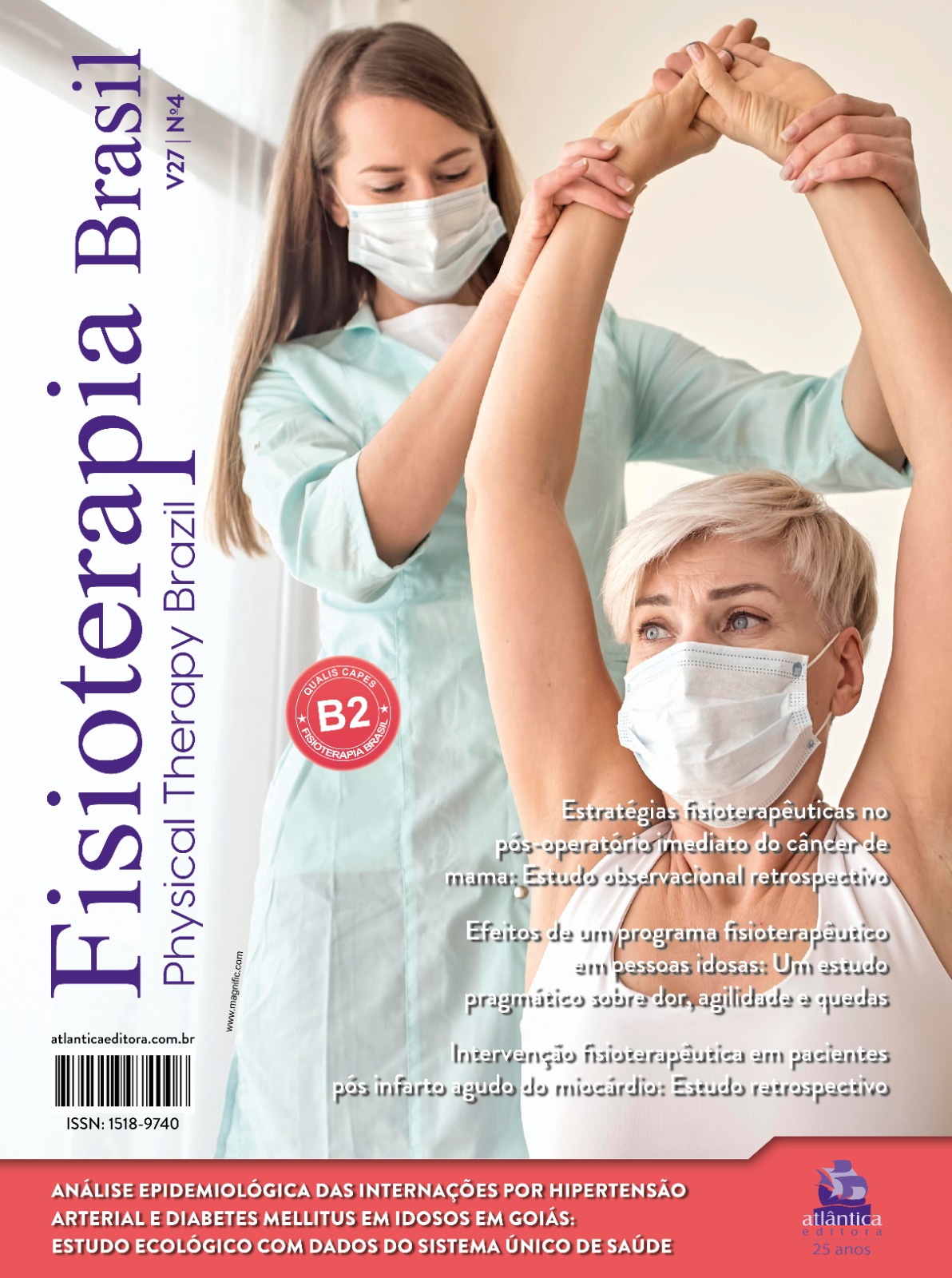
Physiotherapeutic strategies in the immediate postoperative period of breast cancer: A retrospective observational study
DOI:
https://doi.org/10.62827/fb.v27i4.1185Keywords:
Breast Neoplasms; Postoperative Period; Primary Prevention; Lymphedema; Kinesiophobia.Abstract
Introduction: Breast cancer may lead to functional complications in the postoperative period, such as lymphedema, pain, and reduced upper limb range of motion, requiring early physiotherapeutic interventions aimed at preventing complications and promoting functional rehabilitation. Objective: To characterize the profile of patients treated and to describe the physiotherapeutic strategies adopted in the immediate postoperative period of women undergoing breast cancer surgery. Methods: This is a retrospective observational study based on the analysis of medical records from screening assessments conducted by a Physiotherapy service in a female surgical ward of a public hospital. Women in the immediate postoperative period of breast surgery, attended between February 2018 and November 2024, were included. Data were analyzed descriptively using absolute and relative frequencies and presented in tables. Results: A total of 245 medical records were analyzed, of which 12 (4.9%) were excluded due to missing data, resulting in a sample of 233 patients. Regarding the mode of diagnosis, 130 (56%) identified the disease through self-examination and 61 (26%) through mammography. Quadrantectomy was the most frequent surgical procedure, accounting for 66 cases (28%). Inflammatory signs were not observed in 151 (65.6%) patients, and 114 (51%) were referred for physiotherapeutic follow-up. All patients received instructions for early mobilization of the upper limbs, including active free exercises aimed at improving shoulder mobility, reinforced by educational materials. After one week, no signs of lymphedema or limitation in range of motion were observed in the reassessed patients. Conclusion: Physiotherapeutic strategies implemented in the immediate postoperative period were relevant for preventing complications and promoting upper limb mobility and functionality, highlighting the importance of early physiotherapy intervention in this context.
References
Instituto Nacional de Câncer. INCA estima 704 mil casos de câncer por ano no Brasil até 2025. Rio de Janeiro: INCA; 2022.
Santos MO, Lima FCS, Martins LFL, Cancela MC, Souza DLB. Estimativa de incidência de câncer no Brasil 2023-2025. Rev Bras Cancerol. 2023;69(1). DOI: 10.32635/2176-9745.RBC.2023v69n1.3700.
Jemal A, Bray F, Center MM, Ferlay J, Ward E, Forman D. Global cancer statistics. CA Cancer J Clin. 2011;61(2):69-90. DOI: 10.3322/caac.20107.
Majewski JM, Lopes ADF, Davoglio T, Leite JCC. Qualidade de vida em mulheres submetidas à mastectomia comparada com aquelas que se submeteram à cirurgia conservadora: uma revisão de literatura. Cien Saude Colet. 2012;17(3):707-716. DOI: 10.1590/S1413-81232012000300017.
Antonini M, Pinheiro DJPC, Salerno GRF, Matos ABTMB, Ferraro O, Mattar A, Lopes RGC, Real JM. Does Pink October really impact breast cancer screening? Public Health Pract (Oxf). 2022; 4:100316. DOI: 10.1016/j.puhip.2022.100316.
Brasil. Ministério da Saúde. Política nacional de atenção integral à saúde da mulher: princípios e diretrizes. Brasília: Ministério da Saúde; 2004.
Fayer VA, Guerra MR, Nogueira MC, Corrêa CSL, Bustamante-Teixeira MT. Controle do câncer de mama no estado de São Paulo: uma avaliação do rastreamento mamográfico. Cad Saude Colet. 2020;28(1):140-152. DOI: 10.1590/1414-462X202028010322.
Anothaisintawee T, Wiratkapun C, Lerdsitthichai P, Kasamesup V, Wongwaisayawan S, Srinakarin J, Hirunpat S, Woodtichartpreecha P, Boonlikit S, Sritara P. Risk factors of breast cancer: a systematic review and meta-analysis. Asia Pac J Public Health. 2013;25(5):368-387. DOI: 10.1177/1010539513488795.
Ohl ICB, Ohl RI, Chavaglia SRR, Goldman RE. Public actions for control of breast cancer in Brazil: integrative review. Rev Bras Enferm. 2016;69(4):793-803. DOI: 10.1590/0034-7167.2016690424i.
Instituto Nacional de Câncer. Detecção precoce do câncer. Rio de Janeiro: INCA; 2021.
Sharma GN, Dave R, Sanadya J, Sharma P, Sharma KK. Various types and management of breast cancer: an overview. J Adv Pharm Technol Res. 2010;1(2):109-126.
Jacob T, Peleg R, Cohen H. The implementation of post breast cancer surgery physical therapy instructions for patients: a case study of Israeli medical centers. Eur J Gynaecol Oncol. 2022;43(4):1-7.
Nascimento SL, Oliveira RR, Oliveira MMF, Amaral MTP. Complicações e condutas fisioterapêuticas após cirurgia por câncer de mama: estudo retrospectivo. Fisioter Pesqui. 2012;19(3):248-255. DOI: 10.1590/S1809-29502012000300010.
Lacomba MT, Yuste Sánchez MJ, Zapico Goñi A, Prieto Merino D, Mayoral del Moral O, Cerezo Téllez E, Minayo Mogollón E. Effectiveness of early physiotherapy to prevent lymphoedema after surgery for breast cancer: randomised, single blinded, clinical trial. BMJ. 2010;340:b5396. DOI: 10.1136/bmj.b5396.
Ferlay J, Colombet M, Soerjomataram I, Parkin DM, Piñeros M, Znaor A, Bray F. Cancer statistics for the year 2020: an overview. Int J Cancer. 2021;149(4):778-789. DOI: 10.1002/ijc.33588.
Xue T, Zhang L, Zhang D. Exercise-based interventions for postoperative rehabilitation in breast cancer patients: a systematic review and meta-analysis of randomized controlled trials. Medicine (Baltimore). 2025;104(34):e43705. DOI: 10.1097/MD.0000000000043705.
Almeida Rizzi SKL, Haddad CAS, Giron PS, Ferreira LM, Montezuma T, et al. Early free range-of-motion upper limb exercises after mastectomy and immediate implant-based reconstruction are safe and beneficial: a randomized trial. Ann Surg Oncol. 2020;27(12):4750-4759. DOI: 10.1245/s10434-020-08882-z.
Estevão A, Mendes AF, Silva ML, Ventura PL, Biagi AC, Cunha MB. Exercícios imediatos versus exercícios tardios no pós-operatório de cirurgias oncomamárias: limitação ou liberação da amplitude de movimento? Rev Bras Cancerol. 2018;64(4):551-560. DOI: 10.32635/2176-9745.RBC.2018v64n4.205.
Choi SW, Ryu SY, Han MA, Park J. Higher breast cancer prevalence associated with higher socioeconomic status in the South Korean population; has it resulted from overdiagnosis? PLoS One. 2018;13(7):e0200484. DOI: 10.1371/journal.pone.0200484.
Zhou Y, Zheng J, Li S, Zhou T, Zhang P, Li H. Association between breastfeeding and breast cancer risk: evidence from a meta-analysis. Breastfeed Med. 2015;10(3):175-182. DOI: 10.1089/bfm.2014.0141.
Qiu R, Zhong Y, Hu M, Wu B. Breastfeeding and reduced risk of breast cancer: a systematic review and meta-analysis. Comput Math Methods Med. 2022;2022:8500910. DOI: 10.1155/2022/8500910.
Galimberti V, Cole BF, Zurrida S, Viale G, Luini A, Veronesi P, Intra M, Gentilini O, Chifu C, Sargenti M, et al. Axillary dissection versus no axillary dissection in patients with sentinel-node micrometastases (IBCS 23-01): a phase 3 randomised controlled trial. Lancet Oncol. 2013;14(4):297-305. DOI: 10.1016/S1470-2045(13)70035-4.
Sousa E, Vieira RAC, Rezende LF, Silva TB, Mauad EC. Funcionalidade de membro superior em mulheres submetidas ao tratamento do câncer de mama. Rev Bras Cancerol. 2013;59(3):409-417. DOI: 10.32635/2176-9745.RBC.2013v59n3.506.
Wang Y, Tong L, Wang S, Shi W, Xu D. Effectiveness of a lymphedema prevention program for patients with breast cancer: a randomized controlled trial based on the Protection Motivation Theory and Information-Motivation-Behavioral Skills Model. Asia Pac J Oncol Nurs. 2025;12:100667. DOI: 10.1016/j.apjon.2025.100667.
Downloads
Published
Issue
Section
License
Copyright (c) 2026 Gisela Rosa Franco Salerno, Isabela Sousa Morais, Giovanna Leal de Oliveira, Gabriela Nogueira (Autor)

This work is licensed under a Creative Commons Attribution 4.0 International License.
Autores que publicam nesta revista concordam com os seguintes termos:
Autores mantém os direitos autorais e concedem à revista o direito de primeira publicação, com o trabalho simultaneamente licenciado sob a Licença Creative Commons Attribution 4.0 que permite o compartilhamento do trabalho com reconhecimento da autoria e publicação inicial nesta revista.
Autores têm autorização para distribuição não-exclusiva da versão do trabalho publicada nesta revista (ex.: publicar em repositório institucional ou como capítulo de livro), com reconhecimento de autoria e publicação inicial nesta revista.