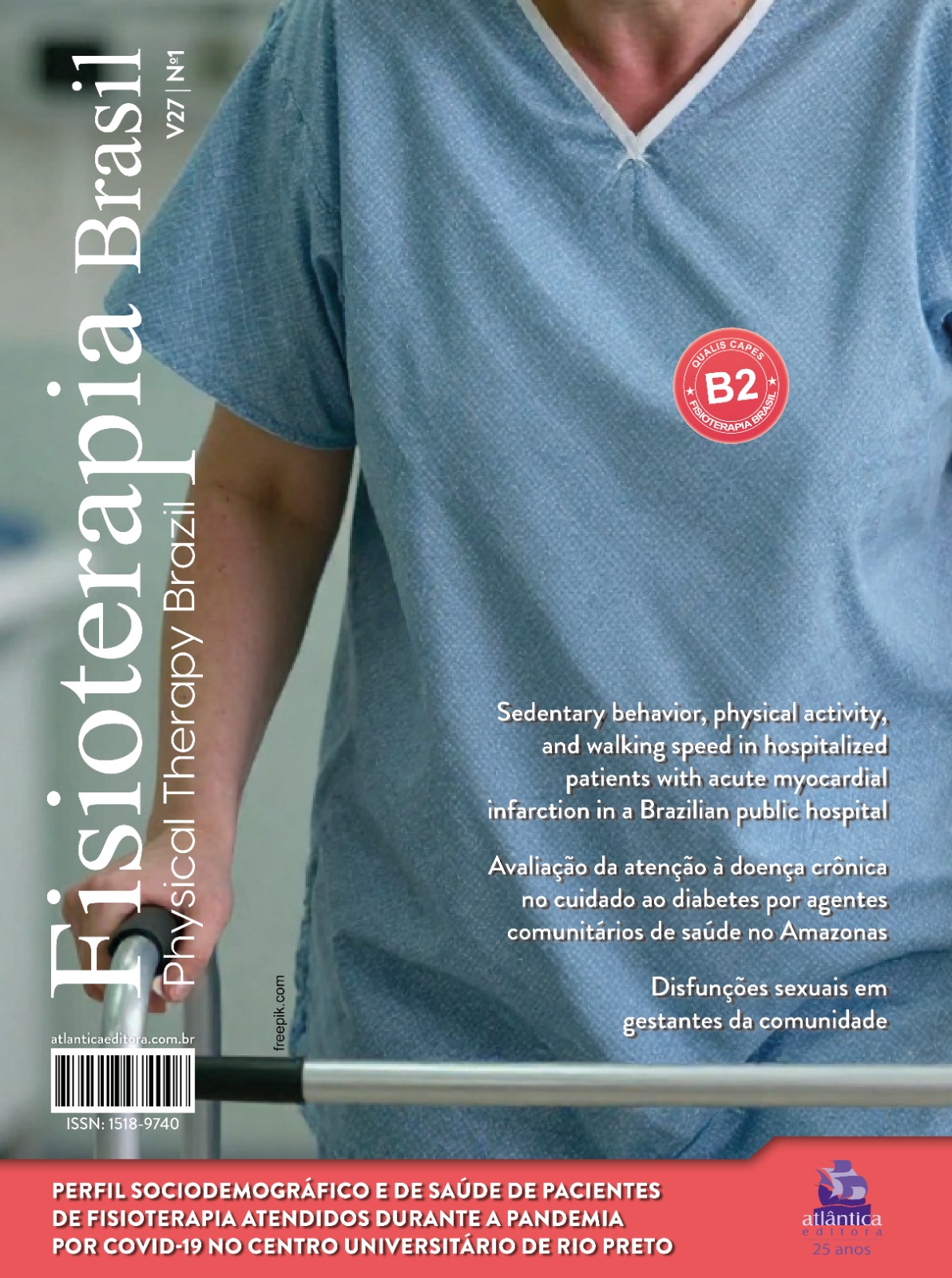
Comportamento sedentário, atividade física e velocidade da marcha em pacientes internados com infarto agudo do miocárdio em um hospital público Brasileiro
DOI:
https://doi.org/10.62827/fb.v27i1.1111Palavras-chave:
Exercício Físico; Comportamento Sedentário; Infarto do Miocárdio; Unidades de Terapia Intensiva; Velocidade de Caminhada.Resumo
Introdução: Os benefícios da atividade física para a prevenção de doenças cardiovasculares são bem documentados na literatura; no entanto, uma alta porcentagem de indivíduos adultos não atinge os níveis de atividade física recomendados pela Organização Mundial da Saúde. Objetivo: Este estudo teve como objetivo avaliar os níveis prévios de atividade física e o comportamento sedentário em pacientes estáveis internados na UTI com diagnóstico de infarto agudo do miocárdio. Métodos: Este estudo transversal foi conduzido na UTI cardiológica de um hospital de alta complexidade. O comportamento sedentário e a atividade física foram avaliados utilizando o Questionário de Comportamento Sedentário (SBQ) e o Questionário Internacional de Atividade Física (IPAQ). O Teste de Velocidade da Marcha (TVM) foi utilizado para avaliar a capacidade funcional. Resultados: Uma alta porcentagem dos participantes (45%) não atingiu as recomendações de atividade física. A dislipidemia foi o único fator de risco associado à atividade física (p=0,025). O tempo médio de comportamento sedentário foi de 37,24 h/semana (IC95% 31,17; 43,17) avaliado pelo IPAC e de 52,17 h/semana (IC95% 42,93; 61,41) avaliado pelo SBQ. Houve correlação positiva entre o comportamento sedentário avaliado pelo SBQ e pelo IPAC (rs = 0,39; p = 0,01). A velocidade média de caminhada foi de 1,38 ± 0,36 m/s. Conclusão: Uma alta proporção de pacientes não atingiu as recomendações de atividade física antes do infarto agudo do miocárdio. A atividade física apresentou associação com dislipidemia. O comportamento sedentário avaliado pelo IPAC e pelo SBQ apresentou correlação positiva. O TVM mostrou-se seguro, fácil de aplicar na UTI e adequado para essa população.
Referências
WORLD HEALTH ORGANIZATION (WHO). The top 10 causes of death, 2020. Available from: https://www.who.int/news-room/fact-sheets/detail/the-top-10-causes-of-death. Accessed on February 09, 2022.
GBD 2019 Diseases and Injuries Collaborators. Global burden of 369 diseases and injuries in 204 countries and territories, 1990-2019: a systematic analysis for the Global Burden of Disease Study 2019. Lancet [Internet]. 2020 Oct;396(10258):1204-1222. Available from: https://www.thelancet.com/journals/lancet/article/PIIS0140-6736(20)30925-9/fulltext. doi:10.1016/S0140-6736(20)30925-9
Précoma DB, Oliveira GMM, Simão AF, Dutra OP, Coelho OR, Izar MCO, et al. Atualização da Diretriz de Prevenção Cardiovascular da Sociedade Brasileira de Cardiologia – 2019. Arq Bras Cardiol [Internet]. 2019;113(4):787-891. Available from: http://publicacoes.cardiol.br/portal/abc/portugues/aop/2019/aop-diretriz-prevencao-cardiovascular-portugues.pdf. doi:0.5935/abc.20190204
WHO. WHO 2020 guidelines on physical activity and sedentary behaviour. World Health Organization, Geneva 2020. Available in: https://apps.who.int/iris/bitstream/handle/10665/336656/9789240015128-eng.pdf . Accessed on April 20, 2023.
Matthews CE, Carlson SA, Saint-Maurice PF, Patel S, Salerno EA, Loftfield E, Troiano RP, Fulton JE, Sampson JN, Tribby C, Keadle SK, Berrigan D. Sedentary Behavior in U.S. Adults: Fall 2019. Med Sci Sports Exerc [Internet]. 2021;53(12):2512-2519. Available from: https://journals.lww.com/acsm-msse/fulltext/2021/12000/sedentary_behavior_in_u_s__adults__fall_2019.6.aspx doi: 10.1249/MSS.0000000000002751.
Matsudo S, Araújo T, Marsudo V. Questinário internacional de atividade física (IPAQ): estudo de validade e reprodutibilidade no Brasil. Rev. Bras. Ativ. Fís. Saúde [Internet]. 2001;6(2)05-18. Available from: https://rbafs.org.br/rbafs/article/view/93. doi:10.12820/rbafs.v.6n2p5-18.
Guthold R, Stevens GA, Riley LM, Bull FC. Worldwide trends in insufficient physical activity from 2001 to 2016: a pooled analysis of 358 population-based surveys with 1· 9 million participants. The lancet global health [Internet]. 2018 Oct;6(10):e1077-e1086. Available from: https://www.thelancet.com/journals/langlo/article/PIIS2214-109X(18)30357-7/fulltext doi:10.1016/S2214-109X(18)30357-7
Hamilton MT, Hamilton DG, Zderic TW. Role of low energy expenditure and sitting in obesity, metabolic syndrome, type 2 diabetes, and cardiovascular disease. Diabetes [Internet]. 2007;56(11):2655-2667. Available from: https://diabetesjournals.org/diabetes/article-abstract/56/11/2655/13643/Role-of-Low-Energy-Expenditure-and-Sitting-in?redirectedFrom=fulltext doi:10.2337/db07-0882
Lazaros G, Oikonomou E, Vogiatzi G, et al. The impact of sedentary behavior patterns on carotid atherosclerotic burden: implications from the Corinthia epidemiological study. Atherosclerosis [Internet]. 2019 Mar;282:154-161. Available from: https://www.atherosclerosis-journal.com/article/S0021-9150(19)30039-5/abstract doi:10.1016/j.atherosclerosis.2019.01.026
Howard BJ, Fraser SF, Sethi P, et al. Impact on hemostatic parameters of interrupting sitting with intermittent activity. Med Sci Sports Exercise [Internet]. 2013;45(7):1285-1291.Available from: https://journals.lww.com/acsm-msse/fulltext/2013/07000/impact_on_hemostatic_parameters_of_interrupting.9.aspx doi: 10.1249/mss.0b013e318285f57e.
Katzmarzyk PT, Powell KE, Jakicic JM, Troiano RP, Piercy K, Tennant B. Physical Activity Guidelines Advisory Committee (2019). Sedentary behavior and health: update from the 2018 Physical Activity Guidelines Advisory Committee. Med Sci Sports Exercise [Internet]. 2019 June;51(6):1227. Available from: https://journals.lww.com/acsm-msse/fulltext/2019/06000/sedentary_behavior_and_health__update_from_the.18.aspx. doi:10.1249/MSS.0000000000001935.
Petersen CB, Bauman A, Gronbaek M, et al. Total sitting time and risk of myocardial infarction, coronary heart disease and all-cause mortality in a prospective cohort of Danish adults. Int J Behav Nutr Phys Act [Internet]. 2014;11(1):1-11. Available from: https://ijbnpa.biomedcentral.com/articles/10.1186/1479-5868-11-13. Doi:10.1186/1479-5868-11-13
Healy GN, Dunstan DW, Salmon J, Shaw JE, Zimmet PZ, Owen N. Television time and continuous metabolic risk in physically active adults. Med Sci Sports Exerc [Internet]. 2008 Apr; 40:639–645. Available from: https://journals.lww.com/acsm-msse/fulltext/2008/04000/television_time_and_continuous_metabolic_risk_in.8.aspx. doi:10.1249/MSS.0b013e3181607421
Hamilton M, Healy G, Dunstan D, Zderic T, Owen N. Too little exercise and too much sitting: inactivity physiology and the need for new recommendations on sedentary behavior. Curr Cardiovasc Rep [Internet]. 2008 Oct;2:292–298. Avalilable from: https://link.springer.com/article/10.1007/s12170-008-0054-8. doi:10.1007/s12170-008-0054-8.
Fuentes-Abolafio IJ, Stubbs B, Pérez-Belmonte LM, Bernal-López MR, Gómez-Huelgas R, Cuesta-Vargas AI. Physical functional performance and prognosis in patients with heart failure: a systematic review and meta-analysis. BMC Cardiovasc Disord [Internet]. 2020 Dec;20(1):512. Available from: https://bmccardiovascdisord.biomedcentral.com/articles/10.1186/s12872-020-01725-5. doi:10.1186/s12872-020-01725-5
Costa TY, Cristaldo MRA, Marin FA, Spexoto MCB. Nutrition impact symptoms, sarcopenia, and malnutrition in hospitalized patients. ABCS Health Sciences [Internet]. 2022;48: e023206. Available from: https://www.portalnepas.org.br/abcshs/article/view/2124. doi:10.7322/abcshs.2021079.2124
Martinez BP, Batista AKMS, Ramos IR, et al. Viability of gait speed test in hospitalized elderly patients. J Bras Pneumologia [Internet]. 2016;42(3):196-202. Available from: https://www.scielo.br/j/jbpneu/a/bb3sxpYjQKKNXXtcr3tZCTF/?format=html&lang=en. doi:10.1590/s1806-37562015000000058
Arjunan A, Peel NM, Hubbard R. Gait speed and frailty status in relation to adverse outcomes in geriatric rehabilitation. Arch Phys Med Rehabilitation [Internet]. 2019;100(5):859-864. Available from: https://www.archives-pmr.org/article/S0003-9993(18)31370-4. doi:10.1016/j.apmr.2018.08.187.
Fritz S, Lusardi M. White paper: “walking speed: the sixth vital sign”. J Geriatric Physical Therapy [Internet]. 2009;32(2):2-5. Available from: https://pubmed.ncbi.nlm.nih.gov/20039582/
Middleton A, Fritz SL, Lusardi M. Walking speed: the functional vital sign. J Aging Physical Activity [Internet]. 2015;23(2);314-322. Available from: Walking speed: the functional vital sign doi:10.1123/japa.2013-0236.
Thygesen K, Alpert JS, Jaffe AS, et al. Fourth universal definition of myocardial infarction (2018). Eur Heart J [Internet]. 2019;40(3):237-269. Available from: doi:10.1093/eurheartj/ehy462
Benedetti TRB, Antunes PDC, Rodriguez-Añez CR, Mazo G Z, Petroski ÉL. Reprodutibilidade e validade do Questionário Internacional de Atividade Física (IPAQ) em homens idosos. Rev Bras Med Esporte [Internet]. 2007;13(1):11-16. Available from: https://www.scielo.br/j/rbme/a/qMfYbx6NVfKKFyKZLSnBJgH/?lang=pt. doi:10.1590/S1517-86922007000100004
Rosenberg DE, Norman GJ, Wagner N, Patrick K, Calfas KJ, Sallis JF. Reliability and validity of the Sedentary Behavior Questionnaire (SBQ) for adults. J Physical Activity Health [Internet]. 2010;7(6):697-705. Available from: https://journals.humankinetics.com/view/journals/jpah/7/6/article-p697.xml. doi:10.1123/jpah.7.6.697
Carvalho LA. In: Adaptação e validação do sedentary behavior questionnaire for adults para o português brasileiro [database online]. Ceará: Universidade Estadual do Ceará; 2017. Available from: http://siduece.uece.br/siduece/trabalhoAcademicoPublico.jsf?id=85733. Updated February 8, 2021. Accessed february 24, 2021
Dodson J A, Arnold S V, Gosch K L, et al. Slow gait speed and risk of mortality or hospital readmission after myocardial infarction in the translational research investigating underlying disparities in recovery from acute myocardial infarction: patients' health status registry. Journal of the American Geriatrics Society [Internet]. 2016;64(3):596-601. Available from: https://agsjournals.onlinelibrary.wiley.com/doi/abs/10.1111/jgs.14016?casa_token=vupowhszDNcAAAAA%3A-2NGIYd6ZOM_eYQz9z8uENCuyLjXojWVfz1sELdv-eIz8MfgbR9CTRth-pSc-TP-03SD31_PhgTNk5-Vhg . doi:10.1111/jgs.14016
Jorge JDG, Santos MAA, Barreto Filho JAS, et al. Level of physical activity and in-hospital course of patients with acute coronary syndrome. Arq Bras Cardiologia [Internet]. 2015;106(1):33-40. Available from: https://www.scielo.br/j/abc/a/tcbs7J4fWPPbq5YRBjZMJYP/?format=html&lang=en. doi:10.5935/abc.20160006.
Pitsavos C, Kavouras SA, Panagiotakos DB, et al. Physical activity status and acute coronary syndromes survival: the GREECS (Greek Study of Acute Coronary Syndromes) study. J Am College Cardiology [Internet]. 2008;51(21):2034–2039. Available from: https://www.jacc.org/doi/abs/10.1016/j.jacc.2008.01.053. doi:10.1016/j.jacc.2008.01.053.
Matthias AT, de Silva D K N, Indrakumar J, Gunatilake S B. Physical activity levels of patients prior to acute coronary syndrome–Experience at a tertiary care hospital in Sri Lanka. Indian Heart Journal [Internet]. 2018;70(3):350-352. Available from: https://www.sciencedirect.com/science/article/pii/S0019483216309415. doi:10.1016/j.ihj.2017.08.020.
Winzer EB, Woitek F, Linke A. Physical activity in the prevention and treatment of coronary artery disease. J Am Heart Association [Internet]. 2018;7(4):e007725. Available from: https://www.ahajournals.org/doi/full/10.1161/JAHA.117.007725. doi:10.1161/JAHA.117.007725.
Tanasescu M, Leitzmann MF, Rimm EB, Willett WC, Stampfer MJ, Hu FB. Exercise type and intensity in relation to coronary heart disease in men. JAMA [Internet]. 2002;288(16):1994 –2000. Available from: https://jamanetwork.com/journals/jama/fullarticle/195439. doi:10.1001/jama.288.16.1994.
Sesso HD, Paffenbarger RS Jr., Lee IM. Physical activity and coronary heart disease in men: the Harvard Alumni Health Study. Circulation [Internet]. 2000;102:975-80. Available from: https://www.ahajournals.org/doi/full/10.1161/01.CIR.102.9.975. doi:10.1161/01.CIR.102.9.975.
Yusuf S, Hawken S, Ounpuu S, et al. Effect of potentially modifiable risk factors associated with myocardial infarction in 52 countries (the INTERHEART study): case-control study. Lancet [Internet]. 2004 Sept;364(9438):937-952. Available from: https://www.thelancet.com/journals/lancet/article/PIIS0140-6736(04)17018-9/abstract?pubType=related. doi:10.1016/S0140-6736(04)17018-9
Iborra RT, Ribeiro IC, Neves MQ, Charf AM, Lottenberg SA, Negrão CE, et al. Aerobic exercise training improves the role of high-density lipoprotein antioxidant and reduces plasma lipid peroxidation in type 2 diabetes mellitus. Scand J Med Sci Sports [Internet]. 2008;18(6):742-50. Available from: https://onlinelibrary.wiley.com/doi/abs/10.1111/j.1600-0838.2007.00748.x?casa_token=qtpIObCS_0QAAAAA:ncbgGDF8S7JD5t5RLdyemCqecANNrZaNKdUQJJeaH27VR5A3Q9a7rgkW1-xaBIWoHZONWip_JjUHIPQLJg. doi:10.1111/j.1600-0838.2007.00748.x.
Krüger K, Tirekoglou P, Weyh C. Immunological mechanisms of exercise therapy in dyslipidemia. Front Physiol [Internet]. 2022 Aug 8;13:903713. Available from: https://www.frontiersin.org/journals/physiology/articles/10.3389/fphys.2022.903713/full. doi:10.3389/fphys.2022.903713.
Kehler DS, Stammers AN, Horne D, et al. Impact of preoperative physical activity and depressive symptoms on post-cardiac surgical outcomes. Plos One [Internet]. 2019;14(2):e0213324. Available from: https://journals.plos.org/plosone/article?id=10.1371/journal.pone.0213324. doi:10.1371/journal.pone.0213324
Bakker EA, Hopman MT, Lee DC, et al. Correlates of Total and domain-specific Sedentary behavior: a cross-sectional study in Dutch adults. BMC Public Health [Internet]. 2020;20(1):1-10. Available from: https://link.springer.com/article/10.1186/s12889-020-8316-6. doi:10.1186/s12889-020-8212-0
McLaughlin M, Atkin AJ, Starr L. Worldwide surveillance of self-reported sitting time: a scoping review. Int J Behavioral Nutr Physical Activity [Internet]. 2020; 17(1):1-12. Available from: https://link.springer.com/article/10.1186/s12966-020-01008-4. doi:10.1186/s12966-020-01008-4
Santos DA, Silva AM, Baptista F, et al. Sedentary behavior and physical activity are independently related to functional fitness in older adults. Experimental Gerontology [Internet]. 2012;47(12):908-912. Available from: https://www.sciencedirect.com/science/article/pii/S053155651200201X?casa_token=aFjqxYdEgjgAAAAA:Ps5JGElAnU_mXzOXK6r_D3neutiwb6CeuXoLtMn_SJzwd_2M0c0TQYNGGbZsP006B5X-IpYasxYm.
Lau JH, Lee E S, Zhang Y, Zhang Y, Vaingankar JA, et al. Association Between Self-Reported Sedentary Behavior and Health-Related Quality of Life Among Multimorbidity Patients in Singapore. Am J Health Promotion [Internet]. 2021; 35(7):929-938. Available from: https://journals.sagepub.com/doi/epub/10.1177/08901171211001274. Doi:1177/08901171211001274
Rosenberg, DE, Bull FC, Marchall AL, Sallis JF, Bauman AE. Assessment of sedentary behavior with the International Physical Activity Questionnaire. J Physical Activity Health [Internet]. 2008;5(1):S30-S44. Available from: https://journals.humankinetics.com/view/journals/jpah/5/s1/article-pS30.xml. doi:10.1123/jpah.5.s1.s30.
Sato A, Kamiya K, Hamazaki N, Nozaki K, Ichikawa T, Yamashita M, Ako J. Gait speed and 6-minute walking distance are useful for identifying difficulties in activities of daily living in patients with cardiovascular disease. Heart & Lung [Internet]. 2022;51:46-51. Available from: https://www.sciencedirect.com/science/article/pii/S0147956321002466?casa_token=YkJUMk-Q5MoAAAAA:4coKpqK-FaAXUPelhsMqK26M6PX4Cq6Rofn6eIETczg6_TKVVuKaN_fST_gmmHWQzPcFivzTpYWd. doi:10.1016/j.hrtlng.2021.09.002
Gray EA, Skinner MA, Hale LA, Bunton RW. Preparation and support for physical activity following hospital discharge after coronary artery bypass graft surgery: A survey of current practice in New Zealand. Physiotherapy Research International [Internet]. 2022; 27(2): e1940. Available from: https://onlinelibrary.wiley.com/doi/abs/10.1002/pri.1940?casa_token=N61wtyjzdxUAAAAA:m9QXLxt_wtKNnmEjMz3nSDyjHhhNoVx6rCXNJywNuzDgej4L8rRF_rpfwLgK0x17c4xHDltL-IrFhttzHA. doi:10.1002/pri.1940
Downloads
Publicado
Edição
Seção
Licença
Copyright (c) 2026 Daniele Loss Gambet França, Patrícia Nóbrega Oliva, Flávia Marini Paro , Grace Anne Santos Silva, Raiany Franca Guimarães, Marcela Cangussu Barbalho-Moulim (Autor)

Este trabalho está licenciado sob uma licença Creative Commons Attribution 4.0 International License.
Autores que publicam nesta revista concordam com os seguintes termos:
Autores mantém os direitos autorais e concedem à revista o direito de primeira publicação, com o trabalho simultaneamente licenciado sob a Licença Creative Commons Attribution 4.0 que permite o compartilhamento do trabalho com reconhecimento da autoria e publicação inicial nesta revista.
Autores têm autorização para distribuição não-exclusiva da versão do trabalho publicada nesta revista (ex.: publicar em repositório institucional ou como capítulo de livro), com reconhecimento de autoria e publicação inicial nesta revista.