
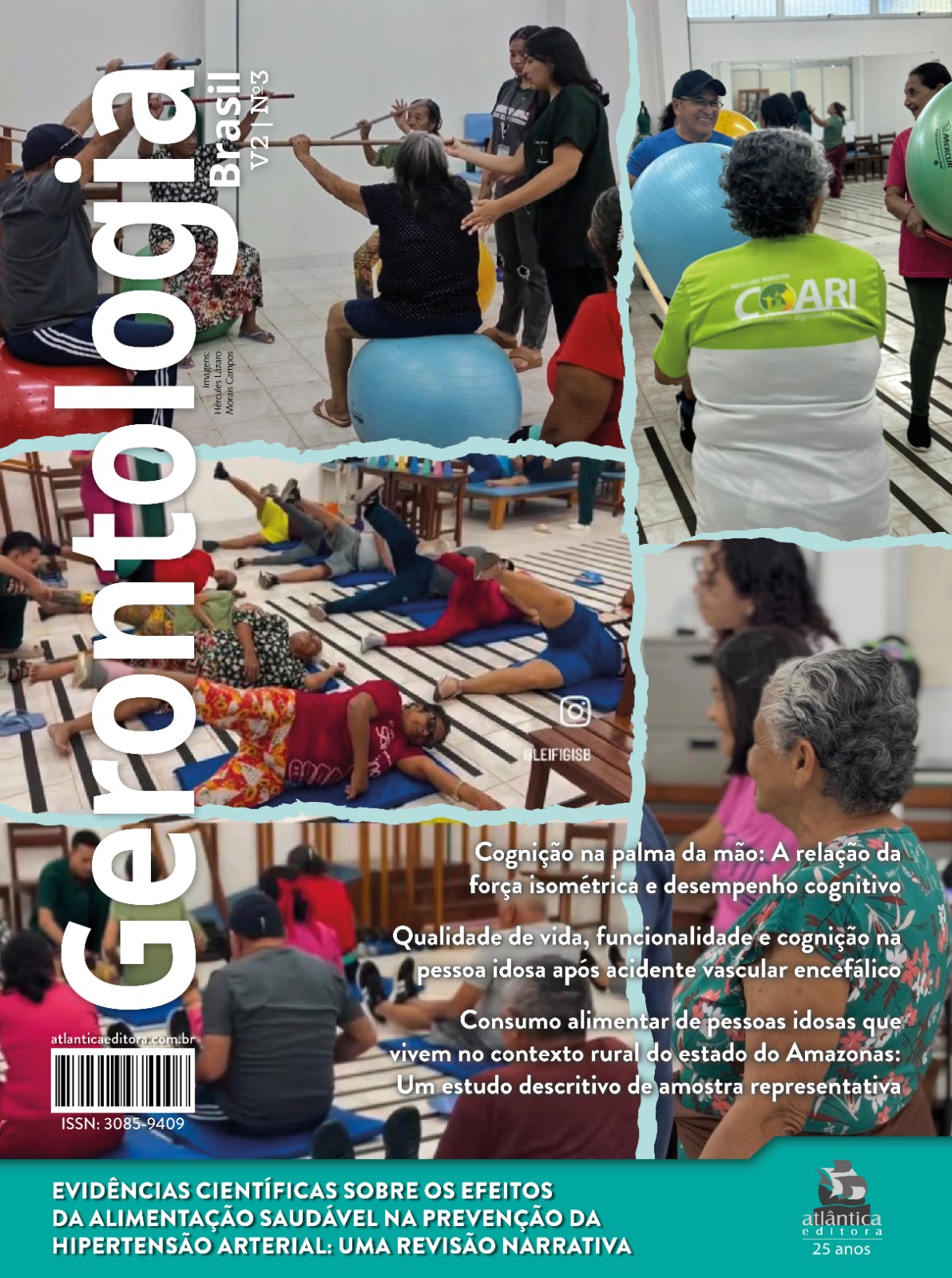
Cognição na palma da mão: A relação da força isométrica e desempenho cognitivo
DOI:
https://doi.org/10.62827/gb.v2i3.0017Palavras-chave:
Envelhecimento; Testes Neuropsicológicos; Desempenho Psicomotor; Autonomia Pessoal.Resumo
Introdução: O envelhecimento acarreta declínio na capacidade funcional, biofisiológica e neurológicas. Objetivo: Analisou-se a correlação entre a força de preensão palmar (FPP) e o escore no Mini Exame do Estado Mental (MEEM), e verificar a sua magnitude e sensibilidade em estimar o desempenho cognitivo em idosas irregularmente ativa. Métodos: Participaram do estudo 35 pessoas idosas com idade entre 60 e 87 anos. O MEEM foi utilizado para avaliar a capacidade cognitiva. A avaliação da força isométrica foi realizada por meio do teste de FPP. A relação entre o escore total no MEEM e as variáveis de FPP foi verificado pelo coeficiente de correlação de Pearson. As diferenças das médias da FPP entre os diferentes níveis cognitivo foi avaliado pela a Anova. A magnitude do tamanho da diferença foi obtida por meio do d de Cohen. O modelo de regressão linear foi utilizado para analisar a relação entre a média FPP e o escore no teste MEEM. Resultados: A análise da correlação entre a FPP e o escore do MEEM, revelou uma associação positiva e estatisticamente significativa (direita: r=0,360 p=0,034; esquerda: r=0,485 p=0,003). Um efeito significativo do nível de força entre as classificações no desempenho cognitivo [F(2,32)=5.51, p<0,01, d=0,255] foi observado. O coeficiente de correlação (R2) indicou que aproximadamente 20,9% da variabilidade nos escores do teste cognitivo pode ser explicado pela variação na FPP. Conclusão: A força de preensão palmar está significativa e positivamente associada ao desempenho cognitivo em idosos irregularmente ativos, apresentando um gradiente claro em relação à severidade do comprometimento.
Referências
Cruz-Jentoft AJ, Baeyens JP, Bauer JM, Boirie Y, Cederholm T, Landi F, et al. Sarcopenia: European consensus on definition and diagnosis. Age Ageing. 1o de julho de 2010;39(4):412–23. doi:10.1093/ageing/afq034
Marzetti E. Musculoskeletal Aging and Sarcopenia in the Elderly. Int J Mol Sci. 4 de março de 2022;23(5):2808. doi:10.3390/ijms23052808
Coelho Júnior HJ, Aguiar SDS, Gonçalves IDO, Sampaio RAC, Uchida MC, Moraes MR, et al. Sarcopenia Is Associated with High Pulse Pressure in Older Women. J Aging Res. 2015;2015:1–6. doi:10.1155/2015/109824
Drumond-Bock AL, Blankenship HE, Pham KD, Carter KA, Freeman WM, Beckstead MJ. Parallel Gene Expression Changes in Ventral Midbrain Dopamine and GABA Neurons during Normal Aging. eneuro. maio de 2025;12(5):ENEURO.0107-25.2025. doi:10.1523/ENEURO.0107-25.2025
Piechota M, Sunderland P. [Neuronal ageing]. Postepy Biochem. 2014;60(2):177–86. PubMed PMID: 25134353.
Iadecola C, Duering M, Hachinski V, Joutel A, Pendlebury ST, Schneider JA, et al. Vascular Cognitive Impairment and Dementia. J Am Coll Cardiol. julho de 2019;73(25):3326–44. doi:10.1016/j.jacc.2019.04.034
Lawson RA, Yarnall AJ, Duncan GW, Breen DP, Khoo TK, Williams-Gray CH, et al. Cognitive decline and quality of life in incident Parkinson’s disease: The role of attention. Parkinsonism Relat Disord. junho de 2016;27:47–53. doi:10.1016/j.parkreldis.2016.04.009
Lee MT, Jang Y, Chang WY. How do impairments in cognitive functions affect activities of daily living functions in older adults? Innamorati M, organizador. PLOS ONE. 7 de junho de 2019;14(6):e0218112. doi:10.1371/journal.pone.0218112
Korczyn AD. Parkinson’s and Alzheimer’s diseases: Focus on mild cognitive impairment. Parkinsonism Relat Disord. janeiro de 2016;22 Suppl 1:S159-161. doi:10.1016/j.parkreldis.2015.09.053 PubMed PMID: 26516060.
Frisoni GB, Aho E, Brayne C, Ciccarelli O, Dubois B, Fox NC, et al. Alzheimer’s disease outlook: controversies and future directions. The Lancet. setembro de 2025;406(10510):1424–42. doi:10.1016/S0140-6736(25)01389-3
Norris D, Clark MS, Shipley S. The Mental Status Examination. Am Fam Physician. 15 de outubro de 2016;94(8):635–41. PubMed PMID: 27929229.
Wang G, Estrella A, Hakim O, Milazzo P, Patel S, Pintagro C, et al. Mini-Mental State Examination and Montreal Cognitive Assessment as Tools for Following Cognitive Changes in Alzheimer’s Disease Neuroimaging Initiative Participants. J Alzheimers Dis. 25 de outubro de 2022;90(1):263–70. doi:10.3233/JAD-220397
Pinto TCC, Machado L, Bulgacov TM, Rodrigues-Júnior AL, Costa MLG, Ximenes RCC, et al. Is the Montreal Cognitive Assessment (MoCA) screening superior to the Mini-Mental State Examination (MMSE) in the detection of mild cognitive impairment (MCI) and Alzheimer’s Disease (AD) in the elderly? Int Psychogeriatr. abril de 2019;31(4):491–504. doi:10.1017/S1041610218001370
Arosio B, Calvani R, Ferri E, Coelho-Junior HJ, Carandina A, Campanelli F, et al. Sarcopenia and Cognitive Decline in Older Adults: Targeting the Muscle–Brain Axis. Nutrients. 12 de abril de 2023;15(8):1853. doi:10.3390/nu15081853
Beeri MS, Leugrans SE, Delbono O, Bennett DA, Buchman AS. Sarcopenia is associated with incident Alzheimer’s dementia, m ILD COGNITIVE IMPAIRMENT, and cognitive decline. J Am Geriatr Soc. julho de 2021;69(7):1826–35. doi:10.1111/jgs.17206
Peng TC, Chen WL, Wu LW, Chang YW, Kao TW. Sarcopenia and cognitive impairment: A systematic review and meta-analysis. Clin Nutr. setembro de 2020;39(9):2695–701. doi:10.1016/j.clnu.2019.12.014
McGrath R, Vincent BM, Hackney KJ, Robinson-Lane SG, Downer B, Clark BC. The Longitudinal Associations of Handgrip Strength and Cognitive Function in Aging Americans. J Am Med Dir Assoc. maio de 2020;21(5):634-639.e1. doi:10.1016/j.jamda.2019.08.032
Vancampfort D, Stubbs B, Firth J, Smith L, Swinnen N, Koyanagi A. Associations between handgrip strength and mild cognitive impairment in middle‐aged and older adults in six low‐ and middle‐income countries. Int J Geriatr Psychiatry. abril de 2019;34(4):609–16. doi:10.1002/gps.5061
Choi JY, Lee S, Min JY, Min KB. Asymmetrical Handgrip Strength Is Associated with Lower Cognitive Performance in the Elderly. J Clin Med. 20 de maio de 2022;11(10):2904. doi:10.3390/jcm11102904
Setia M. Methodology series module 3: Cross-sectional studies. Indian J Dermatol. 2016;61(3):261. doi:10.4103/0019-5154.182410
Carpinelli Mazzi M, Iavarone A, Russo G, Musella C, Milan G, D’Anna F, et al. Mini-Mental State Examination: new normative values on subjects in Southern Italy. Aging Clin Exp Res. abril de 2020;32(4):699–702. doi:10.1007/s40520-019-01250-2
Qiao H, Chen L, Zhu F. Ranking convolutional neural network for Alzheimer’s disease mini-mental state examination prediction at multiple time-points. Comput Methods Programs Biomed. janeiro de 2022;213:106503. doi:10.1016/j.cmpb.2021.106503
Souto Filho JM, Daiane Nonato De Lima, Almeida ATDS, Rabêlo LS, Marcos Antonio Medeiros Do Nascimento, Maia DF, et al. FORÇA ISOMÉTRICA CORRELACIONA-SE COM DESEMPENHO EM TESTES FUNCIONAIS EM IDOSOS. Saúde Coletiva Barueri. 7 de novembro de 2024;14(91):13548–59. doi:10.36489/saudecoletiva.2024v14i91p13548-13559
Souto Filho JM, Coelho KGFDS, Modesto IEG. Treino de força e estresse durante a pandemia do COVID-19. Saúde Coletiva Barueri. 4 de junho de 2021;11(65):6000–11. doi:10.36489/saudecoletiva.2021v11i65p6000-6011
Souto Filho JM, Lima DND, Sátiro Filho NDQ, Nascimento MAMD, Farias ALPD, Maia DF, et al. Estágio de adaptação a oficiais temporários da aeronáutica e aptidão físicos. Res Soc Dev. 26 de maio de 2024;13(5):e3013545863. doi:10.33448/rsd-v13i5.45863
Souto Filho JM, Sousa CVD, Rosa TDS, Simões HG. Greater muscle strength is associated with reduced autonomic reactivity. Res Soc Dev. 26 de maio de 2021;10(6):e16510615593. doi:10.33448/rsd-v10i6.15593
Lövdén M, Fratiglioni L, Glymour MM, Lindenberger U, Tucker-Drob EM. Education and Cognitive Functioning Across the Life Span. Psychol Sci Public Interest. agosto de 2020;21(1):6–41. doi:10.1177/1529100620920576
Bolton CJ, Khan OA, Liu D, Wilhoite S, Dumitrescu L, Peterson A, et al. Cognitive status and demographics modify the association between subjective cognition and amyloid. Ann Clin Transl Neurol. novembro de 2024;11(11):2977–86. doi:10.1002/acn3.52209
Kim Y, Wang M, Sharp SJ, Au Yeung SL, Luo S, Jang H, et al. Incidence of Dementia and Alzheimer’s Disease, Genetic Susceptibility, and Grip Strength Among Older Adults. Lipsitz LA, organizador. J Gerontol Ser A. 1o de março de 2024;79(3):glad224. doi:10.1093/gerona/glad224
Zhang Y, DeFina LF, Leonard D, Chen B, Hébert ET, Barlow CE, et al. Muscle Strength and Later Incident Dementia and Related Mortality: The Cooper Center Longitudinal Study. J Phys Act Health. 1o de dezembro de 2025;22(12):1621–8. doi:10.1123/jpah.2025-0058
Seals DR, Melov S. Translational Geroscience: Emphasizing function to achieve optimal longevity. Aging. 10 de agosto de 2014;6(9):718–30. doi:10.18632/aging.100694
McGrath R, Robinson-Lane SG, Cook S, Clark BC, Herrmann S, O’Connor ML, et al. Handgrip Strength Is Associated with Poorer Cognitive Functioning in Aging Americans. J Alzheimer’s Dis. 20 de agosto de 2019;70(4):1187–96. doi:10.3233/JAD-190042
Han H, Zhang J, Zhang F, Li F, Wu Z. Optimal exercise interventions for enhancing cognitive function in older adults: a network meta-analysis. Front Aging Neurosci. 11 de julho de 2025;17:1510773. doi:10.3389/fnagi.2025.1510773
Publicado
Edição
Seção
Licença
Copyright (c) 2026 José Morais Souto Filho (Autor)

Este trabalho está licenciado sob uma licença Creative Commons Attribution 4.0 International License.
Autores que publicam nesta revista concordam com os seguintes termos:
Autores mantém os direitos autorais e concedem à revista o direito de primeira publicação, com o trabalho simultaneamente licenciado sob a Licença Creative Commons Attribution 4.0 que permite o compartilhamento do trabalho com reconhecimento da autoria e publicação inicial nesta revista.
Autores têm autorização para distribuição não-exclusiva da versão do trabalho publicada nesta revista (ex.: publicar em repositório institucional ou como capítulo de livro), com reconhecimento de autoria e publicação inicial nesta revista.