
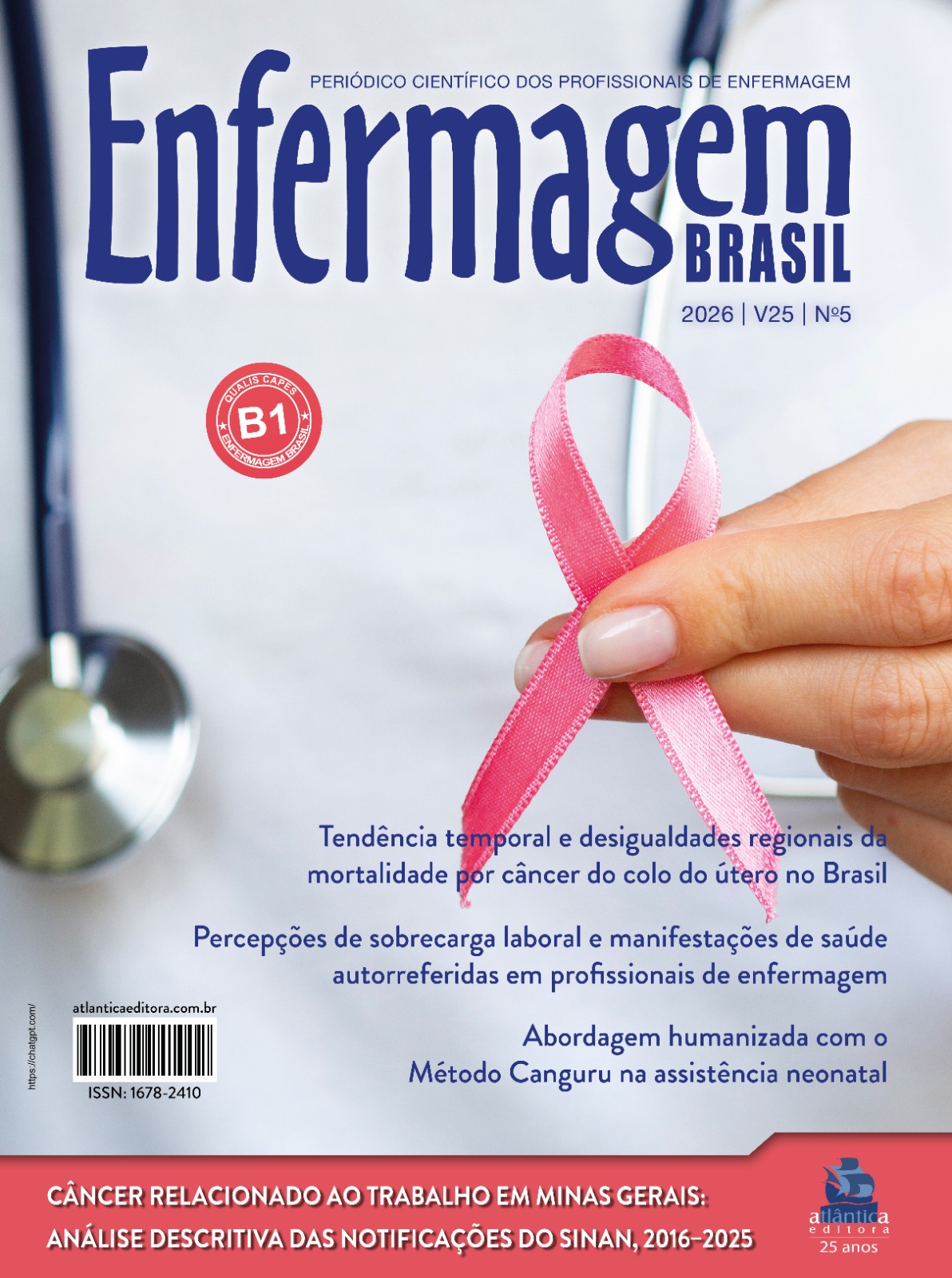
Perceived work overload and self-reported health symptoms among nursing professionals
DOI:
https://doi.org/10.62827/eb.v25i5.4243Keywords:
Nursing; Workload; Occupational Health.Abstract
Introduction: Work overload among nursing professionals represents a significant challenge in healthcare services and may be associated with impaired physical and emotional health and the quality of care provided. Objective: To describe perceptions of work overload and self-reported health manifestations among nursing professionals. Methods: A cross-sectional, exploratory, and descriptive study with a quantitative approach was conducted online with 45 nursing professionals, including nurses and nursing technicians, recruited through non-probability convenience and snowball sampling. Data were collected using a structured electronic questionnaire administered through Google Forms, covering sociodemographic and professional characteristics, perceptions of work overload, and health-related manifestations. Data were analyzed using descriptive statistics, including absolute and relative frequencies. Results: A total of 53.3% of participants reported that they sometimes considered their workload to be high, while 57.8% reported feeling overloaded at the same frequency. Additionally, 93.3% reported having experienced work-related stress symptoms, 91.1% reported excessive fatigue at the end of the workday, considering both “yes” and “sometimes” responses, and 66.7% reported frequent physical pain. Conclusion: High frequencies of self-reported work overload, work-related stress, excessive fatigue, and physical pain were identified among the nursing professionals studied. These findings highlight the importance of strategies aimed at improving working conditions and promoting the health of nursing professionals, without establishing causal relationships between the variables assessed.
References
Costa AMP, Araújo LP. O papel do enfermeiro na promoção da saúde na atenção primária. Revista DELOS [Internet]. 2025 [cited 2026 Mar 3];18(69):1-14. Available from: https://doi.org/10.55905/rdelosv18.n69-124. doi:10.55905/rdelosv18.n69-124.
Diz ABM, Lucas PRMB. Hospital patient safety at the emergency department: a systematic review. Cien Saude Colet. 2022;27(5):1803-12. doi:10.1590/1413-81232022275.22742021EN.
Nemati-Vakilabad R, Ebadi E, Homaei A, Hoseini S, Mirzaei A. The relationship between perceived nursing workload and occupational fatigue in clinical nurses: the moderating role of nursing teamwork. J Clin Nurs [Internet]. 2024 [cited 2026 Mar 3]. Available from: https://doi.org/10.1111/jocn.17616. doi:10.1111/jocn.17616.
Gündüz ES, Öztürk NK. Mental workload as a predictor of burnout in intensive care nurses. Nurs Crit Care [Internet]. 2025 [cited 2026 Mar 3];30(2):e13173. Available from: https://doi.org/10.1111/nicc.13173. doi:10.1111/nicc.13173.
Galanis P, Vraka I, Fragkou D, Bilali A, Kaitelidou D. Nurses' burnout and associated risk factors during the COVID-19 pandemic: a systematic review and meta-analysis. J Adv Nurs [Internet]. 2021 [cited 2026 Mar 3]. Available from: https://doi.org/10.1111/jan.14839. doi:10.1111/jan.14839.
Katsuta N, Ito K, Fukuda H, Nakajima K, Yamamoto Y, Kikuchi S, et al. Association between long working hours and depression among healthcare workers: a cross-sectional study. J Occup Health. 2021;63.
Almeida S, Nascimento A, Lucas PB, Jesus É, Araújo B. RN4CAST study in Portugal: validation of the Portuguese version of the Practice Environment Scale of the Nursing Work Index. Aquichan. 2020;20(3):e2038. doi:10.5294/aqui.2020.20.3.8.
Kim SO. Development of a patient safety management protocol for nurses in long-term care hospitals. Sci Rep [Internet]. 2025 [cited 2026 Mar 4];15:45329. Available from: https://doi.org/10.1038/s41598-025-29547-5. doi:10.1038/s41598-025-29547-5.
Costa CS, Stroschein Normann KA, Silva da Rocha Tanaka AK, Cicolella DA. A influência da sobrecarga de trabalho do enfermeiro na qualidade da assistência. Rev Uningá [Internet]. 2018 [cited 2026 Mar 4];55(4):110-20. Available from: https://doi.org/10.46311/2318-0579.55.eUJ2403. doi:10.46311/2318-0579.55.eUJ2403.
Oliveira EN, Costa MSA, Marques NS, Lomeo RC, Nascimento PIFV, Rodrigues CS, et al. Projeto Vida em Quarentena: estratégia para promoção da saúde mental de enfermeiros diante da covid-19. Enferm Foco. 2020;11(1 esp.):162-7. doi:10.21675/2357-707X.2020.v11.n1.esp.3741.
Gil AC. Métodos e técnicas de pesquisa social. 7a ed. São Paulo: Atlas; 2019.
Brasil. Ministério da Saúde. Conselho Nacional de Saúde. Resolução nº 466, de 12 de dezembro de 2012. Aprova diretrizes e normas regulamentadoras de pesquisas envolvendo seres humanos. Brasília (DF): Ministério da Saúde; 2012.
Brasil. Ministério da Saúde. Conselho Nacional de Saúde. Resolução nº 510, de 7 de abril de 2016. Dispõe sobre as normas aplicáveis a pesquisas em Ciências Humanas e Sociais. Brasília (DF): Ministério da Saúde; 2016.
Brasil. Lei nº 14.874, de 28 de maio de 2024. Dispõe sobre a pesquisa com seres humanos e institui o Sistema Nacional de Ética em Pesquisa com Seres Humanos. Brasília (DF): Presidência da República; 2024.
Caruso CC, Hitchcock EM, Dick RB, Russo JM, Schmit JM. Overtime and extended work shifts: recent findings on illnesses, injuries, and health behaviors [Internet]. Washington (DC): U.S.; 2004 [cited 2026 Apr 8]. Available from: https://www.ucm.es/data/cont/docs/795-2015-01-28-JORNADAS%20LARGAS.pdf.
Laschinger HKS, Fida R. New nurses burnout and workplace wellbeing: the influence of authentic leadership and psychological capital. Burn Res. 2014;1(1):19-28. doi:10.1016/j.burn.2014.03.002.
Cho H, Steege LM. Nurse fatigue and nurse, patient safety, and organizational outcomes: a systematic review. West J Nurs Res. 2021;43(12):1157-68. doi:10.1177/0193945921990892.
Trinkoff AM, Le R, Geiger-Brown J, Lipscomb J, Lang G. Longitudinal relationship of work hours, mandatory overtime, and on-call to musculoskeletal problems in nurses. Am J Ind Med. 2006;49(11):964-71. doi:10.1002/ajim.20330.
Jacquier-Bret J, Gorce P. Worldwide work-related musculoskeletal disorder prevalence among nurses: systematic review and meta-analysis. Saf Sci [Internet]. 2025 [cited 2026 Mar 3];191:106970. Available from: https://doi.org/10.1016/j.ssci.2025.106970. doi:10.1016/j.ssci.2025.106970.
Richardson A, McNoe B, Derrett S, Harcombe H. Interventions to prevent and reduce the impact of musculoskeletal injuries among nurses: a systematic review. Int J Nurs Stud [Internet]. 2018 [cited 2026 Mar 3];82:58-67. Available from: https://doi.org/10.1016/j.ijnurstu.2018.03.018. doi:10.1016/j.ijnurstu.2018.03.018.
Downloads
Published
Issue
Section
License
Copyright (c) 2026 Luziane Cristine Bernardes , Laryssa Fernanda Bernardes , Fernanda Augusta Marques Pinheiro, Katia Aparecida Campos, Claudio Avelar Vallim, Guilherme Luís Nascimento Quintiliano, Daiana Silva Reis Santos , Alice Carolino Gonçalves (Autor)

This work is licensed under a Creative Commons Attribution 4.0 International License.
Autores que publicam nesta revista concordam com os seguintes termos:
Autores mantém os direitos autorais e concedem à revista o direito de primeira publicação, com o trabalho simultaneamente licenciado sob a Licença Creative Commons Attribution 4.0 que permite o compartilhamento do trabalho com reconhecimento da autoria e publicação inicial nesta revista.
Autores têm autorização para distribuição não-exclusiva da versão do trabalho publicada nesta revista (ex.: publicar em repositório institucional ou como capítulo de livro), com reconhecimento de autoria e publicação inicial nesta revista.