
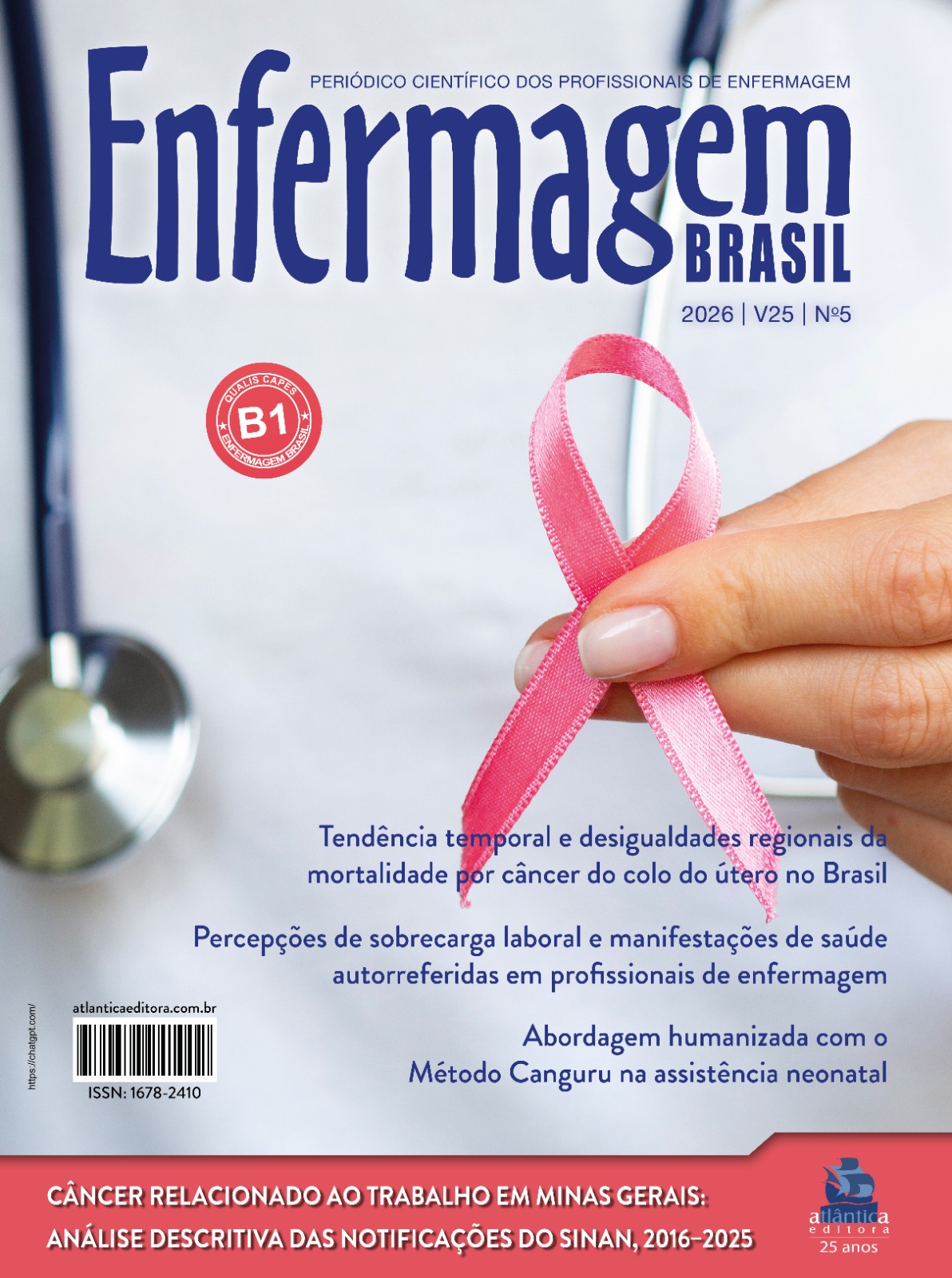
Temporal trend and regional inequalities in cervical cancer mortality in Brazil
DOI:
https://doi.org/10.62827/eb.v25i5.4240Keywords:
Uterine Cervical Neoplasms; Time Series Studies; Health Status Disparities; Health Information Systems.Abstract
Introduction: Cervical cancer is the third most incident malignant neoplasm among Brazilian women and shows marked regional inequalities. Objective: To analyze the temporal trend of crude cervical cancer mortality rates in Brazil and its macroregions from 2014 to 2024 and to describe the differences among them. Methods: Ecological time-series study using deaths recorded in the Mortality Information System and population projections from the Brazilian Institute of Geography and Statistics. Crude rates per 100,000 women were calculated, without age standardization. Trends were estimated by ordinary least squares and Prais-Winsten regression. Regions were compared exploratorily with the Kruskal-Wallis and Dunn tests. Results: The national crude rate rose from 5.29 to 6.73 deaths per 100,000 women (+27.2%), with an increasing trend (β = 0.112/year; 95% confidence interval: 0.057 to 0.167). The Northeast, Southeast and South showed increasing trends. In the North, which kept the highest rates (9.81/100,000 in 2024), and in the Central-West, the Prais-Winsten model found no statistically significant trend, a result sensitive to model choice. The South had the largest percentage increase (+46.5%). Conclusion: Crude cervical cancer mortality rates increased in Brazil between 2014 and 2024, with no declining trend in any region and persistent regional inequalities. Because rates were not age-standardized, these changes may reflect shifts in the age structure of the population and should not be interpreted in isolation as an increase in the risk of death.
References
Corrêa FM, Migowski A, Almeida LM, Soares MA. Cervical cancer screening, treatment and prophylaxis in Brazil: current and future perspectives for cervical cancer elimination. Front Med (Lausanne). 2022;9:945621. doi: 10.3389/fmed.2022.945621
Bray F, Laversanne M, Sung H, Ferlay J, Siegel RL, Soerjomataram I, et al. Global cancer statistics 2022: GLOBOCAN estimates of incidence and mortality worldwide for 36 cancers in 185 countries. CA Cancer J Clin. 2024;74(3):229-63. doi: 10.3322/caac.21834
Li Z, Liu P, Song K, et al. Global landscape of cervical cancer incidence and mortality in 2022 and predictions to 2030: the urgent need to address inequalities in cervical cancer. Int J Cancer. 2025;157(2):288-97. doi: 10.1002/ijc.35369
Instituto Nacional de Câncer José Alencar Gomes da Silva. Dados e números sobre câncer do colo do útero: relatório anual 2023 [Internet]. Rio de Janeiro: INCA; 2023 [citado 3 mar 2026]. Disponível em: https://www.inca.gov.br/publicacoes/relatorios/dados-e-numeros-sobre-cancer-do-colo-do-utero-relatorio-anual-2023
Li XY, Li G, Gong TT, Lv JL, Gao C, Liu FH, et al. Non-genetic factors and risk of cervical cancer: an umbrella review of systematic reviews and meta-analyses of observational studies. Int J Public Health. 2023;68:1605198. doi: 10.3389/ijph.2023.1605198
Melo MS, Lima SVMA, Santos AD, Ribeiro CJN, Júnior PAB, Silva TKS, et al. Temporal trends, spatial and spatiotemporal clusters of cervical cancer mortality in Brazil from 2000 to 2021. Sci Rep. 2024;14:24436. doi: 10.1038/s41598-024-75378-1
Freitas EGS, Carvalho BF, Sampaio MFB, Luz VEB, Vasconcelos AF. Mortality from cervical cancer in Brazilian regions: an ecological study. Res Soc Dev. 2024;13(1):e10713144848. doi: 10.33448/rsd-v13i1.44848
Migowski A. Past, present, and future of screening for cervical cancer in Brazil: lessons learned? Cad Saude Publica. 2025;41(8):e00134625. doi: 10.1590/0102-311XEN134625
Melo AC, Silva JL, Santos ALS, Thuler LCS. Population-based trends in cervical cancer incidence and mortality in Brazil: focusing on Black and Indigenous population disparities. J Racial Ethn Health Disparities. 2024;11(1):255-63. doi: 10.1007/s40615-023-01516-6
Silva Filho AL, Romualdo GR, Pinhati MES, Neves GL, Oliveira JA, Marques RM, et al. Exploring cervical cancer mortality in Brazil: an ecological study on socioeconomic and healthcare factors. Int J Gynecol Cancer. 2025;35(6):101851. doi: 10.1136/ijgc-2024-005738
Meira KC, Magnago C, Mendonça AB, Duarte SFS, Freitas PHO, Santos J, et al. Inequalities in temporal effects on cervical cancer mortality in states in different geographic regions of Brazil: an ecological study. Int J Environ Res Public Health. 2022;19(9):5591. doi: 10.3390/ijerph19095591
Luizaga CTM, Jardim BC, Wünsch-Filho V, Eluf-Neto J, Azevedo e Silva G. Recent changes in trends of mortality from cervical cancer in Southeastern Brazil. Rev Saude Publica. 2023;57:25. doi: 10.11606/s1518-8787.2023057004709
World Health Organization. Global strategy to accelerate the elimination of cervical cancer as a public health problem. Geneva: WHO; 2020.
Ferrari YAC, Jesus CVF, Batista JFC, Silva BEB, Cavalcante AB, Lima CA. Secular trend of cervical cancer mortality in Brazil and regions. Cien Saude Colet. 2025;30(3):e09962023. Disponível em: https://scielosp.org/article/csc/2025.v30n3/e09962023/en
von Elm E, Altman DG, Egger M, Pocock SJ, Gøtzsche PC, Vandenbroucke JP. The Strengthening the Reporting of Observational Studies in Epidemiology (STROBE) statement: guidelines for reporting observational studies. Lancet. 2007;370(9596):1453-7. doi: 10.1016/S0140-6736(07)61602-X
Gamarra CJ, Valente JG, Silva GA. Correção da magnitude da mortalidade por câncer do colo do útero no Brasil, 1996-2005. Rev Saude Publica. 2010;44(4):629-38. doi: 10.1590/S0034-89102010000400006
Antunes JLF, Cardoso MRA. Uso da análise de séries temporais em estudos epidemiológicos. Epidemiol Serv Saude. 2015;24(3):565-76. doi: 10.5123/S1679-49742015000300024
Dunn OJ. Multiple comparisons using rank sums. Technometrics. 1964;6(3):241-52. doi: 10.1080/00401706.1964.10490181
Schäfer AA, Santos LP, Miranda VIA, Tomasi CD, Soratto J, Quadra MR, et al. Desigualdades regionais e sociais na realização de mamografia e exame citopatológico nas capitais brasileiras em 2019: estudo transversal. Epidemiol Serv Saude. 2021;30(4):e2021172. doi: 10.1590/S1679-49742021000400016
Shao D, Wu P, Jiang H, Wang Z. Global trends and future projections of cervical cancer burden: an integrated analysis of GBD 2021, UN population and WHO HPV vaccination data. Front Public Health. 2026;14:1702186. doi: 10.3389/fpubh.2026.1702186
Luiz OC, Nisida V, Silva Filho AM, Souza ASP, Nunes APN, Nery FSD. Iniquidade racial na mortalidade por câncer de colo de útero no Brasil: estudo de séries temporais de 2002 a 2021. Cien Saude Colet. 2024;29(3):e05202023. doi: 10.1590/1413-81232024293.05202023
Barbosa IR, Souza DLB, Bernal MM, Costa ICC. Desigualdades regionais na mortalidade por câncer de colo de útero no Brasil: tendências e projeções até o ano 2030. Cien Saude Colet. 2016;21(1):253-62. doi: 10.1590/1413-81232015211.03662015
Formigosa LAC, Santos LF, Formigosa JDC, Pinto DS, Reis DST, Silva MVS. Impact of screening on cervical cancer incidence and mortality in a Northern Brazilian city. Ecancermedicalscience. 2022;16:1418. doi: 10.3332/ecancer.2022.1418
Martins FTS, Busato IMS. Correlação entre vulnerabilidade social e óbitos por neoplasia maligna do colo do útero: região norte brasileira. Humanid Perspect. 2025;9(22):83-93. Disponível em: https://www.cadernosuninter.com/index.php/humanidades/article/view/3492
Oliveira NPD, Cancela MC, Martins LFL, Castro JL, Meira KC, Souza DLB. Desigualdades sociais no diagnóstico do câncer do colo do útero no Brasil: um estudo de base hospitalar. Cien Saude Colet. 2024;29(6):e03872023. doi: 10.1590/1413-81232024296.03872023
Yaji IAS, Nascimento ACR, Hilário Júnior JC, Aragão FF, Alves GR, Santos CP. Câncer do colo do útero: relação entre o índice de desenvolvimento humano e a não realização do rastreio nas regiões do Brasil. Braz J Health Rev. 2026;9(1):e85555. doi: 10.34119/bjhrv9n1-157
Gomes MLS, et al. Spatial-temporal analysis of cervical cancer screening and social and health indicators in Brazil. Public Health. 2025:105747. doi: 10.1016/j.puhe.2025.105747
Han J, et al. Global HPV vaccination programs and coverage rates: a systematic review. EClinicalMedicine. 2025;84:103290. doi: 10.1016/j.eclinm.2025.103290
Martins LFL, Chaves GV, Oliveira JFP, Souza LBL, Chagas Neto P, Carvalho FN, et al. Perfil epidemiológico da incidência de câncer no Brasil e regiões: estimativas para o triênio 2026-2028. Rev Bras Cancerol. 2026;72(2):e-025587. doi: 10.32635/2176-9745.RBC.2026v72n2.5587
Downloads
Published
Issue
Section
License
Copyright (c) 2026 Vivian Emanuelle Silva Marinho de Omena, Andréa Carla Rocha e Silva, Katiany Bezerra Toledo Campos, Gabriel Henrique Carvalho Leite Romeiro, Lusitania Maria de Barros (Autor)

This work is licensed under a Creative Commons Attribution 4.0 International License.
Autores que publicam nesta revista concordam com os seguintes termos:
Autores mantém os direitos autorais e concedem à revista o direito de primeira publicação, com o trabalho simultaneamente licenciado sob a Licença Creative Commons Attribution 4.0 que permite o compartilhamento do trabalho com reconhecimento da autoria e publicação inicial nesta revista.
Autores têm autorização para distribuição não-exclusiva da versão do trabalho publicada nesta revista (ex.: publicar em repositório institucional ou como capítulo de livro), com reconhecimento de autoria e publicação inicial nesta revista.