Letícia Karen Lima Gomes de Sousa1, Jander Phillipe Diniz Figueiredo1, Gessica dos Santos da Silva1, Milenna Thâmyres Alves do Nascimento1, Mayele Tavares Pacheco1, Jandre Santiago Amorim de Araujo1, Carlos Giovanny Rivas Dugarte1, Inês Amanda Streit1
1Federal University of Amazonas (UFAM), Manaus, Amazonas, Brazil
Received: April 29, 2025; Accepted: May 20, 2025.
Correspondence: Inês Amanda Streit, inesamanda@ufam.edu.br
How to cite
Sousa LKLG, Figueiredo JPD, Silva GS, Nascimento MTA, Pacheco MT, Araujo JSA, Dugarte CGR, Streit IA. Functional capacity, depressive symptoms and quality of life: A study with long-lived rural elderly in the Amazon context. Geronto Bras. 2025;1(1):14-25. doi:10.62827/gb.v1i1.0003
Abstract
Introduction: Population aging is a global phenomenon that is becoming increasingly evident in Brazil and the state of Amazonas. Understanding this process in different geographic and sociocultural contexts, such as rural areas, is essential to support public health actions aimed at the elderly population. Objective: To analyze the association between functional capacity, depressive symptoms, and quality of life in older elderly individuals living in the rural area of Manaus, AM. Methods: Cross-sectional, population-based study with a quantitative approach involving 91 elderly individuals aged 80 years or older. The following instruments were applied: Katz Scale (ABVD), Lawton and Brody Scale (IADL), Geriatric Depression Scale (EDG-15), and EUROHIS-QOL. Data were analyzed using descriptive statistics and linear regression. Results: The mean age was 85.6 years, and most participants were male (49/ 53.8%), brown (65/ 71.4%), and widowed (40/ 44%). There was a predominance of independence in BADL, with greater female dependence in IADL. Depressive symptoms were present in 29.6% of the elderly people (n=27). There was a significant association between IADL and quality of life, indicating that greater dependence is related to a worse perception of quality of life. No association was identified between functional capacity and depressive symptoms. Conclusion: Limitation in instrumental activities is associated with reduced quality of life of older elderly individuals in rural areas. The lack of association with depressive symptoms suggests the influence of contextual aspects. The findings reinforce the importance of public policies that promote functional autonomy and social support in old age in rural areas.
Keywords: Activities of Daily Living; Physical Functional Performance; 80 and over; Depression; Quality of life.
Resumo
Capacidade funcional, sintomas depressivos e qualidade de vida: Um estudo com longevos da zona rural no contexto amazônico
Introdução: O envelhecimento populacional é um fenômeno global que se torna cada vez mais evidente no Brasil e no estado do Amazonas. Compreender esse processo em diferentes contextos geográficos e socioculturais, como as áreas rurais, é fundamental para subsidiar ações de saúde pública voltadas à população idosa. Objetivo: Analisou-se a associação entre capacidade funcional, sintomas depressivos e qualidade de vida em idosos longevos residentes na zona rural de Manaus, AM. Métodos: Estudo transversal, de base populacional e abordagem quantitativa, envolvendo 91 idosos com 80 anos ou mais. Foram aplicados os seguintes instrumentos: Escala de Katz (ABVD), Escala de Lawton e Brody (AIVD), Escala de Depressão Geriátrica (EDG-15) e EUROHIS-QOL. Os dados foram analisados por meio de estatística descritiva e regressão linear. Resultados: A média de idade foi 85,6 anos e a maioria dos participantes era do sexo masculino (49/ 53,8%), de cor parda (65/ 71,4%) e viúva (40/ 44%). Observou-se predominância de independência nas ABVD, com maior dependência feminina nas AIVD. Sintomas depressivos estiveram presentes em 29,6% dos idosos (n=27). Houve associação significativa entre AIVD e qualidade de vida, indicando que maior dependência está relacionada à pior percepção de qualidade de vida. Não foi identificada associação entre capacidade funcional e sintomas depressivos. Conclusão: A limitação nas atividades instrumentais está associada à redução da qualidade de vida dos idosos longevos da zona rural. A ausência de relação com sintomas depressivos sugere influência de aspectos contextuais. Os achados reforçam a importância de políticas públicas que promovam autonomia funcional e suporte social na velhice em áreas rurais.
Palavras-chave: Atividades Cotidianas; Desempenho Físico Funcional; Idoso de 80 Anos ou mais; Depressão; Qualidade de Vida.
Resumen
Capacidad funcional, síntomas depresivos y calidad de vida: Un estudio con longevos en el contexto rural amazónico
Introducción: El envejecimiento poblacional es un fenómeno global que se hace cada vez más evidente en Brasil y en el estado de Amazonas. Comprender este proceso en diferentes contextos geográficos y socioculturales, como las zonas rurales, es fundamental para sustentar acciones de salud pública dirigidas a la población adulta mayor. Objetivo: Se analizó la asociación entre la capacidad funcional, síntomas depresivos y calidad de vida en ancianos residentes en la zona rural de Manaus, AM. Métodos: Estudio transversal, poblacional, con enfoque cuantitativo, en 91 adultos mayores de 80 años o más. Se aplicaron los siguientes instrumentos: Escala de Katz (ABVD), Escala de Lawton y Brody (AIVD), Escala de Depresión Geriátrica (EDG-15) y EUROHIS-QOL. Los datos se analizaron utilizando estadística descriptiva y regresión lineal. Resultados: La edad media fue de 85,6 años y la mayoría de los participantes eran varones (49/53,8%), morenos (65/71,4%) y viudos (40/44%). Se observó un predominio de la independencia en las ABVD, con mayor dependencia femenina en las AIVD. Los síntomas depresivos estaban presentes en el 29,6% de los ancianos (n=27). Se encontró una asociación significativa entre las AIVD y la calidad de vida, indicando que una mayor dependencia se relaciona con una peor percepción de la calidad de vida. No se identificó asociación entre la capacidad funcional y los síntomas depresivos. Conclusión: Las limitaciones en las actividades instrumentales se asocian con una menor calidad de vida de los adultos mayores en zonas rurales. La falta de relación con los síntomas depresivos sugiere la influencia de aspectos contextuales. Los hallazgos refuerzan la importancia de las políticas públicas que promuevan la autonomía funcional y el apoyo social en la vejez en zonas rurales.
Palabras-clave: Actividades Diarias; Rendimiento Físico Funcional; Personas de 80 años en adelante; Depresión; Calidad de Vida.
Introduction
Populational aging is an increasing reality worldwide, mainly in Brazil, where the proportion of older adults has rapidly increased in the last decades. According to Instituto Brasileiro de Geografia e Estatística (IBGE- Brazilian Institute of Geography and Statistics - IBGE) [1], approximately 10.9% of the Brazilian population is 65 years old or more, representing the highest percentage recorded in the demographic censuses. The expressive growth of centenaries also stands out, which increased by 67% compared to the 2010 survey, going from 22,676 to 37,814 people with 100 years or more.
The aging process is followed by anatomic and physiologic alterations that negatively affect muscle mass and articular mobility and increase the susceptibility of rheumatologic pathologies [2]. Besides physical factors, as age increases, there is an increase in functional dependence, a decline in physical capacity, unproductiveness, and life quality increase [3]. Such changes are even more pronounced among long-living people — those who are 80 years old or longer— who have a higher prevalence of chronic diseases, difficulties in daily activities, and a higher propensity for social isolation and depressive symptoms [4].
In this context, the World Health Organization (WHO) defines healthy aging as a process of developing and maintaining functional capacity. It is understood as a set of attributes that allow people to fulfill their basic needs, displace themselves, build relationships, and contribute to society. Therefore, preserving functional capacity is essential to guarantee autonomy and life quality for older adults [3].
In turn, life quality is a multidimensional concept that includes physical, psychological, social, and environmental aspects. According to the definition from WHO, it is related to the individual perception of life position regarding their objectives, expectations, standards, and concerns in the context of one’s culture and value system. Thus, it is not only restricted to diseases or a preserved functional capacity but also involves personal satisfaction and emotional well-being [5].
Among the prevailing chronic diseases in aging, depression stands out and is considered one of the main causes of the decrease in life quality in older adults. Factors such as low socioeconomic conditions, experience of stressful events, functional limitation, and the presence of chronic diseases are recognized as important predictors of depressive symptoms in old age [4]. Besides compromising mental health, depression negatively influences functional capacity, worsening autonomy loss, and exacerbating preexisting physical problems.
Hence, it is essential to investigate the interaction among functional capacity, life quality, and depressive symptoms in older adults, mainly those living in rural and riverside communities, in which the conditions to access health services and social support are more limited. Identifying these factors is key to ground strategies to intervene and promote health for this population segment. Therefore, this study aims to verify if there is an association among functional capacity, depressive symptoms, and life quality in long-living older adults living in the rural and riverside area of Manaus, in the state of Amazonas, Brazil.
Methods
Study and participant characterization
The population-based study is characterized as observational, descriptive, and associative [7]. This approach highlights the characteristics of these long-living older adults regarding their functional capacity, relating this variable to depressive symptoms and life quality.
The participants are 92 long-living older adults who are 80 years or more old and living in the rural and riverside area of Manaus, Amazonas. To find the long-living people, the researchers accessed non-public information provided by the Distrito de Saúde Rural (DISA Rural- Rural Health District), with the consent of Núcleo de Pesquisa, Extensão e Inovação em Saúde – NUPES (Center of Research, Outreach, and Innovation in Health), connected to the Escola de Saúde Pública de Manaus – ESAP (Manaus Public Health School) from the Secretaria Municipal de Saúde de Manaus – SEMSA (Manaus Municipal Health Secretary).
We included people with documents proving they were 80 years or older, living in the rural area of Manaus, AM, and who could understand and answer the research instruments (with or without the help of a family member or caregiver except in the subjective sections).
Place of study
The study was conducted in the rural area of Manaus, in the state of Amazonas, Brazil, which occupies around 93% of the city’s territory but encompasses a scattered population with limited access to essential health, transport, education, and leisure services. The communities in the rural area include riverside, Indigenous, and agricultural areas, frequently isolated, which directly affects this population’s life quality and health conditions. The Municipal Human Development Index (MHDI) of Manaus’s rural area is 0.576, lower than the urban area (0.737), reflecting inequalities in access to public policies and social protection services [8].
Instruments
We used two instruments to evaluate functional capacity: the Basic Activities of Daily Living (BADL) scale- Katz Index, adapted by Lino et al. [9], which evaluates autonomy in tasks such as showering, dressing, going to the toilet, walking, eating, and continence, the scale goes from 0 (complete dependence) to 6 (complete independence); and the Instrumental Activities of Daily Living Scale (IADL)- Lawton & Brody Scale, adapted by Frutuoso et al. [10], which measures more complex tasks, such as using the telephone, shop, prepare meals, and manage finances, with a total score varying from 8 to 27.
The depressive symptoms were evaluated with the Geriatric Depression Scale (GDS-15), version reduced and validated by Almeida and Almeida [11] and Paradela and colleagues [12]. The scale has 15 questions with yes/no answers, and a score ≥5 indicates the presence of depressive symptoms.
Life quality was evaluated through the EUROHIS-QOL 8-item index, a reduced version from WHOQOL-BREF, translated and validated for the Brazilian context by Romero et al. [13]. This instrument evaluates eight subjective domains of life quality, with answers recorded on a Likert scale from 1 to 5; the highest scores indicate a better life quality perception.
Ethical aspects and data collection procedures
The research followed the ethical principles established by Resolution nº 466/2012 from the Conselho Nacional de Saúde (National Health Council). It was approved by the Ethics Committee in Research with Human Beings from the Universidade Federal do Amazonas (UFAM) under the report registered at CAAE nº 60858522.0.0000.5020. All participants and their legal representatives signed the terms of free and informed consent.
Data collection took place in person at the older adults’ houses, with the support of the health teams of the Unidades Básicas de Saúde Rural (UBSR- Basic Units of Rural Health), especially Agentes Comunitários de Saúde (ACS-Community Health Agents), who followed the researchers in the first visits to the long-living people. The interviews lasted an average of 40 to 50 minutes, and at least two visits to the same person occurred within a one-week interval.
Data analysis used the Software R (R Development Core Team, 2022), version 4.3.2. The descriptive statistic was conducted through absolute and relative frequencies, averages, standard deviations, medians, and interquartile intervals. For the inferential analysis, we applied simple and multiple linear regressions to evaluate the associations between the scores of life quality and the independent variables. The significance test used was p<0.05, with a confidence interval of 95% (CI 95%). Furthermore, the adjusted R² and the Akaike Information Criterion (AIC) were used to evaluate the quality of adjusted models.
Results
The study reached its aims when characterizing the sociodemographic profile and the functional capacity of long-living people residing in Manaus Rural Area, AM, focusing on depressive symptoms and life quality.
Table 1 presents the sociodemographic characteristics of the 91 participants, who had an average age of 85.6 years old (±4.8). Most participants were men (n=49/ 53.8%), and most declared themselves brown (n=65/ 71.4%). The marital status was distributed among 44% widows/widowers (n=40), 43% married (n=39), and 13% single or divorced (n=12). The average family income was R$2,779.00, with a significant difference between men (R$4,163.60) and women (R$2,080.00). These data are presented in Table 1.
Table 1 – Sociodemographic characteristics of long-living people in the rural area of Manaus, AM (N=91)
|
Women |
men |
Total |
|
|
f (%) |
42 (46.2%) |
49 (53.8%) |
91 (100%) |
|
Age |
|||
|
average (SD) |
85.2 (±5.3) |
84.1 (±4.3) |
85.6 (±4.8) |
|
Max. |
104 |
104 |
104 |
|
skin color/ethnicity |
|||
|
brown (%) |
26 (28.6%) |
39 (42.9%) |
65 (71.4%) |
|
INDIGENOUS (%) |
6 (6.6%) |
4 (4.4%) |
10 (11%) |
|
white (%) |
6 (6.6%) |
4 (4.4%) |
10 (11%) |
|
black (%) |
4 (6.6%) |
2 (2.2%) |
6 (6.6%) |
|
Marital status |
|||
|
Singles/Divorced (%) |
2 (2%) |
10 (11%) |
12 (13%) |
|
married (%) |
10 (11%) |
29 (32%) |
39 (43%) |
|
widow/widower (%) |
30 (33%) |
10 (11%) |
40 (44%) |
|
family income |
|||
|
average |
2080 (±1094.6) |
4163.6 (±3325.8) |
2779 (±1926) |
|
Min. - Max. |
1300 - 11000 |
1200 - 11400 |
1200 - 11000 |
Source: Created by the authors (2025)
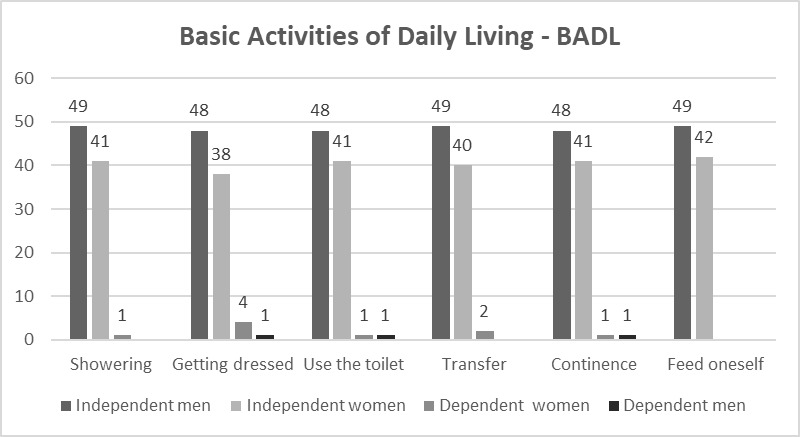
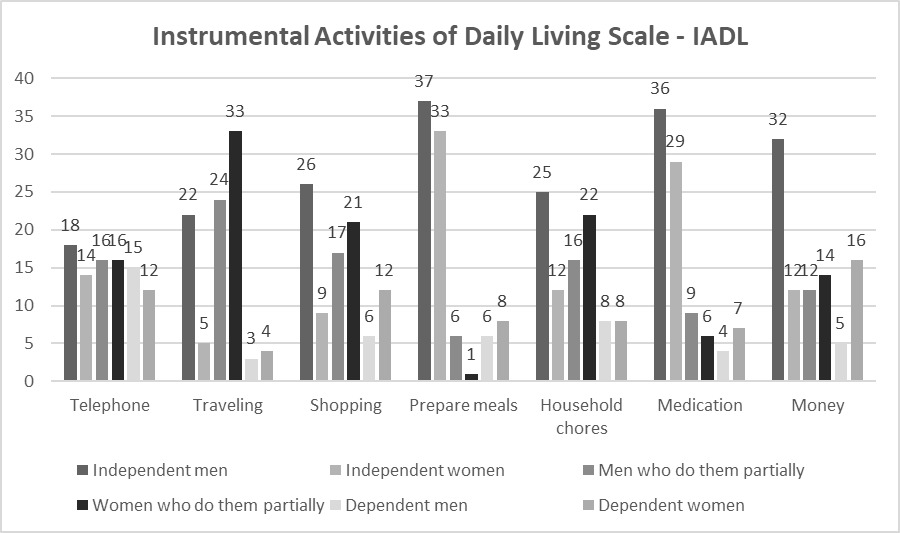
Regarding functional capacity, most participants were independent in the Basic Activities of Daily Living (BADL), as shown in Figure 1. Women showed higher dependence on BADL, especially in activities such as dressing and transfer. Considering the Instrumental Activities of Daily Living Scale (IADL), we observed a greater dependence among women, mainly in managing money and shopping, as shown in Figure 2.
Source: Created by the authors (2025)
Figure1 - Independence or Dependence in BADL (N=91)
Source: Created by the authors (2025)
Figure 2 – Independence or Dependence in IADL (N=91)
Regarding depressive symptoms, 70.32% of participants had no signs of depression, 25.27% had mild depression, and 4.39% presented more severe depression symptoms. The linear regression analysis, presented in Table 3, indicated that functional capacity was not associated with depressive symptoms but found a positive correlation between IADL and life quality, suggesting that dependence on the IADL negatively affects life quality.
Table 3 - Association of functional capacity, depressive symptoms, and life quality in long-living older people (N=91)
|
Variables |
Depressive symptoms |
Life Quality |
||||
|
Coefficient (IC95%) |
Standard deviation |
P-value |
Coefficient (IC95%) |
Standard deviation |
P-value |
|
|
Gross |
||||||
|
BADL |
-51.71 (-605.57; 502.15) |
278.70 |
0.853 |
-1.63 (-3.40; 0.13) |
0.89 |
0.069 |
|
IADL |
-10.95 (-74.90; 53.01) |
32.18 |
0.735 |
0.40 (0.08; 0.72) |
0.16 |
0.014 |
|
Adjusted |
||||||
|
Intercept |
395.83 (-802.53; 1594.18) |
602.91 |
0.513 |
26.29 (20.34; 32.24) |
2.99 |
<0.001 |
|
BADL |
-115.74 (-735.24; 503.77) |
311.68 |
0.711 |
-0.81 (-2.76; 1.14) |
0.98 |
0.413 |
|
IADL |
-16.82 (-88.39; 54.75) |
36.01 |
0.642 |
0.33 (-0.02; 0.69) |
0.18 |
0.065 |
|
R2 adjusted |
<0.01 |
- |
- |
0.05 |
- |
- |
|
AIC |
1514.983 |
- |
- |
571.0106 |
- |
- |
Legend: AIC - Akaike Information Criterion /Source: Created by the authors (2025)
Discussion
The results of this study indicate a different profile of the long-living population in the rural area of Manaus compared to urban areas, mainly regarding sex and marital status. Though the life expectancy of Brazilian women is higher than that of men, 80.5 and 73.6 years old, respectively [8], the predominance of men in this study points out possible specific characteristics of the rural area, such as the prevalence of long-living men in this context. This presence seems related to agriculture and livestock activities, which could favor a more autonomous and independent profile of most participants.
Literature confirms that losing a spouse, common in the elderly population, directly impacts health and life quality [14], which is also observed among the long-living people in this study. Regarding skin color/ethnicity, most participants declared themselves brown, in consonance with IBGE data for the Brazilian population in general. The presence of Indigenous, though in a reduced number, reflects the cultural diversity in the rural and riverside communities.
The analysis of family income shows gender inequality, as men have a significantly higher income compared to women, pointing out that the average of men’s family income is two times higher than women’s income. This finding is consistent with socioeconomic inequalities in Brazil, which associate low income with health risks and life quality in older adults [15]. These issues contribute to exacerbating socioeconomic inequalities between urban and rural areas, directly affecting the life quality and development of these communities and their Human Development Index.
Regarding functional capacity, the result of this study has an interesting result regarding independence for BADL and IADL, as men are more independent in conducting basic and instrumental activities in everyday life. This result differs from other studies, such as Frutuozo and collaborators [16], involving 498 older adults in urban areas who used the Primary Healthcare System and shows that women are more independent than men in all activities. Regarding this discrepancy, seen when comparing the independence between men and women, we can observe that these are different contexts, such as rural and urban areas and participants’ differences in age range in each study. However, the warning concerning the preservation of functional capacity is useful for all older adults, as there is an association between the prevalence of falls and the dependence on basic and instrumental activities in daily life [16].
The relationship between functional capacity and life quality was shown in the IADL analysis, which had a positive association with life quality, corroborating the studies that indicate that IADL dependence reduces life quality [17]. Moreover, the presence of depressive symptoms was more evident among dependent older adults, suggesting that the loss of autonomy contributes to a worse psychological state [18].
The linear regression analysis did not find a significant association between functional capacity and depressive symptoms, which could be explained by the complex interaction between sociodemographic factors and functional capacity or even by the low prevalence of people with depressive symptoms. Some studies reinforce the importance of social support and active social participation to improve older adults’ life quality and mental health, mainly in rural areas [3, 17].
Considering that few older adults presented symptoms of more severe depression and most participants had their functional capacity preserved, we support the need to maintain independence for basic and instrumental activities in everyday life, which is crucial for the life quality of long-living people in the rural area of Manaus. Another aspect this study points out is that the strategies of social and family support can help mitigate the negative impacts of dependence and depressive symptoms.
This study’s results are scientifically relevant when promoting information regarding this population, raising awareness, improving care services, developing more efficient health policies, and creating more inclusive and resilient societies considering population aging. The work also contributes to forming a support system for Primary Health Care teams caring for rural older adults.
Concerning the study’s limitations, we highlight the sample size that may not fully represent the general universe of long-living people, and the results might be specific to the rural context of individuals. Finally, we suggest broadening studies with long-living people, mainly in rural areas, to know how they produce their health and establish support systems to care for aging people.
Conclusion
This study described the profile of long-lived older people in rural Manaus, Amazonas, regarding their functional capacity, depressive symptoms, and quality of life. It was found that there was a positive association between instrumental activities of daily living and quality of life; that is, the greater the difficulty in basic and instrumental tasks, the worse the quality of life.
Acknowledgments
We would like to thank the Coordenação de Aperfeiçoamento de Pessoal de Nível Superior - Brazil (CAPES) and the Fundação de Amparo a Pesquisa do Estado do Amazonas (FAPEAM) for their institutional support.
Conflict of Interest
The authors declare that there are no conflicts of interest of any kind.
Sources of funding
Own funding.
Authors’ contribution
Research conception and design: Sousa LKL, Streit IA. Data collection: Streit IA, Figueiredo JP, Pacheco MT, Araujo JSA. Data analysis and interpretation: Sousa LKL, Streit IA, Figueiredo JP, Silva GS, Nascimento MTA, Pacheco MT, Araujo JSA, Dugarte CGR. Manuscript writing: Sousa LKL, Streit IA. Critical review of the manuscript for important intellectual content: Sousa LKL, Figueiredo JP, Silva GS, Nascimento MTA, Pacheco MT, Araujo JSA, Dugarte CGR, Streit IA.
References
1. Instituto Brasileiro de Geografia e Estatística (IBGE). Censo Demográfico 2022: População - Primeiros Resultados [Internet]. Rio de Janeiro: IBGE; 2022 [citado 2024 fev 8]. Available from: https://cidades.ibge.gov.br/brasil/am/panorama
2. Pereira JL, de Araujo FF, Santos KT. Capacidade funcional e qualidade de vida em idosos. Fisioter Bras. 2020;21(2):135–40. Available from: https://doi.org/10.33233/fb.v21i2.1310
3. Sant’Helena DP, Silva PC da, Gonçalves AK. Capacidade funcional e atividades da vida diária no envelhecimento. In: Envelhecimento Humano: Desafios Contemporâneos - Volume 1. [s.l.]: Editora Científica Digital; 2020. p. 204–18. Available from: https://doi.org/10.37885/200901493
4. De Jesus dos Santos A, Fuga da Silva D, Gatti AL, Lima AMS de Aquino RC de C. Sintomas de depressão, risco nutricional e capacidade funcional em idosos longevos. Estudos Interdisciplinares em Psicologia. 2021;12(3):3–21. Available from: https://doi.org/10.5433/2236-6407.2021v12n3p03
5. Antunes R, et al. Quality of life, vitality and handgrip strength in elderly practitioners of physical exercise [Internet]. [S.l.]: [s.n.]; [citado 2024 abr 25]. Available from: https://dx.doi.org/10.6018/cpd.467011
6. Santos RC, et al. Factors associated with depressive symptoms and cognition in elderly victims of violence. Rev Bras Enferm. 2020;73. Available from: https://doi.org/10.1590/0034-7167-2019-0383.
7. GIL AC. Métodos e Técnicas e Pesquisa Social. 7. ed. Editora Atlas SA, 2019. Available from: https://ayanrafael.com/wp-content/uploads/2011/08/gil-a-c-mc3a9todos-e-tc3a9cnicas-de-pesquisa-social.pdf
8. IBGE – INSTITUTO BRASILEIRO DE GEOGRAFIA E ESTATÍSTICA. Panorama Amazonas. Pesquisa Nacional por Amostra de domicílios Contínua. Brasil: IBGE: 2022. Available from: https://cidades.ibge.gov.br/brasil/am/panorama.
9. Katz S. et al. Studies of Illness in the Aged The Index of ADL: A Standardized Measure of Biological and Psychosocial Function. 1963. JAMA. 1963;185(12):914-919. Available from: 10.1001/jama.1963.03060120024016
10. Lawton MP.; Brody E.M. Assessment of Older People: Self-maintaining and Instrumental Activities of Daily Living. Gerontologist 1969; 9: 179-186. Available from: https://doi.org/10.1093/geront/9.3_Part_1.179
11. Almeida OP, Almeida EA. Short versions of the geriatric depression scale: a study of their validity for the diagnosis of a major depressive episode according to ICD-10 and DSM-IV. Revista Internacional de Psiquiatria Geriátrica. [S.l.]: [s.n.]; [s.d.]. Available from: https://doi.org/10.1002/(SICI)1099-1166(199910)14:10<858::AID-GPS35>3.0.CO;2-8
12. Paradela EMP, Lourenço RA, Veras RP. Validação da escala de depressão geriátrica em um ambulatório geral. Rev Saúde Pública. 2005;39(6):918–23. Available from: https://doi.org/10.1590/S0034-89102005000600008
13. Romero SS, et al. Validity and reliability of the 8-item EUROHIS-QOL to assess Brazilian adults’ quality of life. Cadernos de Saúde Pública, v. 38, n. 11, 2022. Available from: https://doi.org/10.1590/0102-311XPT200921
14. Ceccon RF, Vieira LJES, Brasil CCP, Soares KG, Portes VM, Garcia Júnior CAS, Schneider IJC, Carioca AAF. Aging and dependence in Brazil: sociodemographic and care characteristics of older adults and caregivers. Cien Saude Colet. 2021 Jan;26(1):17-26. Portuguese, English. Available from: https://doi.org/10.1590/1413-81232020261.30352020
15. Scherrer G. et al. Atividades de vida diária, sintomas depressivos e qualidade de vida de idosos. Acta Paulista de Enfermagem, v. 35, 17 maio 2022. Available from: https://doi.org/10.37689/acta-ape/2022AO0237345
16. Frutuoso CA, Aguiar Silva W, Furtado BS. Avaliação da capacidade funcional de idosos urbanos para atividades instrumentais de vida diária. Anais V CIEH. Campina Grande: Realize Editora, 2017. Available from: https://www.editorarealize.com.br/artigo/visualizar/34192
17. Okuno MFP, Costa AF, da Belasco AGSS. Satisfação com a vida, qualidade de vida e capacidade funcional de octogenários hospitalizados. REME. Rev Min Enferm. 2020;24: e-1314. Available from: https://doi.org/10.5935/1415.2762.20200068
18. Pereira JL, de Araujo FF, Santos KT. Capacidade funcional e qualidade de vida em idosos. Fisioter Bras. 2020; 21(2):135–40. Available from: https://doi.org/10.33233/fb.v21i2.1310.
19. De Oliveira ACA, Bueno Perina KC, Machado PMM. Avaliação da capacidade funcional e prevalência de sintomas depressivos em idosos institucionalizados. REAS [Internet]. 2jul.2020 [citado 27abr.2025];(52):e3473. Available from: https://doi.org/10.25248/reas.e3473.2020
20. Lino TS, Pereira SRM, Camacho LAB, Ribeiro Filho ST, Buksman S. Adaptação transcultural da Escala de Independência em Atividades da Vida Diária (Escala de Katz). Cad Saúde Pública. 2008;24(10):2296–302. Available from: https://doi.org/10.1590/S0102-311X2008000100010
